Encyclopedia of American Governance
Home Financing in America: Mortgage Rates, Loan Limits, Refinancing and Foreclosure
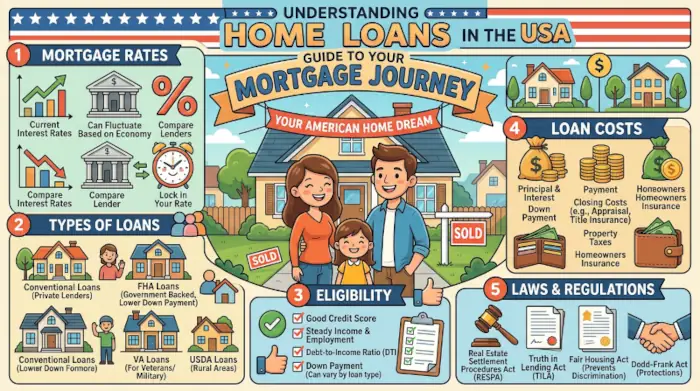
A home loan in the United States, commonly called a mortgage, is a secured loan used to purchase, construct, or refinance residential property. The borrower receives funds from a bank, credit union, mortgage company or other lender and repays the debt over an agreed period, usually 15 or 30 years. The house is the lender’s collateral. If the borrower fails to meet the contractual obligations, the lender may ultimately enforce its security through the applicable foreclosure process.
For a person seeking a mortgage in the United States, the first question is not simply “What is today’s mortgage rate?” The more important question is which loan programme, lender, rate, term, down payment and total closing cost produce the lowest overall cost for that particular borrower. Current quoted U.S. mortgage rates supplied from major lending and financial platforms range approximately from 5.38% to 7.63%, depending on the programme and lender. Illustrative current purchase quotations include a 30-year FHA at 5.38% interest and 6.11% APR, a 30-year conventional mortgage at 7.38% and 7.55% APR, a standard 30-year fixed mortgage at 7.63% and 7.85% APR, a 15-year fixed mortgage at 6.75% and 7.10% APR, a 5/6 adjustable-rate mortgage at 6.63% and 6.79% APR, and a VA 30-year fixed loan at 7.13% and 7.53% APR. Refinancing quotations in the supplied market data include approximately 7.75% for a 30-year refinance and 6.75% for a 15-year refinance.
These figures demonstrate why a borrower should shop among lenders. Mortgage pricing is not uniform. Recent marketplace data indicates that approximately 87% of American mortgage borrowers did not select the most competitive rate available, with the resulting difference estimated at approximately $3,343 per year. A borrower should obtain quotations from several banks, credit unions, mortgage brokers or online lenders and compare the interest rate, APR, points, origination charges, lender credits, mortgage insurance, closing costs and total cash required at closing. A mortgage that advertises a lower rate may nevertheless be more expensive if it requires substantial points or fees.
The principal mortgage structures are conventional loans, FHA loans, VA loans, USDA loans and jumbo loans. A conventional mortgage is generally originated by a private lender and is often structured to meet the standards of Fannie Mae or Freddie Mac. Borrowers with strong credit and stable income generally receive the most competitive terms. A conventional borrower who makes less than a 20% down payment may have to pay Private Mortgage Insurance (PMI). PMI protects the lender rather than the borrower and increases the monthly cost of the mortgage. Once sufficient equity is established, conventional borrowers may generally seek cancellation of PMI under the applicable rules.
An FHA mortgage is insured by the Federal Housing Administration. It is particularly important for borrowers who cannot qualify for the most favourable conventional financing because of credit history, limited savings or a smaller down payment. FHA underwriting is generally more flexible, with eligibility possible at credit scores around 580 or lower depending on the circumstances and programme requirements. FHA financing can therefore reduce the initial barrier to homeownership, although mortgage insurance costs must be included in the calculation.
A VA home loan is designed for eligible active-duty service members, veterans and certain surviving spouses. One of its most significant characteristics is the possibility of zero down payment, subject to eligibility and applicable loan requirements. For an eligible borrower, the absence of a conventional down-payment requirement can substantially reduce the amount of cash needed to purchase a property.
A USDA rural housing loan, backed by the U.S. Department of Agriculture, can also provide 0% down financing for qualifying properties in designated rural or suburban areas. Household income restrictions apply, and the property must satisfy the geographical and programme requirements. Consequently, a borrower should determine eligibility before assuming that a particular loan type is available for a proposed purchase.
The choice between a 30-year and 15-year mortgage is one of the largest financial decisions in the transaction. The 30-year mortgage spreads repayment over 360 months and therefore produces a lower immediate monthly principal-and-interest payment. The 15-year mortgage requires substantially higher monthly payments but eliminates the debt much sooner and dramatically reduces lifetime interest.
For example, on a $300,000 loan, an illustrative 30-year fixed mortgage at 6.41% produces a principal-and-interest payment of approximately $1,878.48 per month, with about $376,254 in total interest over the life of the loan. A 15-year mortgage at 5.80% produces a payment of approximately $2,499.27, but total lifetime interest falls to approximately $149,869. The shorter loan therefore saves about $226,385 in interest, although the borrower must accommodate an additional monthly payment of roughly $620.
The same principle applies to relatively small changes in interest rates. On a $400,000 30-year mortgage, an illustrative 6% rate produces a monthly principal-and-interest payment of approximately $2,398 and lifetime interest of about $463,353. At 6.50%, the payment rises to approximately $2,528; at 7%, to approximately $2,661; and at 7.50%, to approximately $2,796, with lifetime interest approaching $606,715. A rate difference that appears small on the quotation sheet can therefore produce a six-figure difference over thirty years.
The borrower should also distinguish between interest rate and APR. The interest rate determines the contractual interest charged on the outstanding principal. The Annual Percentage Rate (APR) incorporates specified finance charges and therefore provides a broader measure of borrowing cost. Comparing APRs is particularly useful when two lenders offer apparently similar interest rates but impose different fees.
A borrower can sometimes reduce the rate through discount points. One point ordinarily represents 1% of the loan amount and may reduce the mortgage rate, frequently by approximately 0.25%, although the actual reduction varies. Points make economic sense only when the expected interest savings exceed the upfront cost during the period the borrower expects to keep the mortgage.
Another mechanism is the temporary buydown, such as a 2-1 buydown. A mortgage with a 6.25% note rate could, for example, provide an effective payment rate of approximately 4.25% during the first year, 5.25% during the second year, and return to 6.25% thereafter. The borrower must understand that this generally changes the payment schedule rather than permanently changing the underlying note rate.
An important issue for home shoppers is the mortgage rate lock. A lender will not necessarily allow a borrower to lock a rate merely because the borrower has begun looking for a house. Many lenders require an accepted purchase agreement before providing a conventional rate lock. Borrowers who want protection while shopping can investigate a “Lock and Shop” arrangement. The precise period, extension cost and conditions should be obtained in writing.
The amount a borrower can obtain depends heavily on credit, income, debt and assets. Mortgage underwriting examines employment, income stability, existing debts, credit history, down payment and available reserves. The debt-to-income ratio (DTI) is particularly important. Reducing credit-card balances and other revolving debt before applying can improve borrowing capacity. Some lenders and programmes use a back-end DTI around 43% as an important benchmark, although actual underwriting limits vary by loan programme and borrower profile.
The property itself must also satisfy the lender. An independent appraisal determines whether the home’s market value reasonably supports the proposed loan. If a buyer agrees to pay $500,000 but the appraisal values the property at $470,000, the lender may not finance the full contractual amount. The buyer may have to renegotiate the purchase price, challenge the appraisal, increase the cash contribution or abandon the transaction depending on the contract and financing terms. This is known as an appraisal gap.
Cash requirements extend beyond the down payment. The borrower may have to pay closing costs, prepaid interest, property taxes, homeowners insurance, title-related charges, lender fees and other settlement expenses. Some lenders and government programmes offer assistance. For example, the supplied material identifies a Bank of America programme offering, for eligible borrowers, up to $7,500 in closing-cost credits and $10,000 in down-payment assistance. Such programmes are eligibility-dependent and should be checked directly with the lender before being treated as part of the purchase budget.
The monthly mortgage payment may therefore be much larger than the advertised principal-and-interest figure. Property taxes and homeowners insurance are frequently collected through an escrow account. In high-property-tax states such as Texas and New Jersey, escrow can materially increase the monthly payment. A borrower comparing two properties should therefore compare the complete monthly housing cost, not merely the mortgage principal and interest.
Thirty-year mortgages also contain an important amortisation characteristic. During the early years, a large proportion of each payment goes toward interest because interest is calculated on the still-large outstanding principal. Consequently, borrowers who sell or refinance relatively early may discover that the principal balance has declined much less than expected. Extra principal payments can reduce interest and shorten the repayment period, subject to the mortgage terms.
Adjustable-rate mortgages, or ARMs, create a different risk structure. A 5/6 ARM, for example, generally has an initial fixed period followed by adjuExcerptstments at stated intervals. The future rate is determined according to the loan’s index, margin and adjustment rules, subject to contractual caps. ARMs can be useful when the borrower expects to move or refinance before substantial adjustments occur, but they transfer more future interest-rate risk to the borrower than a fixed-rate mortgage.
Mortgage rates are affected by wider economic conditions. Inflation, Treasury yields, Federal Reserve policy, energy prices, employment conditions and mortgage-backed-security markets all influence the cost of mortgage credit. The supplied benchmark of approximately 7.49% for a 30-year fixed mortgage is high compared with the extraordinary sub-3% rates seen during the pandemic period, but it is close to the approximately 7.23% long-term median identified in the supplied historical comparison since 1971. The borrower therefore should not assume that a rate near 7% is historically unprecedented merely because it is substantially higher than recent pandemic-era rates.
The present market also contains a significant lock-in effect. Approximately 80% of existing homeowners are reported to have mortgages below 5%, discouraging them from selling and replacing those loans with mortgages around 7%. This reduces existing-home inventory. Homebuilders have responded by offering incentives, including permanent lender rate buydowns and closing-cost assistance, to make nExcerptExcerptewly constructed homes more affordable despite elevated market rates.
Loan size is another structural consideration. Conforming mortgages are subject to annual FHFA limits because they are generally eligible for purchase or guarantee within the Fannie Mae and Freddie Mac secondary-market system. The supplied benchmark identifies a national baseline of approximately $832,750, with higher limits in expensive metropolitan areas, potentially reaching approximately $1,249,125. Borrowing above the applicable conforming limit normally produces a jumbo mortgage, for which lenders commonly require stronger credit, greater liquidity and substantial reserves.
The legal paperwork of a U.S. mortgage is not optional formalism. TILA, RESPA, and the TRID “Know Before You Owe” framework require lenders to provide standardized disclosures. The borrower normally receives a Loan Estimate within three business days of application and a Closing Disclosure at least three business days before consummation. These documents should be read carefully before signing. The borrower should compare the final Closing Disclosure with the original Loan Estimate and question unexplained changes in rates, fees, credits or cash required to close.
The borrower should also understand that mortgage servicing continues after closing. The company receiving monthly payments may not be the same institution that originally made the loan. Servicers administer principal, interest, escrow, insurance, taxes and payment histories. Errors can arise through payment misapplication, escrow mismanagement or improper force-placed insurance. A borrower who receives a servicing notice, foreclosure notice or unexplained fee should preserve the complete payment and correspondence record and obtain professional legal advice where necessary.
If payments become unaffordable, the consequences depend upon the mortgage documents and the law of the state where the property is located. Some states principally use judicial foreclosure, requiring the lender to bring a court proceeding. Others permit non-judicial foreclosure, allowing a trustee to proceed under a power-of-sale provision after statutory notices and waiting periods. States such as New York and Florida are associated with judicial foreclosure, while Texas and California permit non-judicial procedures under specified circumstances.
A mortgage dispute may therefore involve both state and federal law. State courts ordinarily handle title, foreclosure and property disputes. Federal courts may hear claims arising under TILA, RESPA, ECOA and other federal statutes, or cases satisfying federal diversity jurisdiction requirements. Bankruptcy Court provides another route when a homeowner files for bankruptcy; the automatic stay generally halts foreclosure activity temporarily, subject to the lender’s ability to seek relief from the stay.
For a person actually seeking a home loan, the practical sequence is therefore straightforward: determine the affordable purchase price; check credit; reduce unnecessary debt; establish the available down payment and reserves; identify whether conventional, FHA, VA or USDA financing is appropriate; obtain quotations from multiple lenders; compare APR and total fees rather than rate alone; obtain a Loan Estimate; secure an appropriate rate lock; verify the property appraisal; review insurance and property taxes; examine the Closing Disclosure; and calculate the complete monthly and lifetime cost before signing.
The most important principle is that a mortgage is not merely a monthly payment. It is a financial contract that can transfer hundreds of thousands of dollars in interest, fees, insurance, taxes and risk over decades. The borrower who compares lenders, understands the loan structure, verifies the property value, controls debt and reads the disclosure documents can substantially improve the economics of homeownership. The borrower who chooses solely on the basis of the lowest advertised monthly payment can easily purchase a loan that is inexpensive in appearance but extremely expensive over its full life.
Read More
- Guaranteed Return Investment Plans in America
- Easy Loans in America: U.S. Personal Loans, Credit, Rates and Lenders
Home Loan in USA — Sarvarthapedia Conceptual Network
Core Node: United States Home Loan
Home Loan in USA
→ Mortgage
→ Residential Real Estate Finance
→ Secured Lending
→ Homeownership
→ Household Debt
→ Long-Term Financial Obligation
→ Property as Collateral
→ Mortgage Servicing
→ Foreclosure Law
Central relationship:
Borrower → Lender → Mortgage Contract → Property Collateral → Repayment → Servicing → Release of Lien / Foreclosure
Mortgage Product Cluster
Mortgage Types
Conventional Mortgage
→ Fannie Mae
→ Freddie Mac
→ Conforming Loan
→ PMI
→ Credit Score
→ Down Payment
FHA Mortgage
→ Federal Housing Administration
→ Government Insurance
→ Lower Down Payment
→ Mortgage Insurance
→ First-Time Homebuyer
VA Mortgage
→ Veterans
→ Active-Duty Service Members
→ Surviving Spouses
→ Zero-Down Financing
→ Federal Housing Benefit
USDA Mortgage
→ Rural Housing
→ Suburban Eligible Areas
→ Zero Down Payment
→ Household Income Limits
Jumbo Mortgage
→ FHFA Loan Limits
→ High-Value Property
→ High Credit Requirement
→ Liquidity
→ Cash Reserves
Interest Rate Cluster
Mortgage Rate
Mortgage Interest Rate
→ Federal Reserve Policy
→ Treasury Yields
→ Mortgage-Backed Securities
→ Inflation
→ Energy Prices
→ Employment
→ Credit Risk
→ Loan Programme
→ Lender Pricing
Mortgage Rate → Monthly Payment → Lifetime Interest → Affordability
Fixed-Rate Mortgage
30-Year Fixed
→ Lower Monthly Payment
→ Longer Amortisation
→ Greater Lifetime Interest
→ Interest-Rate Certainty
15-Year Fixed
→ Higher Monthly Payment
→ Faster Principal Reduction
→ Lower Lifetime Interest
→ Earlier Debt Freedom
Adjustable-Rate Mortgage
ARM
→ Initial Fixed Period
→ Index
→ Margin
→ Adjustment Interval
→ Interest-Rate Caps
→ Future Payment Risk
ARM → Lower Initial Rate → Future Rate Uncertainty
Cost-of-Borrowing Cluster
Interest Rate versus APR
Interest Rate
→ Contractual Interest Cost
APR
→ Interest
→ Certain Finance Charges
→ Broader Cost Comparison
Interest Rate ↔ APR → Lender Comparison
Discount Points
Discount Points
→ Upfront Cost
→ Lower Interest Rate
→ Lower Future Payments
→ Break-Even Period
Points → Upfront Capital → Future Interest Savings
Temporary Buydown
2-1 Buydown
→ Initial Payment Reduction
→ Year 1 Subsidy
→ Year 2 Subsidy
→ Permanent Note Rate
Temporary Payment Relief ≠ Permanent Rate Reduction
Borrower Qualification Cluster
Credit
Credit Score
→ Loan Eligibility
→ Interest Rate
→ Mortgage Insurance
→ Down Payment Requirement
Debt-to-Income Ratio
DTI
→ Gross Income
→ Existing Debt
→ Proposed Mortgage Payment
→ Borrowing Capacity
Credit Card Debt Reduction → Lower DTI → Greater Mortgage Capacity
Income and Employment
Income Verification
→ Employment History
→ Debt-Service Capacity
→ Underwriting
→ Ability-to-Repay
Assets and Reserves
Liquid Assets
→ Down Payment
→ Closing Costs
→ Emergency Reserves
→ Jumbo Underwriting
Property and Collateral Cluster
Property Valuation
Appraisal
→ Market Value
→ Loan-to-Value Ratio
→ Collateral Adequacy
→ Mortgage Approval
Contract Price > Appraised Value → Appraisal Gap → Additional Cash / Renegotiation / Transaction Risk
Loan-to-Value
LTV
→ Down Payment
→ Mortgage Insurance
→ Credit Risk
→ Loan Pricing
Higher Down Payment → Lower LTV → Lower Risk → Potentially Lower Cost
Monthly Housing Cost Cluster
Principal and Interest
Mortgage Payment
→ Principal
→ Interest
→ Amortisation
Escrow
Escrow Account
→ Property Tax
→ Homeowners Insurance
→ Monthly Payment
→ Annual Adjustment
Mortgage Cost ≠ Principal + Interest Alone
Complete Housing Cost
Total Monthly Housing Cost
→ Principal
→ Interest
→ Property Tax
→ Homeowners Insurance
→ PMI / Mortgage Insurance
→ HOA Charges
→ Maintenance
Amortisation Cluster
Mortgage Amortisation
Amortisation Schedule
→ Beginning Principal
→ Interest Calculation
→ Principal Reduction
→ Outstanding Balance
Early Mortgage Years → High Interest Component → Slow Principal Reduction
Extra Principal Payment
→ Lower Outstanding Balance
→ Lower Future Interest
→ Shorter Loan Duration
Mortgage Shopping Cluster
Lender Competition
Multiple Lender Quotes
→ Rate Comparison
→ APR Comparison
→ Fee Comparison
→ Points Comparison
→ Lender Credits
→ Closing Cost Comparison
One Lender Quote → Limited Information
Three or More Quotes → Competitive Price Discovery
Rate Lock
Rate Lock
→ Interest-Rate Protection
→ Purchase Agreement
→ Lock Period
→ Extension Cost
Lock and Shop
→ House Hunting
→ Rate Protection
→ Reduced Rate Volatility Risk
Transaction Cluster
Home Purchase Process
Home Search
→ Prequalification
→ Preapproval
→ Offer
→ Purchase Contract
→ Appraisal
→ Underwriting
→ Rate Lock
→ Closing Disclosure
→ Closing
→ Mortgage Servicing
Closing Costs
Closing Costs
→ Origination Charges
→ Appraisal
→ Title Services
→ Recording
→ Prepaid Interest
→ Property Taxes
→ Insurance
→ Mortgage Insurance
Legal and Regulatory Cluster
Truth in Lending
TILA / Regulation Z
→ Interest Disclosure
→ APR
→ Finance Charges
→ Consumer Disclosure
→ Rescission Rights in Applicable Transactions
Real Estate Settlement Regulation
RESPA / Regulation X
→ Settlement Services
→ Escrow
→ Servicing
→ Anti-Kickback Rules
→ Borrower Protection
TRID
TRID
→ Loan Estimate
→ Closing Disclosure
→ Three-Business-Day Rules
→ Closing Transparency
Loan Application → Loan Estimate → Underwriting → Closing Disclosure → Closing
Mortgage Rights Cluster
Fair Lending
ECOA
→ Credit Discrimination Prohibition
→ Equal Access to Credit
Fair Housing Act
→ Housing Discrimination
→ Mortgage Lending
Fair Lending → Credit Access → Homeownership
Ability to Repay
Ability-to-Repay Rule
→ Income Verification
→ Asset Verification
→ Debt Verification
→ Underwriting
→ Qualified Mortgage
Mortgage Servicing Cluster
Servicing
Mortgage Servicer
→ Monthly Payments
→ Principal Accounting
→ Interest Accounting
→ Escrow
→ Insurance
→ Payment History
Servicing Transfer
→ New Payment Address
→ New Servicer
→ Payment-Application Risk
Servicing Problems
Payment Misapplication
→ Suspense Account
→ Incorrect Balance
→ Late Charges
→ Credit Reporting Problems
Escrow Error
→ Tax/Insurance Shortfall
→ Payment Increase
→ Borrower Dispute
Force-Placed Insurance
→ Insurance Cost
→ Servicing Dispute
Default and Foreclosure Cluster
Mortgage Default
Missed Payment
→ Delinquency
→ Servicing Intervention
→ Loss Mitigation
→ Foreclosure Risk
Judicial Foreclosure
Judicial Foreclosure
→ Court Proceeding
→ Judicial Judgment
→ Sale / Redemption Rules
New York / Florida
→ Judicial Foreclosure Model
Non-Judicial Foreclosure
Non-Judicial Foreclosure
→ Deed of Trust / Power of Sale
→ Trustee
→ Statutory Notice
→ Foreclosure Sale
Texas / California
→ Significant Non-Judicial Foreclosure Systems
Bankruptcy Cluster
Bankruptcy
Mortgage Default → Bankruptcy
→ Automatic Stay
→ Foreclosure Delay
→ Chapter 7
→ Chapter 13
→ Bankruptcy Court
Chapter 13
→ Reorganisation
→ Repayment Plan
→ Mortgage Arrears Management
Federal and State Court Cluster
State Courts
State Court
→ Foreclosure
→ Title
→ Property Rights
→ State Mortgage Law
→ Contract Enforcement
Federal Courts
Federal District Court
→ TILA Claims
→ RESPA Claims
→ ECOA Claims
→ Federal Questions
→ Diversity Jurisdiction
28 U.S.C. §1331
→ Federal Question Jurisdiction
28 U.S.C. §1332
→ Diversity Jurisdiction
→ Complete Diversity
→ Amount in Controversy
Appellate Boundaries
Rooker-Feldman Doctrine
→ State-Court Judgment
→ Federal District Court
→ Limits on Collateral Federal Review
Macroeconomic Cluster
Federal Reserve
Federal Reserve Policy
→ Federal Funds Rate
→ Treasury Market
→ Mortgage Rates
→ Mortgage Demand
→ Housing Activity
Inflation
Inflation
→ Federal Reserve Policy
→ Bond Yields
→ Mortgage Pricing
→ Housing Affordability
Treasury Market
10-Year Treasury Yield
→ Mortgage-Backed Securities
→ Mortgage Rate Pricing
Treasury Yield ↑ → Mortgage Pricing Pressure ↑
Housing-Market Cluster
Mortgage Rate Lock-In
Existing Mortgage Below 5%
→ Homeowner Reluctance to Sell
→ Reduced Housing Inventory
→ Lower Transaction Volume
→ Housing Supply Constraint
Homebuilders
High Mortgage Rates
→ Affordability Pressure
→ Builder Incentives
→ Rate Buydowns
→ Closing-Cost Assistance
→ New-Home Competition
Geography Cluster
State-Level Mortgage Environment
State Law
→ Foreclosure Procedure
→ Property Tax
→ Insurance Cost
→ Mortgage Servicing
→ Closing Costs
Texas / New Jersey
→ High Property-Tax Burden → Higher Escrow
New York / Florida
→ Judicial Foreclosure
Texas / California
→ Non-Judicial Foreclosure
Refinancing Cluster
Mortgage Refinance
Existing Mortgage
→ Refinance
→ New Interest Rate
→ New Term
→ Closing Costs
→ Break-Even Analysis
High Existing Rate → Refinance Opportunity
Low Existing Rate → Lock-In Effect
Cash-Out Refinance
Home Equity
→ New Mortgage
→ Cash Extraction
→ Higher Secured Debt
→ Interest Cost
→ Property Risk
Equity Cluster
Home Equity
Property Value − Mortgage Balance = Home Equity
Home Equity
→ PMI Cancellation
→ Refinance
→ HELOC
→ Home Sale
→ Wealth Accumulation
Mortgage Principal Reduction → Equity Accumulation
Risk Cluster
Borrower Risk
Income Loss
→ Payment Stress
→ Delinquency
→ Default
→ Foreclosure
Interest-Rate Risk
ARM
→ Rate Adjustment
→ Payment Increase
→ Affordability Risk
Property Risk
Appraisal Decline
→ Higher LTV
→ Reduced Refinancing Capacity
→ Negative Equity Risk
Liquidity Risk
Low Cash Reserves
→ Reduced Shock Absorption
→ Higher Default Vulnerability
Core Sarvarthapedia Cross-References
Home Loan ↔ Personal Finance
Mortgage
↔ Household Debt
↔ Income
↔ Credit
↔ Savings
↔ Net Worth
↔ Financial Independence
Home Loan ↔ Real Estate
Mortgage Finance
↔ Property Value
↔ Land
↔ Housing Market
↔ Title
↔ Registration
↔ Property Tax
↔ Foreclosure
Home Loan ↔ Law
Mortgage Contract
↔ Contract Law
↔ Property Law
↔ Banking Law
↔ Consumer Protection
↔ Federal Regulation
↔ State Foreclosure Law
Home Loan ↔ Banking
Mortgage Origination
↔ Bank Lending
↔ Credit Risk
↔ Securitisation
↔ Mortgage-Backed Securities
↔ Secondary Mortgage Market
Home Loan ↔ Macroeconomics
Mortgage Rate
↔ Federal Reserve
↔ Inflation
↔ Treasury Yield
↔ Employment
↔ Housing Demand
↔ Housing Supply
Home Loan ↔ Wealth
Homeownership
→ Mortgage Debt
→ Principal Repayment
→ Home Equity
→ Net Worth
→ Intergenerational Wealth
Home Loan ↔ Financial Risk
Leverage
→ Mortgage Debt
→ Asset Exposure
→ Interest Risk
→ Liquidity Risk
→ Default Risk
→ Foreclosure
Sarvarthapedia “See Also” Knowledge Web
Direct Nodes
- Mortgage
- Homeownership
- Residential Real Estate
- Mortgage Interest Rate
- APR
- Conventional Mortgage
- FHA Loan
- VA Loan
- USDA Loan
- Jumbo Mortgage
- Adjustable-Rate Mortgage
- Mortgage Refinancing
- Mortgage Amortisation
- Mortgage Servicing
- Mortgage Default
- Foreclosure
- Home Equity
- PMI
- Escrow
- Appraisal
- Debt-to-Income Ratio
- Credit Score
- Closing Costs
- Rate Lock
- Mortgage-Backed Securities
Legal Nodes
- TILA
- RESPA
- TRID
- Regulation Z
- Regulation X
- ECOA
- Fair Housing Act
- Ability-to-Repay Rule
- Qualified Mortgage
- Bankruptcy
- Rooker-Feldman Doctrine
- Judicial Foreclosure
- Non-Judicial Foreclosure
Economic Nodes
- Federal Reserve
- Federal Funds Rate
- U.S. Treasury Yield
- Inflation
- Housing Affordability
- Housing Inventory
- Mortgage Rate Lock-In
- Mortgage-Backed Securities
- Secondary Mortgage Market
- Fannie Mae
- Freddie Mac
- FHFA
Sarvarthapedia Master Conceptual Chain
The Mortgage Civilization Chain
Income → Credit → DTI → Loan Eligibility → Mortgage Product → Interest Rate → APR → Down Payment → LTV → Appraisal → Underwriting → Rate Lock → Closing → Escrow → Amortisation → Servicing → Equity → Refinancing / Sale → Debt Release
The Mortgage Risk Chain
Economic Conditions → Treasury Yields → Mortgage Rates → Monthly Payment → Affordability → Delinquency → Default → Loss Mitigation → Foreclosure → Property Sale → Debt Resolution
The Mortgage Law Chain
Loan Application → Disclosure → TILA → RESPA → TRID → Underwriting → Mortgage Contract → Servicing → Default → State/Federal Remedies → Foreclosure / Bankruptcy
The Mortgage Wealth Chain
Employment Income → Mortgage Leverage → Property Acquisition → Principal Repayment → Home Equity → Property Appreciation → Household Net Worth → Refinancing / Sale → Capital Realisation
The Sarvarthapedia Meta-Node
Home Loan connected not merely to Banking or Real Estate, but to the larger Sarvarthapedia architecture of Law → Finance → Property → State Regulation → Household Economics → Credit → Risk → Wealth → Macroeconomics → Financial Institutions → Civilizational Capital Formation.