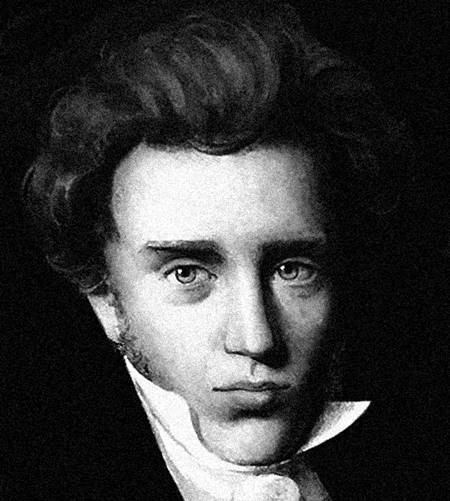
The Crowd is Untruth
Soren KierkegaardSøren Kierkegaard A Danish philosopher (1813–1855) and theologian, lived largely in Copenhagen and was deeply shaped by his devout, melancholic father. Trained in theology and philosophy, he never became a pastor, instead devoting himself to writing. A broken engagement to Regine Olsen profoundly influenced his life and work, catalyzing an extraordinarily productive authorship. Kierkegaard wrote through both pseudonymous and signed works, exploring stages of existence, inwardness, faith, and indirect communication. His later years featured a fierce critique of institutional “Christendom.” Though Christian in intent, his thought profoundly influenced global existential philosophy. Kierkegaard is often described as the “father of existentialism.”
On the Dedication to “That Single Individual” [Note 1]
Translated by Charles K. Bellinger
My dear, accept this dedication; it is given over, as it were, blindfolded, but therefore undisturbed by any consideration, in sincerity. Who you are, I knowKnowledge Knowledge is derived from the process of an informed person integrating data from sense organs or intuition into their psyche. This concept is explored in the Vedic Nasadiya Sukta, which questions the possibility of ultimate truth or knowledge. In different languages, such as Greek, Latin, Sanskrit, and Chinese, knowledge is expressed as "η γνώση," "Scientia," "ज्ञानम् ," and "知识 Zhīshì," respectively. not; where you are, I know not; what your name is, I know not. Yet you are my hope, my joy, my pride, and my unknown honor.
It comforts me, that the right occasion is now there for you; which I have honestly intended during my labor and in my labor. For if it were possible that reading what I write became worldly custom, or even to give oneself out as having read it, in the hope of thereby winning something in the worldWorld Κόσμος , that then would not be the right occasion, since, on the contrary, misunderstanding would have triumphed, and it would have also deceived me, if I had not striven to prevent such a thing from happening.
This, in part, is a possible change in me, something I even wish for, basically a mood of soulSoul Abraham, having wept a short time over his wife’s body, soon rose up from the corpse; thinking, as it should seem, that to mourn any longer would be inconsistent with that wisdom by which he had been taught that he was not to look upon death as the extinction of the soul, but rather as a separation and disjunction of it from the body, returning back to the region from whence it came; and it came, from God. (Philo) न जायते म्रियते वा कदाचिन्-नायं भूत्वा भविता वा न भूयः-अजो नित्यः शाश्वतोयं पुराणो-न हन्यते हन्यमाने शरीरे (Gita 2.20 ) and mindMind We know nothing about its origin, growth, or demise. Where it lives, can it live without a brain? Possibly, the mind is the soul and spirit. See Consciousness, which does not produce change by being more than change and therefore produces nothing less than change; it is rather an admission, in part a thoroughly and well thoughtThinking Human beings began conscious thought as far back as sixty million years ago. By around three hundred thousand years ago, humans inhabiting the Indian subcontinent had developed forms of cognition comparable to those of the modern age, including awareness of competition, defense, and collective security. These early communities were capable of abstract observation, such as counting stars in the night sky, and engaged in reflective discussion about everyday experiences, including the flavors and qualities of food, indicating a sophisticated mental and social life.-out view of “life,” of “the truthTruth Mathematical 'truth' may not be agreeable with the philosophical 'truth.' A question may be asked on propositional 'truth' on the grounds of physics, that space and time actually don't exist. Vedic injunction Satyam Param Dhimahi, technically Satya is none other than Brahman. For Madhymic Buddhists there is nothing as such to be called 'truth', as all the corresponding facts are only mental projections. Apart from Bio-neuroelectricity nothing exists for Biological Cognition. So-called religious truths are nothing more than a marketing strategy.,” and of “the way.”
There is a view of life which holds that where the crowd is, the truth is also, that it is a need in truth itself, that it must have the crowd on its side.[Note 2] There is another view of life; which holds that wherever the crowd is, there is untruth, so that, for a moment to carry the matterMatter Normal matter is made of molecules, which are themselves made of atoms. Inside the atoms, electrons are spinning around the nucleus. The nucleus is made of protons and neutrons. Inside the protons and neutrons, exist indivisible quarks, like the electrons. All matter around us is made of elementary particles. ( building blocks of matter > quarks and leptons). All stable matter in the universe is made from particles that belong to the first-generation. Fundamental forces result from the exchange of force-carrier particles, which belong to a broader group called “bosons”. The strong force is carried by the “gluon”, electromagnetic force is carried by the “photon.” out to its farthest conclusion, even if every individual possessed the truth in private, yet if they came together into a crowd (so that “the crowd” received any decisive, voting, noisy, audible importance), untruth would at once be let in.[Note 3]
For “the crowd” is untruth. Eternally, godly, christianly what Paul says is valid: “only one receives the prize,” [I Cor. 9:24] not by way of comparison, for in the comparison “the others” are still present. That is to say, everyone can be that one, with GodGod People in most cultures believe in the existence of supernatural beings and other supernatural concepts. God is attributed to both anthropomorphic properties (“listens to prayers”) and non-anthropomorphic properties (“knows everything”). Conceptualizing God is associated with willingness to get the COVID-19 vaccine or Vaccine hesitancy. Pope requested people not to practice “Jesus is my vaccine”. For the Jewish, family (Avestan universal) god became national God: I am the God of Abraham, and the God of Isaac, and the God of Jacob,”(ex 3:15). See Ishwar. ’s help – but only one receives the prize; again, that is to say, everyone should cautiously have dealings with “the others,” and essentially only talk with God and with himself – for only one receives the prize; again, that is to say, the humanHuman Ο άνθρωπος (Humanum> Homo sapiens) मानव:. We have failed to consider the minimum need to be a 'human'. For Christians, human beings are sinful creatures, who need some saviour. For Evolution biology a man is still evolving, for what, we don´t know. For Buddhist Nagarjuna, the realisation of having a human body is a mere mental illusion. We are not ready to accept that a human is a computer made of meat. For a slave master, a human person is another animal, his sons and daughters are his personal property. being is in kinship with, or to be a human is to be in kinship with the divinity. The worldly, temporal, busy, socially-friendly person says this: “How unreasonableUnreasonable The meaning of “unreasonable” cannot be determined by recourse to a dictionary, nor, for that matter, by reference to the rules of statutory construction. The task of expounding a constitution is crucially different from that of construing a statute. A statute defines present rights and obligations. It is easily enacted and as easily repealed. A constitution, by contrast, is drafted with an eye to the future. … Once enacted, its provisions cannot easily be repealed or amended. It must, therefore, be capable of growth and development over time to meet new social, political, and historical realities often unimagined by its framers. The judiciary is the guardian of the constitution and must, in interpreting its provisions, bear these considerations in mind (Hunter v. Southam Inc., [1984] 2 S.C.R. 145.), that only one should receive the prize, it is far more probable that several combined receive the prize; and if we become many, then it becomes more certain and also easier for each individually.” Certainly, it is far more probable; and it is also true in relation to all earthly and sensuous prizes; and it becomes the only truth, if it is allowed to rule, for this point of view abolishes both God and the eternal and “the human being’s” kinship with the divinity; it abolishes it or changes it into a fable, and sets the modern (as a matter of factFact Something तथ्य (In-formation) that truly exists or happens or some-thing that has actual existence. Circumstances: a fact or event that makes a situation the way it is. Indian Evidence Act: It means and includes— (i) anything, state of things, or relation of things, capable of being perceived by the senses; (ii) any mental condition of which any person is conscious. “facts in issue” means and includes any fact from which, either by itself or in connection with other facts, the existence, non-existence, nature or extent of any right, liability or disability, asserted or denied in any suit or proceeding, necessarily follows., the old heathen) in its place, so that to be a human being is like being a specimen which belongs to a raceRace It is a major subdivision of mankind, regarded as having a common origin, and is made up of individuals who have a relatively constant combination of physical traits that are handed on from parents to children. Ethnicity and race are often thought of as one and the same, but they do not consistently have the same meaning. Ethnicity refers to cultural features while race has biological as well as cultural components. gifted with reason, so that the race, the species, is higher than the individual, or so that there are only specimens, not individuals. But the eternal, which vaults high over the temporal, quiet as the night sky, and God in heavenHeaven स्वर्गे लोके न भयं किञ्चनास्ति न तत्र त्वं न जरया बिभेति । उभे तीर्त्वा अशनायापिपासे शोकातिगो मोदते स्वर्गलोके ॥ १२ ॥ (Kathopanishad). स्वर्ग (Swarga) is neither physical nor a spiritual place or entity. In Torah Elohim is the creator of שמים shamayim (Sky). Heavenly father = pater caelestis (Ουράνιος πατέρας) in NT. Christian heaven is a Paradisus/Park/παράδεισος where Trinity lives. جَنَّة (Janna) is the place, somewhere in sky where awarded people will get a place., who from this exalted state of bliss, without becoming the least bit dizzy, looks out over these innumerable millions and knows each single individual; he, the great examiner, he says: only one receives the prize; that is to say, everyone can receive it, and everyone ought to become this by oneself, but only one receives the prize. Where the crowd is, therefore, or where a decisive importance is attached to the fact that there is a crowd, there no one is working, living, and striving for the highest end, but only for this or that earthly end; since the eternal, the decisive, can only be worked for where there is one; and to become this by oneself, which all can do, is to will to allow God to help you – “the crowd” is untruth.
A crowd – not this or that, one now living or long dead, a crowd of the lowly or of nobles, of rich or poor, etc., but in its very concept [Note 4] – is untruth, since a crowd either renders the single individual wholly unrepentant and irresponsible, or weakens his responsibility by making it a fraction of his decision. Observe, there was not a single soldier who dared lay a hand on Caius Marius; this was the truth. But given three or four women with the consciousnessConsciousness The mind’s (Mind) function that receives, processes, and evaluates information through the five senses, imagination, emotion, reason, and memory. The senses gather data, imagination and emotion interpret it, reason judges its value, and memory stores or discards it. In neurophysiology, consciousness is often defined as “subjective awareness” — the state of being aware of oneself and one’s surroundings. or idea of being a crowd, with a certain hope in the possibility that no one could definitely say who it was or who started it: then they had the courage for it; what untruth! The untruth is first that it is “the crowd,” which does either what only the single individual in the crowd does, or in every case what each single individual does. For a crowd is an abstraction, which does not have hands; each single individual, on the other hand, normally has two hands, and when he, as a single individual, lays his two hands on Caius Marius, then it is the two hands of this single individual, not after all his neighbor’s, even less – the crowd’s, which has no hands. In the next place, the untruth is that the crowd had “the courage” for it, since never at any timeTime χρόνος. Judicial: Where any expression of it occurs in any Rules, or any judgment, order or direction, and whenever the doing or not doing of anything at a certain time of the day or night or during a certain part of the day or night has an effect in law, that time is, unless it is otherwise specifically stated, held to be standard time as used in a particular country or state. (In Physics, time and Space never exist actually-“quantum entanglement”) यमः , पुं, (यमयति नियमयति जीवानां फलाफलमिति । यम् + अच् । विश्वे च कलयत्येव यः सर्व्वायुश्च सन्ततम् । अतीव दुर्निवार्य्यञ्च तं कालं प्रणमाम्यहम् ॥यमैश्च नियमैश्चैव यः करोत्यात्मसंयमम् । स चादृष्ट्वा तु मां याति परं ब्रह्म सनातनम् ॥ was even the most cowardly of all single individuals so cowardly, as the crowd always is. For every single individual who escapes into the crowd, and thus flees in cowardice from being a single individual (who either had the courage to lay his hand on Caius Marius, or the courage to admit that he did not have it), contributes his share of cowardice to “the cowardice,” which is: the crowd. Take the highest, think of ChristChrist Not before 250 CE, Jesus was attached to this Title (Gospel of Thomas). Lamentations 4:20 > The breath of our nostrils, the Christ (Mašíaḥ) of Yahweh, was captured in their pits, of whom we had said, “Under his shadow, we shall live among the nations.” Greek Septuagint (OT), χριστός derived from χρίω (anointed one). Jews never accepted Jesus as the Messiah. His violent death was interpreted as a curse by Yahweh. For Hindus, Christian claims are absurd. Performing Dharma leads to Liberation. For Muslims, Jesus never died on the Cross. He who confesses that Jesus is Christ is Christian. Confessing Muhammad is the Last Prophet earned the name of Mohammedan. . – and the whole human race, all human beings, which were ever born and ever will be born; the situation is the single individual, as an individual, in solitary surroundings alone with him; as a single individual he walks up to him and spits on him: the human being has never been born and never will be, who would have the courage or the impudence for it; this is the truth. But since they remain in a crowd, they have the courage for it – what frightening untruth.
The crowd is untruth. There is therefore no one who has more contempt for what it is to be a human being than those who make it their profession to lead the crowd. Let someone, some individual human being, certainly, approach such a person, what does he care about him; that is much too small a thing; he proudly sends him away; there must be at least a hundred. And if there are thousands, then he bends before the crowd, he bows and scrapes; what untruth! No, when there is an individual human being, then one should express the truth by respecting what it is to be a human being; and if perhaps, as one cruelly says, it was a poor, needy human being, then especially should one invite him into the best room, and if one has several voices, he should use the kindest and friendliest; that is the truth. When on the other hand it was an assembly of thousands or more, and “the truth” became the object of balloting, then especially one should godfearingly – if one prefers not to repeat in silence the Our Father: deliver us from evil – one should godfearingly express, that a crowd, as the court of last resort, ethically and religiously, is the untruth, whereas it is eternally true, that everyone can be the one. This is the truth.
The crowd is untruth. Therefore was Christ crucified, because he, even though he addressed himself to all, would not have to do with the crowd, because he would not in any way let a crowd help him, because he in this respect absolutely pushed away, would not found a party, or allow balloting, but would be what he was, the truth, which relates itself to the single individual. And therefore everyone who in truth will serve the truth, is eo ipso in some way or other a martyr; if it were possible that a human being in his mother’s womb could make a decision to will to serve “the truth” in truth, so he also is eo ipso a martyr, however his martyrdom comes about, even while in his mother’s womb. For to win a crowd is not so great a trick; one only needs some talent, a certain dose of untruth and a little acquaintance with the human passions. But no witness for the truth – alas, and every human being, you and I, should be one – dares have dealings with a crowd. The witness for the truth – who naturally will have nothing to do with politicsPolitics The art of controlling people and land grabbing. Political Documents. Books: The New Testament, Quran, Mahabharat, The Communist Manifesto. Men: Chanakya, John Locke, Karl Marx, Henry David Thoreau, Mussolini, Lenin, Ben Rhodes. Ideas: Roman Inquisition, Democracy, Socialism, Hindutva, Zionism, Islamic fundamentalism. Classical: Plato, Aristotle, Mahabharata, and to the utmost of his ability is careful not to be confused with a politician – the godfearing work of the witness to the truth is to have dealings with all, if possible, but always individually, to talk with each privately, on the streets and lanes – to split up the crowd, or to talk to it, not to form a crowd, but so that one or another individual might go homeHome Αρχική > from the assembly and become a single individual. “A crowd,” on the other hand, when it is treated as the court of last resort in relation to “the truth,” its judgmentJudgment The statement given by the Judge on the grounds of a decree or order - CPC 2(9). It contains a concise statement of the case, points for determination, the decision thereon, and the reasons for such decision - Order 20 Rule 4(2). Section 354 of CrPC requires that every judgment shall contain points for determination, the decision thereon and the reasons for the decision. Indian Supreme Court Decisions > Law declared by Supreme Court to be binding on all courts (Art 141 Indian Constitution) Civil and judicial authorities to act in aid of the Supreme Court (Art 144) Supreme Court Network On Judiciary – Portal > Denning: “Judges do not speak, as do actors, to please. They do not speak, as do advocates, to persuade. They do not speak, as do historians, to recount the past. They speak to give Judgment. And in their judgments, you will find passages, which are worthy to rank with the greatest literature….” Law Points on Judgment Writing > The judge must write to provide an easy-to-understand analysis of the issues of law and fact which arise for decision. Judgments are primarily meant for those whose cases are decided by judges (State Bank of India and Another Vs Ajay Kumar Sood SC 2022) as the judgment, is detested by the witness to the truth, more than a virtuous young womanMen Ανθρωποι (People), a woman (γυναίκα), Man (Ανδρας) > Adama, Manu > No proof to establish that due to mutation a monkey turned into a human being. detests the dance hall. And they who address the “crowd” as the court of last resort, he considers to be instruments of untruth. For to repeat: that which in politics and similar domains has its validity, sometimes wholly, sometimes in part, becomes untruth, when it is transferred to the intellectual, spiritualSpiritual Inspirational or inspired, energetic, motivated. It is all about earthly potency. It can not be translated as Adhatmya in Sanskrit. 'Christian Spirituality' means being motivated by Christian ideas. An airy or thin, like invisible earthly matter, is also called Spiritual. "Take and receive my spirit" means take courage from me, or just blowing wind from one's mouth., and religious domains. And at the risk of a possibly exaggerated caution, I add just this: by “truth” I always understand “eternal truth.” But politics and the like has nothing to do with “eternal truth.” A politics, which in the real sense of “eternal truth” made a serious effort to bring “eternal truth” into real life, would in the same second show itself to be in the highest degree the most “impolitic” thing imaginable.
The crowd is untruth. And I could weep, in every case I can learn to long for the eternal, whenever I think about our age’s misery, even compared with the ancient world’s greatest misery, in that the daily press and anonymity make our age even more insane with help from “the public,” which is really an abstraction, which makes a claimA Claim A claim is “factually unsustainable” where it could be said with confidence before trial that the factual basis for the claim is entirely without substance, which can be the case if it were clear beyond question that the facts pleaded are contradicted by all the documents or other material on which it is based. to be the court of last resort in relation to “the truth”; for assemblies which make this claimA Claim A claim is “factually unsustainable” where it could be said with confidence before trial that the factual basis for the claim is entirely without substance, which can be the case if it were clear beyond question that the facts pleaded are contradicted by all the documents or other material on which it is based. surely do not take place. That an anonymous person, with help from the press, day in and day out can speak however he pleases (even with respect to the intellectual, the ethical, the religious), things which he perhaps did not in the least have the courage to say personally in a particular situation; every time he opens up his gullet – one cannot call it a mouth – he can all at once address himself to thousands upon thousands; he can get ten thousand times ten thousand to repeat after him – and no one has to answer for it; in ancient times the relatively unrepentant crowd was the almighty, but now there is the absolutely unrepentant thing: No One, an anonymous person: the Author, an anonymous person: the Public, sometimes even anonymous subscribers, therefore: No One. No One! God in heaven, such states even call themselves ChristianChristian A person who believes that Jesus died to remission his/her sin/debt. The People of Antioch were called for the first time as 'Christians', in or around 300 CE. states. One cannot say that, again with the help of the press, “the truth” can overcome the lie and the error. O, you who say this, ask yourself: Do you dare to claim that human beings, in a crowd, are just as quick to reach for truth, which is not always palatable, as for untruth, which is always deliciously prepared, when in addition this must be combined with an admission that one has let oneself be deceived! Or do you dare to claim that “the truth” is just as quick to let itself be understood as is untruth, which requires no previous knowledgeKnowledge Knowledge is derived from the process of an informed person integrating data from sense organs or intuition into their psyche. This concept is explored in the Vedic Nasadiya Sukta, which questions the possibility of ultimate truth or knowledge. In different languages, such as Greek, Latin, Sanskrit, and Chinese, knowledge is expressed as "η γνώση," "Scientia," "ज्ञानम् ," and "知识 Zhīshì," respectively., no schooling, no discipline, no abstinence, no self-denial, no honest self-concern, no patient labor! No, “the truth,” which detests this untruth, the only goalAim ambition aspiration course desideratum design desire direction end intent intent/intention intention mark object objective plan purpose scheme target where one is heading wish of which is to desire its increase, is not so quick on its feet. Firstly, it cannot work through the fantastical, which is the untruth; its communicator is only a single individual. And its communication relates itself once again to the single individual; for in this view of life the single individual is precisely the truth. The truth can neither be communicated nor be received without being as it were before the eyes of God, nor without God’s help, nor without God being involved as the middle term, since he is the truth. It can therefore only be communicated by and received by “the single individual,” which, for that matter, every single human being who lives could be: this is the determination of the truth in contrast to the abstract, the fantastical, impersonal, “the crowd” – “the public,” which excludes God as the middle term (for the personal God cannot be the middle term in an impersonal relation), and also thereby the truth, for God is the truth and its middle term.
And to honor every individual human being, unconditionally every human being, that is the truth and fear of God and love of “the neighbor”; but ethico-religiously viewed, to recognize “the crowd” as the court of last resort in relation to “the truth,” that is to deny God and cannot possibly be to love “the neighbor.” And “the neighbor” is the absolutely true expression for human equality; if everyone in truth loved the neighbor as himself, then would perfect human equality be unconditionally attained; every one who in truth loves the neighbor, expresses unconditional human equality; every one who is really aware (even if he admits, like I, that his effort is weak and imperfect) that the task is to love the neighbor, he is also aware of what human equality is. But never have I read in the HolyHoly Hebrew root qdš makes the word qōdeš (distinct). "And you shall be to Me a kingdom of priests and a holy nation". (Exodus 19:6a). Distinct, which is not common or ordinary. "Be holy, for I, the YAHA, your ELOHIM, am holy" (Lv 19.2; cf. 11.44; 20.26) > be just, pure, and clean. Greek ἅγιος is " set apart" and is different from Hebrew 'qodes'.καὶ τοῦ ἁγίου πνεύματος (Matt 28.19). 'the holy place' (מִקְדָּשׁ, Ezekiel 37:28). Sanskrit 'pavitra -पवित्र' means sanctified by vedic mantra and rituals and not only cleaned 'something' by clean water or by fire. Folly (Oppo). Scriptures this command: You shall love the crowd; even less: You shall, ethico-religiously, recognize in the crowd the court of last resort in relation to “the truth.” It is clear that to love the neighbor is self-denial, that to love the crowd or to act as if one loved it, to make it the court of last resort for “the truth,” that is the way to truly gain powerPower The amount of energy transferred or converted per unit of time. In the International System of Units, the unit of it is the watt, equal to one joule per second. The capacity of energy infrastructure is rated using watts, which indicate its potential to supply or consume energy in a given period of time. A Power-plant rated at 100 MW has the potential to produce 100 MWh if it operates for one hour., the way to all sorts of temporal and worldly advantage – yet it is untruth; for the crowd is untruth.
But he who acknowledges this view, which is seldom presented (for it often happens, that a man believes that the crowd is in untruth, but when it, the crowd, merely accepts his opinionOpinion A judge's written explanation of a decision of the court. In an appeal, multiple opinions may be written. The court’s ruling comes from a majority of judges and forms the majority opinion. A dissenting opinion disagrees with the majority because of the reasoning and/or the principles of law on which the decision is based. A concurring opinion agrees with the end result of the court but offers further comment possibly because they disagree with how the court reached its conclusion. en masse, then everything is all right), he admits to himself that he is the weak and powerless one; how would a single individual be able to stand against the many, who have the power! And he could not then want to get the crowd on his side to carry through the view that the crowd, ethico-religiously, as the court of last resort, is untruth; that would be to mock himself. But although this view was from the first an admission of weakness and powerlessness, and since it seems therefore so uninviting, and is therefore heard so seldom: yet it has the good feature, that it is fair, that it offends no one, not a single one, that it does not distinguish between persons, not a single one. A crowd is indeed made up of single individuals; it must therefore be in everyone’s power to become what he is, a single individual; no one is prevented from being a single individual, no one, unless he prevents himself by becoming many. To become a crowd, to gather a crowd around oneself, is on the contrary to distinguish life from life; even the most well-meaning one who talks about that, can easily offend a single individual. But it is the crowd which has power, influence, reputation, and domination – this is the distinction of life from life, which tyrannically overlooks the single individual as the weak and powerless one, in a temporal-worldly way overlooks the eternal truth: the single individual.
Note The reader will recall, that this (the beginning of which is marked by the atmosphere of its moment, when I voluntarily exposed myself to the brutality of literary vulgarity) was originally written in 1846, although later revised and considerably enlarged. Existence, almighty as it is, has since that time shed light on the proposition that the crowd, seen ethico-religiously as the court of last resort, is untruth. Truly, I am well served by this; I am even helped by it to better understand myself, since I will now be understood in a completely different way than I was at the time, when my weak, lonely voice was heard as a ridiculous exaggeration, whereas it can now scarcely be heard at all on account of existence’s loud voice, which says the same thing.
Notes
[Note 1] This, which is now considerably revised and enlarged, was written and intended to accompany the dedication to “that single individual,” which is found in “Upbuilding Discourses in Various Spirits.” Copenhagen, Spring 1847.
back to text
[Note 2] Perhaps, however, it is right to note once and for all, that which follows of itself and which I have never denied, that in relation to all temporal, earthly, worldly ends the crowd can have its validity, even its validity as a decisive court of last resort. But I am not speakingSpeech 400 million years ago, the larynx was developed and allowed for communication with other animals. 60 million years ago, human beings talked about Dynosure or like animals in India. The vocal tract was in place to support modern human discourse as early as 300,000 years ago in the Indian subcontinent. about such things, which I pay so little attention to. I speak of the ethical, the ethical-religious, of “the truth,” and seen ethico-religiously the crowd is untruth, when it is taken as a valid court of last resort for what “the truth” is.
back to text
[Note 3] Perhaps, however, it is right to note, although it seems to me to be almost superfluous, that it naturally could not occur to me to object to something, for example that there is preaching, or that “the truth” is proclaimed, even though it was to an assembly of a hundred thousand. No, but even if it were an assembly of just ten – and if there should be balloting, that is, if the assembly were the court of last resort, if the crowd were the decisive factor, then there is untruth.
back to text
[Note 4] The reader will therefore recall, that here by “crowd,” “the crowd” is understood as a purely formal conceptual definition, not what one otherwise understands by “the crowd,” when it supposedly is also a qualification, when human selfishness irreligiously divides human beings into “the crowd” and the nobles, and so forth. God in heaven, how would the religious arrive at such in-human equality! No, “crowd” is the numberNumber Αριθμός, the numerical; a number of noblemen, millionaires, high dignitaries, etc. – as soon as the numerical is at work, the “crowd” is “the crowd.”
Søren Aabye Kierkegaard (b. 1813, d. 1855)