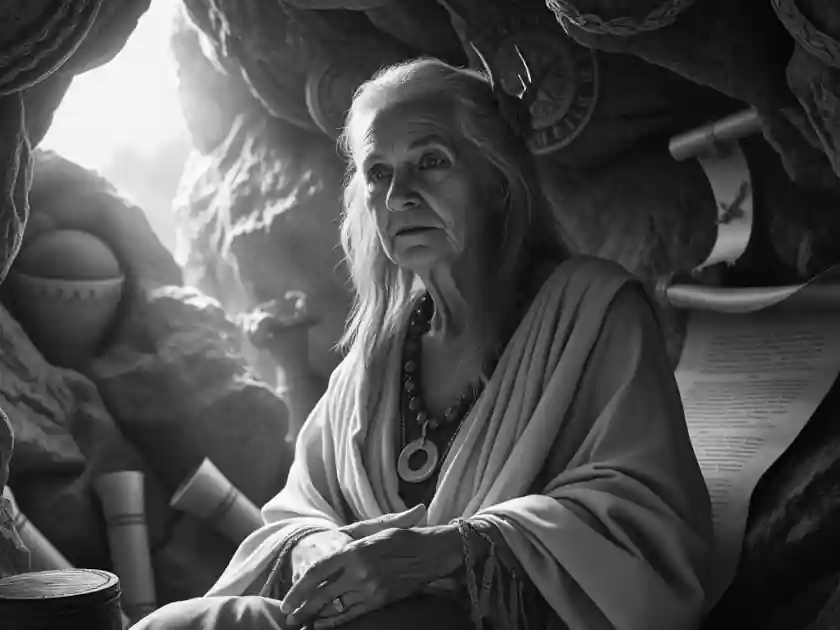
Sibyl`s Oracles (6th Century BCE )
The Sibyls held a prominent place in the traditions and history of ancient Greece and Rome. Their fame spread widely long before the beginning of the Christian era. Heraclitus of Ephesus, writing about five centuries before Christ, compared himself to the Sibyl “who, speaking with an inspired mouth (εμπνευσμένο στόμα), without a smile, without adornment or perfume, penetrates through centuries by the power of the gods.” Various oracles said to have been spoken by these prophetesses appear in the works of Pausanias, Plutarch, Livy, and other ancient authors. From these accounts, the Sibyls were believed to be women endowed with divine inspiration (θεϊκή έμπνευση) and knowledge of the future (γνώση του μέλλοντος), capable of revealing the destinies of individuals, cities, and kingdoms.
The most ancient and celebrated of them was the Sibyl of Cumae, who lived in a cave near Neapolis on the Italian coast. It was to her sacred dwelling that Aeneas journeyed to learn the fate awaiting him, and she became his guide to the underworld, as described in the sixth book of Virgil’s Aeneid. According to legend, Apollo fell in love with her and offered to grant any wish she desired. She asked to live as many years as she could hold grains of sand in her hand. Apollo granted her request, but when she refused his love, he decreed that her long life would be a curse rather than a blessing, leaving her without youth or beauty. She was said to be seven hundred years old when Aeneas came to Italy and destined to live many more centuries until her years equaled the grains of sand she once held. In the end, she was fated to fade away entirely and exist only as a voice. She was also known by other names, including Herophile, Deiphobe, Demophile, Phenomine, Demo, and Amalthea.
Early Christian writers such as Lactantius and others of the first four centuries accepted this tradition as genuine history and frequently cited passages from the Sibylline oracles as though they carried the same authority as the Hebrew prophets. Modern scholars, however, generally regard these traditions as largely based on some genuine collection of ancient oracles.
Many of the early Church leaders made extensive use of these writings to explain their faith and reconstruct faith statements in the 4th Century. Justin Martyr quoted the Sibyl with the same respect he gave to Scripture, arguing to the Greeks that their own prophetess proclaimed truths identical to those of the Hebrew seers. Clement of Alexandria followed a similar approach, citing lines that now appear in the prologue of the Sibylline Books and even referring to the Sibyl as a “prophetess of the Hebrews.” Theophilus of Antioch treated her words as sacred scripture and preserved the only known version of the ancient prologue. Tertullian called the Sibyl “the prophetess of truth,” claiming that even the pagan priests borrowed their titles from her. Later writers such as Eusebius, Augustine, and Jerome also referred to her authority from time to time, but none used her works as frequently as Lactantius, whose writings are filled with citations from the Sibylline verses.
The first printed Greek edition of the Sibylline Oracles was published by Xystus Betuleius in Basel in 1545. A metrical Latin translation by Sebastian Castalio appeared the following year, and an improved Greek edition by the same scholar was issued in 1555. The oracles themselves proclaim belief in a single supreme God:
Ένας Θεός που βασιλεύει μόνος, υπέρτατος, αγέννητος.
Υψηλός πάνω απ’ όλα, Αυτός δημιούργησε τους ουρανούς, τον ήλιο, τα άστρα και τη σελήνη,
Τη γόνιμη γη και τη φουσκωμένη θάλασσα.
Μόνος Αυτός είναι ο Δημιουργός, απεριόριστος,
Που έπλασε όλα τα ζωντανά πλάσματα και τους χάρισε ζωή.
One God who reigns alone, supreme, unborn.
High over all, He made the heavens, the sun, the stars, and the moon,
The fruitful earth and swelling sea.
He alone is Creator, unrestrained,
Who formed all living things and gave them life.
Ὦ θνητοὶ ἄνθρωποι καὶ σαρκικοί, οἳ οὐδέν ἐστε,
πῶς ταχέως ὑψοῦσθε, καὶ οὐ βλέπετε τέλος ζωῆς!
Οὐ τρέμετε, οὐδὲ φόβον ἔχετε Θεοῦ,
τοῦ Ἐπόπτου, τοῦ Ὑψίστου, τοῦ πάντα γινώσκοντος,
τοῦ Πανόπτου, μάρτυρος πάντων,
τοῦ Πάντροφος Δημιουργοῦ, ὃς ἐν πᾶσιν
ἐνεφύτευσεν τὸ γλυκὺ Πνεῦμα αὐτοῦ,
καὶ ἔπλασεν τὸ γένος τῶν θνητῶν.
Εἷς Θεός ἐστιν, ὁ μόνος βασιλεύων,
ὑπέρτατος, ἀγέννητος, παντοκράτωρ, ἀόρατος,
ὁ μόνος τὰ πάντα θεωρῶν,
αὐτὸς δὲ ὑπὸ σαρκὸς οὐδεμιᾶς ὁρᾶται.
Τίς γὰρ δύναται σαρκίνοις ὀφθαλμοῖς
ἰδεῖν τὸν ἀληθινὸν, ἀθάνατον Θεόν,
οὗ ἡ κατοικία ἐν οὐρανῷ ἐστίν;
Οὐδὲ ἐν ταῖς ἀκτῖσι τοῦ λαμπροῦ ἡλίου
ἂν ὑπομείνωσιν ἄνθρωποι γεννητοί,
φλεβῶν καὶ σαρκὸς καὶ ὀστέων ὄντες.
Τίμα οὖν αὐτόν, τὸν μόνον δεσπότην κόσμου,
τὸν δι᾽ αἰώνων μένοντα,
τὸν αὐτοῦ ὄντα, ἀγέννητον,
πάντα δι᾽ ὅλων ἄρχοντα,
καὶ πᾶσιν ἀνθρώποις κρίσιν μεταδιδόντα ἐν φωτὶ κοινοῖς.
Τῶν κακῶν βουλῶν λήψεσθε μισθὸν ἄξιον,
ὅτι οὐκ ἐδοξάσατε τὸν ἀληθινὸν, αἰώνιον Θεόν,
οὐδὲ αὐτῷ προσήνεγκατε ἱερὰς ἑκατόμβας,
ἀλλὰ δαίμοσιν ἐθύσατε —
τοῖς ἐν Ἅιδῃ οὖσιν.
Καὶ περιπατεῖτε ἐν ὑπερηφανίᾳ καὶ μανίᾳ,
ἀπολείποντες τὴν ὁδὸν τῆς δικαιοσύνης,
βαδίζοντες ἐν ἀκανθῶν καὶ βάτων τρίβοις.
Τί πλανάσθε; Στήτε, ὦ μωροί,
οἳ πλανᾶσθε ἐν σκότει καὶ νυκτὶ μέλαινᾳ.
Ἀφέντες τὸ σκότος, δεξάμενοι τὸ φῶς·
ἰδοὺ, φανερὸς ἐστὶ πᾶσιν, ἀναμάρτητος.
Ἔλθετε, μὴ διώκετε τὸ ζόφος ἔτι·
ἰδοὺ, τὸ ἡδύ φῶς τοῦ ἡλίου θαυμαστῶς φαίνει.
Γνῶτε φυλάσσειν σοφίαν ἐν ταῖς καρδίαις ὑμῶν.
Εἷς Θεός ἐστιν, ὁ πέμπων ὑετούς, σεισμούς, ἀνέμους,
ἀστραπὰς καὶ λιμοὺς, νόσους καὶ πένθη,
χιόνας καὶ πάγους· τί δὲ δεῖ πάντα λέγειν;
Αὐτὸς ἄρχει οὐρανοῦ, γῆν κυβερνᾷ, καὶ αὐτοῦ ὑπάρχει.
O mortal and fleshly men, who are nothing,
How quickly you grow proud, and see not the end of life!
You do not tremble, nor have fear of God,
The Overseer, the Most High, who knows all things,
The All-Seeing One, witness of all,
The All-Nourishing Creator, who in all things
Implanted His sweet Spirit
And formed the race of mortals.
There is one God, who alone reigns,
Supreme, unborn, almighty, invisible,
The only One who beholds all things,
But is Himself unseen by any mortal flesh.
For who can, with eyes of flesh,
Behold the true, immortal God,
Whose dwelling is in heaven?
Not even in the rays of the bright sun
Can mortal men endure to stand,
Being but veins and flesh and bones.
Honor Him, then, the only ruler of the world,
Who abides through all ages,
The self-existent, unbegotten One,
Ruling all things through all,
And giving judgment to all men in a common light.
You shall receive the just reward of your evil counsels,
Because you did not glorify the true, eternal God,
Nor offer Him holy sacrifices,
But sacrificed to demons—
To those who dwell in Hades.
And you walk in pride and madness,
Forsaking the path of righteousness,
And treading among thorns and briars.
Why do you wander? Stop, O foolish ones,
Who stray in darkness and black night.
Leave the darkness and receive the light;
Behold, He is manifest to all, without error.
Come, pursue darkness no more;
Behold, the sweet light of the sun shines wondrously.
Learn to keep wisdom within your hearts.
There is one God who sends rain, earthquakes, and winds,
Lightning and famines, plagues and sorrows,
Snow and ice; but why speak of all?
He rules heaven, governs the earth, and is self-existent.
This Oracle, which consists of two sections, is preserved only in the writings of Theophilus, bishop of Antioch, who lived during the latter half of the second century. It is not part of the Sibylline Oracles as they appear in existing manuscripts and printed editions, but seems to have formed the beginning of an older collection now lost, except for fragments—many of which may have been incorporated into the present third book. (See Introduction, page 18.)
Near the end of the second book of his work addressed to his friend Autolycus (Book II, Chapter 36; Migne, Greek Fathers, Vol. 6, p. 1109), Theophilus quotes the first of these fragments (verses 1–41) with these introductory words:
“Now the Sibyl, who among the Greeks and other nations was a prophetess, at the beginning of her prophecy reproaches the race of men, saying—”
Line 1. Cited by Clement of Alexandria (Stromata, III, 3; Migne, Greek Fathers, Vol. 8, p. 1117), who also in the same passage quotes a similar saying from Empedocles. Compare also Homer, Odyssey, XVIII, 130: “Earth nourishes nothing weaker than man.”
Line 4. Overseer — the same Greek word (ἐπίσκοπος, episkopos) used of Christ in 1 Peter 2:25. Compare also Clement of Rome, 1 Corinthians, Chapter 58 (Migne, Greek Fathers, Vol. 1, p. 328).
Line 8. Made him the guide — meaning, made the Spirit the guide. These two lines are quoted by Lactantius (Divine Institutes, IV, 6; Migne, Latin Fathers, Vol. 6, p. 462), who, however, adds the word God. He comments:
“The Erythraean Sibyl, at the beginning of her song, which she commenced by the help of the Most High God, proclaims the Son of God as leader and ruler of all in these verses:
All-nourishing Creator, who in all
Sweet breath implanted, and made God the guide of all.”
Ἀλλ’ εἰ πάντα τὰ γεννώμενα δεῖ καὶ φθείρεσθαι,
οὐκ ἐκ μηρῶν ἀνδρὸς καὶ γυναικὸς ὁ Θεὸς ἐπλάσθη.
Ἀλλ’ εἷς ἐστιν ὁ Θεός, μόνος, ὕψιστος ἁπάντων·
οὗτος ἐποίησεν οὐρανόν, ἥλιον,
καὶ ἄστρα, καὶ σελήνην, καὶ γαῖαν καρποφόρον,
καὶ θαλάσσης ῥεύματα φουσκωμένα, καὶ ὄρη ὑψηλά,
καὶ πηγὰς ἀενάους· καὶ ἐξήγαγεν
τὰ μυρία πλήθη τῶν ὑδάτων·
καὶ ἔθρεψεν ζωὴν ἐν πᾶσι τοῖς ἑρπουμένοις
τοῖς ἐπὶ γῆς, καὶ τοῖς λιγυροῖς ὀρνέοις
ποικίλοις χρώμασι καὶ ταχείας πτέρυγας
ἔχουσιν, ὅσα τέμνουσι τὸν ἀέρα.
Καὶ ἐν ταῖς ὀρέων χαράδραις ἔταξεν
τὰ ἄγρια γένη τῶν θηρίων·
καὶ ἡμῖν θνητοῖς ὑπετάξατο
πάντα τὰ κτήνη· τὸν θεοπλαστὸν ἄνθρωπον
ἔταξεν ἄρχοντα πάντων· καὶ ὑποταξεν ἀνθρώπῳ
πάντα τὰ ποικίλα ζῶα, καὶ ἃ ἀκατάληπτά ἐστιν.
Τίς γὰρ σὰρξ θνητὴ ταῦτα πάντα γνῶναι δύναται;
Μόνος γινώσκει ὁ ἐξ ἀρχῆς ταῦτα ποιήσας,
ὁ ἄφθαρτος Δημιουργός, ὁ αἰώνιος,
ὁ ἐν αἰθέρι καθαρῷ κατοικῶν·
οὗτος τοῖς ἀγαθοῖς δίδωσι πλοῦτον ἄφθονον,
τοῖς δὲ κακοῖς καὶ ἀδίκοις ἐγείρει
θυμὸν δεινόν, πόλεμον, λοιμόν, καὶ δακρυόεντα κακά.
Ὦ ἄνθρωποι, τί ματαίως ὑπερηφανεῖσθε
καὶ εἰς ὄλεθρον ἑαυτοὺς ἄγετε;
Αἰσχύνθητε θεοποιεῖν ζώας καὶ θηρία τέρατα·
οὐχὶ μανία καὶ φρὲν παρακοπὴ ἐστίν,
εἰ θεοὶ κλέπτουσιν ἐδέσματα καὶ σκεύη πηλῖνα ληΐζονται;
Καὶ ὅτε ἐδύναντο ἐν οὐρανῷ χρυσῷ κατοικεῖν,
ἰδοὺ σὴς αὐτοὺς κατέφαγεν,
καὶ ἀράχνης ὑφάσματα πυκνὰ περιέχει.
Ὑμεῖς προσκυνεῖτε ὄφεις, κυνάς, αἴλουρους — ὦ μωροί —
καὶ σέβεσθε ὄρνεα καὶ ἑρπετὰ γῆς,
καὶ λίθινες εἰκόνες, καὶ ἀγάλματα χειροποίητα,
καὶ σωροὺς λίθων παρ’ ὁδοῖς· ταῦτα σεβόμενοι,
καὶ ἄλλα πολλὰ ἀνόητα ἐπιτελεῖτε,
ἃ καὶ λέγειν αἰσχρόν ἐστιν.
Ταῦτά ἐστι τὰ λυμαντικὰ θεῶν ἄφρονων,
ὧν ἐκ στόματος θανάσιμος ἰὸς ῥεῖ.
Παρὰ δὲ αὐτοῦ ἐστὶ ζωὴ καὶ φῶς ἀίδιον ἄφθαρτον,
καὶ χαρὰν ἐπιχέει γλυκυτέραν μέλιτος
τοῖς υἱοῖς τῶν ἀνθρώπων.
Αὐτῷ μόνῳ πρέπον κάμπτειν τράχηλον
καὶ βαδίζειν ὁδοὺς εὐσεβείας αἰωνίους·
ἐκλιπόντες δὲ ἐκείνους, τὸ ποτήριον τῆς τιμωρίας
καθαρόν, ἰσχυρὸν, πεπιεσμένον, ἀμιγές,
πίνετε μανικῶς, ψυχῇ μεθύοντες.
Ἀλλ’ οὐκ ἐξεγείρεσθε ἐκ τοῦ ὕπνου,
οὐδὲ ἔρχεσθε εἰς φρόνησιν, καὶ γινώσκετε Θεόν,
τὸν βασιλέα τὸν μέγαν, τὸν ἐπόπτην πάντων.
Διὰ τοῦτο πῦρ φλέγον ἐπ’ ὑμᾶς ἔρχεται·
καὶ δι’ αἰῶνας καθ’ ἡμέραν
λύχνοις καιομένοις ἐμπρήσεσθε,
διὰ τὰ ψευδῆ καὶ μάταια εἴδωλα ἐπαισχυνθησόμενοι.
Οἱ δὲ φοβούμενοι Θεὸν καὶ τὴν ἀλήθειαν αἰώνιον
ζωὴν κληρονομήσουσιν, καὶ εἰς ἀεὶ κατοικήσουσιν
ἐν τοῖς χλοεροῖς πεδίοις τοῦ Παραδείσου,
ἀπολαύοντες ἄρτου γλυκέος ἐξ οὐρανοῦ ἀστερόεντος.
But if all that is born must also perish,
It cannot be from thighs of man and wife
God has been formed. But God is one alone,
Highest of all. He has made heaven, and sun,
And stars, and moon, and the fruit-bearing earth,
And ocean’s swelling streams, and lofty hills,
And the perennial fountains. And he brought
The countless millions of the waters forth ;
And nourished life in all the creeping things
That move on earth, and clear-toned twittering birds
Of various colors, and of whizzing wings.
That cleave the air. And in the mountain glades
Disposed he the wild races of llie beasts.
And to us mortals made subordinate
All cattle ; the God-formed one made chief
Of all things; and subordinate to man
He put all variegated forms of life,
And things that are incomprehensible.
For all these things what mortal flesh can know?
He only knows who himself made these things
From the beginning, incorruptible Creator,
everlasting One, who dwells
In the pure ether. He rewards the good
With an abundant bounty, but fierce wrath
He rouses for the wicked and unjust.
And war, and pestilence, and tearful woes.
O men, why vainly puffed up do ye bring
Yourselves to ruin? Blush to deify
Polecats and monstrous beasts. And is it not
A madness and a frenzy of the mind
If gods steal plates, and plunder earthen pots?
And when they might inhabit in their power
The golden heaven, see them moth-eaten there,
And thickly woven under spiders’ webs!
Ye worship serpents, dogs, cats—O ye fools.
And reverence birds, and creeping things of earth,
Stone images and statues made by hand,
And stone heaps by the roads. Tliese ye revere.
And also many foolish things besides,
Which it would be even a shame to tell.
These are the baneful gods of houghtless men,
And from their mouth pours deadly poison down.
But of him is life and perennial light
Imperishable, and he sheds a joy
Sweeter than honey on the sons of men.
For him alone should any bend the neck
And tread the eternal paths of piety.
Leaving all those, the full cup of revenge,
Pure, strong, pressed down and unadulterated,
Drain off with madly eager soul, all ye.
But ye will not arouse you from your sleep
And come to sober reason, and know God,
The mighty King, who oversees all things.
Therefore, on you, the flame of burning fire
Is coming; ye through ages every day
Shall be by gleaming torches set on fire.
For false am I, worthless idols put to shame.
But they who fear God and eternal truth,
Life shall inherit, and forever dwell
Amid the verdant fields of Paradise,
Feasting on sweet bread from tlie starry heaven.
Tanmoy Bhattacharyya
15th October 2025
THE SIBYLLINE ORACLES
Book I.
Book II.
Book III.
Book IV.
Book V.
Book VI.
Book VII.
Book VIII.
Book XI.
Book XII.
Book XIII.
Book XIV.