

Court Cases Argued by Dr. Bhimrao Ramji Ambedkar (Barrister-at-Law)
Dr. Ambedkar’s legacy and contribution to India can be seen in many fields. His PhD thesis of 1923 titled “The Evolution of Provincial Finance in British India” provided the academic basis for the Finance Commission of India which was subsequently established through Article 280 of the Constitution to address problems of vertical and horizontal imbalances in financial. Similarly, the Reserve Bank of India was conceptualized based on the guidelines presented by Dr. Ambedkar to the “Royal Commission on Indian Currency & Finance” in 1925. Commission members found Dr. Ambedkar’s book “The Problem of the Rupee- Its Problems and Its Solution” an invaluable reference tool and the Central Legislative Assembly eventually passed these guidelines as the RBI Act 1934. (Indian President Pranab Mukherjee-04-September-2014)
In 1935, Dr. Ambedkar was appointed as the Principal of Government Law College, Mumbai, where he was teaching as a Professor of Law since 1928.
” [Dr. B. R. Ambedkar.] as correct and without question. This devotion in politics to a personality may be excusable in some cases, but it does not seem to me excusable where the fundamental rights ara being invaded. The fundamental rights are the very basis of the Preamble to the Constitution. The Preamble says that this Constitution will have as its basis liberty, equality and fraternity. These objectives of the Constitution are carried out by the fundamental rights. And it is, therefore, the duty, I should have thought, of every Member of Parliament, apart from personal loyalty, to be critical when any invasion is made of the fundamental rights.
Unfortunately, one does not find this kind of critical attitude. The history of fundamental rights in this country is very interesting. In olden times under the Hindu kings, there were fundamental rights only for two —the Brahmin and the cow—and the Puranas described the king as “Gou Brahmana Pratipala.” That was the duty of a king; whether the other sections of his subjects received any consideration at his hands or not, or whether animals other than the ‘Gou’ had any consideration was a matter of no moment at all. So long as the Brahmin and the cow were protected, the king was destined to go to heaven.
When the Muslims came, they took away these fundamental rights which the Hindu kings had granted to the Brahmin and the cow. The cow unfortunately not only lost its right to live, but became the victim of everybody. So was the case of the Brahmin. What the Muslims did was to give privileges to the Mussalman and no rights to the non-Muslims.
After the Muslim rule ended in this country, there came upon us the rule of the British. Anyone who examines the various Government of India Acts passed from 1772 to 1935 will find that there was no such thing as fundamental rights in any of the Government of India Acts that were passed by Parliament for the administration of this country. It was in 1947 or so when Swaraj became a fact in this country that this idea of fundamental rights emerged. It is our Constitution which for the first time contains the embodiment of what are called fundamental rights. It is a very strange thing that although the foreigners were ruling in this country, namely the British, no one ever agitated for the enactment of the fundamental rights. The Congress has been in existence since 1886. Let anyone examine the annual resolutions passed by Congress. They never asked for any fundamental rights (Dr. B. R. Ambedkar-Constitution {Fourth [RAJYA SABHA] Amendment) Bill, 1954 2448)
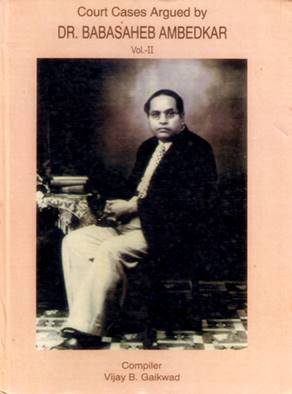
Bibliographic information
Title Court Cases Argued by Dr. Babasaheb Ambedkar
Compiled by Vijay Bapurao Gaikwad
Contributor Bhimrao Ramji Ambedkar
Publisher Vaibhav Prakashan, 2012
Court Cases Argued by Dr. Bhimrao Ramji Ambedkar (Chronological)
1- Yashwant Satva Chaugule vs Emperor
[Ambedkar and B.G. Modak – for Applicant] Citation: AIR 1926 Bombay 314
2- Ahmedabad Cotton & Co. vs Bai Budhian Rajaram (Original Judgment)
[H.V. Divatia – for Appellant. Ambedkar B.G. Modak – for Respondent.] Citation: AIR 1927 Bombay 223
3- Emperor vs Shantaram S. Mirajkar
[Kanga, Advocate General, with O’Gorman for the Crown, Dalvi, with Ambedkar, for accused No. 1 and Sir Chimanlal Setalvad, with F.J. Patel and Ratanlal Ranchhoddas, for accused No. 2] Citation: 1928 (30) Bom. L.R. 320
4-Emperor vs Philip Spratt (No. 2)
[Kanga – for the Crown, F. S. Talyarkhan – Gupte, Ambedkar and Ratanlal Ranchhoddas – for Accused.] Citation: AIR 1928 Bombay 77
5-Emperor vs Philip Spratt (No. 3)
[Kanga, O’Ogrman – for the Crown, F.S. Talyarkhan, Gupte, Ambedkar and Ratanlal Ranchhoddas – for Accused.] Citation: AIR 1928 Bombay 78
6- Nana Khandera Ghadge vs Emperor
[Ambedkar K.A. Padhye – for Applicant, P.B. Shingne – for the Crown.] Citation: AIR 1927 Bombay 647
7-Emperor vs Vithabai Sukha & Others
[Brown – for the Crown, Daruwalla and Ambedkar – for Accused.] Citation: AIR 1928 Bombay 336
8-Khandesh Laksmi Vilas Mills Co. Ltd. vs Graduate Coal Concern, Jalgaon
[Ambedkar, W.B. Pradhan and G.S. Gupte – for applicant, A.G. Desai and P.B. Gajendragadkar – for Opponent.] Citation: AIR 1935 Bombay 75
9-Gulabrao Laxmanrao Chandgude vs Emperor
[B.R. Ambedkar and V.D. Limaye for Accused. P.B. Shingne – for the Crown.] Citation: AIR 1935 Bombay 409
10-Emperor vs A. A. Alwe
[K.Mcl. Kemp, Advocate General, with P.B. Shingne, Government Pleader – for the Crown., B.R. Ambedkar, S.C. Joshi and N.B. Samarth, with A.S. Asyekar and A.G. Kotwal, for the accused.] Citation : 1935 (37) Bom 892
11-Vithabai Dattu Pattar and Others vs Malhar Shankar Kulkarni
[P.V. Kane – for Appellants, Dr. B.R. Ambedkar , S.A. Desai and S.A. Kher – for Appellant No. 6, G.N. Thakore and B.D. Belvi – for Respondent No. 1] Citation: AIR 1938 Bombay 228
12-Ramchandra Ganpatrao Dalvi vs Laxmibai Shamrao Kalkundri
[Dr. B.R. Ambedkar B.D. Belvi – for Appellant., G.N. Thakor and S.B. Jathar – for Respondent 1.] Citation: AIR 1938 Bombay 331
13-Asman Vaman Yadav and Others. vs Ganpat Tukaram and Others
[P.B. Gajendragadkar (in No. 303), Dr. B.R. Ambedkar Ramnath Shivlal for A.S. Asyekar (in No. 69), for Appellants., Dr. B.R. Ambedkar and Ramnath Shivlal for A.S. Asyekar (in No. 303), for Respondent 1; P.B. Gajendragadkar (in No. 69), for Respondents 1 to 3.] Citation: AIR 1938 Bom 443
14-Govind Gurunath Naik vs Deekappa Mallappa Hubballi
[G. N. Thakor and K.G. Datar – for Appellant. Dr. B.R. Ambedkar G.R. Madbhavi – for Respondent.] Citation : AIR 1938 Bom 388.
15-Muktawandas Ajabdas and Others vs Emperor
[ Dr. B.R. Ambedkar and T. G. Chobles – for Accused No. 1. T.J. Kedar, R.K. Rau, R.G. Rau, S W.A. Rizwi and W.C. Dutt – for Appellants Nos. 2 to 14.] Citation : AIR 1939 Nagpur 13
16-Shanmukhappa Gurulingappa and Others vs Rudrappa Golappa Malli
[S.R. Purulekar (in No. 149), Dr. B.R. Ambedkar, G.R. Madbhavi and K.R. Bengeri (in No. 222) – for Applellants] Citation: AIR 1939 Bombay 266
17-T. L. Wilson and Co. Solicitors vs Hari Ganesh Joshi and Others.
[ H.C. Coyajee and P.B. Gajandragadkar – for Applicants. Dr. B.R. Ambedkar, and L.G. Khare, and Y.V. Dixit and B.N. Gokhale – for Respondents] Citation: AIR 1939 Bombay 250
18- Jivanrao Anandrao Deshpande vs Vishnu Rangnath Kalawade
[ Dr. B.R. Ambedkar,and P.S. Bakhale – for appellant. G.K. Chitale and C.H. Patwardhan – for Respondent.] Citation: AIR 1939 Bombay 207
19-Janardan Govind Gore and Others vs Advocate General of Bombay
[S.R. Tendulkar – for Plaintiff, Dr. B.R. Ambedkar, M.H. Gandhi and D.B. Desai, and K.A. Somjee – for Defendants 2 &3, and 4 Respectively.] Citation: AIR 1939 Bombay 202
20-Putlaji Vishram Desai Others vs Damodar Vishnu Vaidya
[Dr. B.R. Ambedkar and A. A. Adarkar – for Appellants. H.C. Coyajee and Y. V. Dixit – for Respondent (Plaintiff)] Citation: AIR 1939 Bombay 405
21-Krishna Vitnak Mahar and another vs Shankar Krishna Gandhi Others.
[Dr .B.R. Ambedkar and B.G. Modak – for Appellants.,M.G. Chitale – for Respondent]Citation: AIR 1939 Bombay 419
22-Narbheramji Gyaniramji Ramsnehi vs Vivekramji Bhagatramji Ramsnehi
[H.C. Coyajee, M.R. Vidyarthi, R.A. Desai, B. Moropanth and R.P. Cholia – for Appellant. B.R. Ambedkar, M.H. Vakeel and P.N. Shende – for Respondent.] Citation: AIR 1939 Bombay 425
23-Mahadeo Sundar Mehta vs Khanderao Sitaram Tipnis
[K.N. Dharap – for Appellants., Dr. B.R. Ambedkar V.B. Virkar – for Respondents.] Citation: AIR 1939 Bombay 526
24-Jagannath Ganeshram Agarwala vs Shivnarayan Bhagirath and Others
[G.N. Thakor and S.G. Patwardhan – for Appellant. Sir Jamshedji Kanga, B.R. Ambedkar, Ramnath Shivalal and A.S. Asyekar – for Respondents.] Citation: AIR 1940 Bombay 247
25-Emperor vs Saver Manuel Dantes
[M.C. Setalved (Advocate-General) V.F. Taraporewala, G.N. Joshi and R.A. Jahagirdar (Government Pleader) – for the Crown. Sir Jamshedji Kanga, S.G. Velinker, R.J. Kolah and Dr. B.R. Ambedkar – for Accused.]Citation: AIR 1940 Bombay 307
26-Alla Datta vs Emperor
[B.R. Ambedkar and G.J. Mane – for Applicant M.C. Setalvad, (Advocate-General) and R.A. Jahagirdar (Government Pleader) – for the Crown.] Citation: AIR 1941 Bombay 334
27-Emperor vs Karsandas Govindaji Ved
[R. A. Jahagirdas, Government Pleader – for the Government of Bombay. B.R. Ambedkar and H.D. Thakor – for Accused.] Citation: AIR 1942 Bombay 326
28-Narayan Ramchandra Jarag and Others vs Emperor
[B.R. Ambedkar and V.R. Gadkari – for Accused., S.G. Patwardhan, Government Pleader – for the Crown.]
Citation: AIR 1948 Bombay 244
29-Mahadev Dhanappa Gunaki and another vs The State of Bombay
[Dr. B.R. Ambedkar Shri H.F.M. Reddy, Advocate, instructed by Shri M.S.K. Sastri, Agent – for Appellants; Shri M. C. Setalvad, Attorney-General for India and Shri C. K. Daphtary, Solicitor – General for India (Shri G. N. Joshi, Advocate, with them), instructed by Shri G. H. Rajadhyaksha, Agent – for the State] Citation: AIR 1953 SC 179

Court Cases Argued by Dr. Bhimrao Ramji Ambedkar
Read also:
Narhari Damodar Vaidya vs Bhimrao Ramji Ambedkar (17 March, 1937)-Citations: (1937) 39 BOMLR 1295, 173 Ind Cas 910
Dr. Ambedkar’s Speech on Conversion (31/05/1936)
Mr. Gandhi’s tenacious quest for Hindu-Muslim unity: Dr. BR Ambedkar (1940)
PAKISTAN OR THE PARTITION OF INDIA BY Dr. B. R. Ambedkar 1940
More Stories
Title 2 – The Congress (U.S. State Code): Congress, Elections, Committees, Budget and Congressional Administration
1 U.S. Code Sec 1 – Words denoting number, gender, and so forth
Title 1 – General Provisions (U.S. State Code): General Provisions, Statutory Construction and Codification