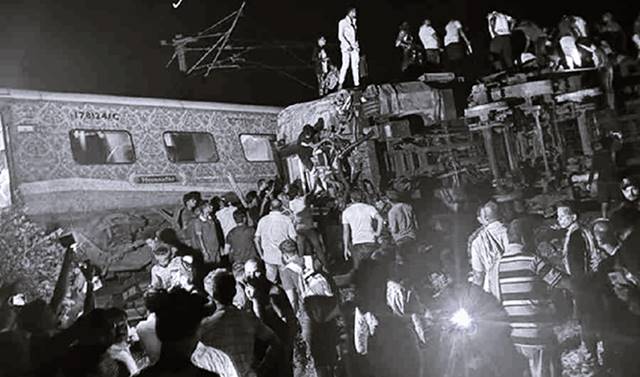
“223 people were killed, around 900 injured in a triple train crash in Odisha’s Balasore district on 2nd June 2023”
Section 113 of the Railways Act, 1989 required intimation of serious accidents to be sent to the Commissioner of Railway Safety. Under the Statutory Investigation into Railway Accidents Rules, 1998 issued by the Ministry of Civil Aviation, a statutory inquiry by the Commissioner of Railway Safety is obligatory in every serious accident to a train carrying passengers which is attended with loss of human life, or with grievous hurt, as defined in the Indian Penal Code, to a passenger or passengers in the train or with serious damage to railway property of the value exceeding Rs. 2 crore in each case. While holding statutory inquiry, the Commission not only examines affected passengers but also invites members of the public to give evidence in person during the inquiry or to write to the Commission. Some of the serious accidents at manned or unmanned level crossings attended with loss of life or with grievous injury to persons travelling in road vehicles are also inquired into by the Commissioner of Railway Safety.
Indian Railways is quite unique and distinctive in character, really a microcosm of India. To make it a safe and reliable system is an enormous challenge. The Railways has the most intricate and involved inter-dependencies. Safety on the Railways is the end product of the cohesive fusion of its myriad parts. A single flaw in the 64,600 route kms of track that criss-cross the country, a defect in over 9,500 locos,
55,000 coaches and 2.39 lakh wagons that haul about 23 million passengers and nearly 2.7 million tonnes of freight every day, an incorrect indication on one of the thousands of signals that dot the rail landscape, a mistake or an act of negligence by one of its staff directly associated with train running, even a rash act by one of the millions of road users who daily negotiate around odd level crossing gates spread across the system, an irresponsible act of carrying inflammable goods – any one of these multiple possibilities has the potential to cause a major tragedy. Added to these are the acts of sabotage by misguided elements spanning the whole country. Thus utmost vigil is safety in operations and also security of the traveling public is accorded by the Railways [Ministry of Railways, Outcome and Performance Budget 2013-14, p. 46]
Of the total of 131 train accidents that occurred on Indian Railways during 2011-12, 115 (87.78 per cent) were due to human failure, including 52 (36.69 percent) due to the failure of railway staff and 63 (48.09 per cent) due to the failure of other than railway staff, 5 (3.81 per cent) accidents due to failure of equipments, 6 (4.58 per cent) accidents were caused due to Sabotage, 1 (0.76 per cent) accident was due to combination of factors, 3 (2.29 per cent) accidents were due to incidental factors and 1 (0.76 per cent) accident for which causes could not be established.
Section 124-A of the Railways Act, 1989, the railway administration has also become liable to pay compensation for loss of life or injury to bonafide rail passengers who become victims of untoward incidents such as terrorist acts, violent attack, robbery, dacoity, rioting, shoot-out or arson by any person in or on any train carrying passengers, waiting hall, cloakroom, reservation or booking office, platform, any place within the precincts of a railway station or the accidental falling of any passenger from a train carrying passengers.
.
The Railway Board in the Ministry of Railway are the safety controlling authority and are responsible for laying down and enforcing safety standards for the Indian Railways, the main task of the Commission is to direct, advise and caution the railway executives through its inspectional, investigatory and advisory functions and thereby assist them in ensuring that all stipulated measures are taken in regard to the
soundness of rail construction and safety in train operation.
CAG Report No. 29 of 2015 – Performance Audit on Union Government, Railways
In India, the Railways are the most preferred mode of transport both for the movement of people and goods consignments in bulk. Indian Railways aimed at zero tolerance to accidents through implementation of Corporate Safety Plan (CSP) (2003-13) and Indian Railways Vision 2020.
Key Findings:
The CSP envisaged bringing down the number of accidents by 80 per centfrom 2001-02 by 2013, but number of accidents went up by 160 per cent during the above period. The loss of human lives in Fire accidents in passenger coaches steeply increased from 3 in 2001-02 to 9 in 2011-12, 32 in 2012-13 and 35 in 2013-14.
The Research Designs and Standards Organisation (RDSO), the agency responsible for prescribing specifications for fire retardant materials did not have their own laboratory facilities and the proposal (2006) to create state of the art laboratory is still in nascent stage. The fire simulation software procured in 2010 at a cost of Rs. 1.5 crore, meant for optimisation of coach design could not be put to optimum use due to non-availability of testing facilities.
There is no clear roadmap drawn by RDSO/Railway Board to match the international trends as envisaged in the XII plan document on safety. RDSO has been guided by the norms of International Union of Railways [UIC] for developing specifications for fire retardant materials. In 2006 RDSO envisaged that these specifications were only an intermediary step and ultimately fire retardant norms have to be further upgraded to the latest international norms. The present UIC norms are being phased out in major International Railway systems and being replaced with new fire safety standard EN-455451 which envisage testing of the coach/ assembly as a whole to see the overall impact of smoke, heat and toxic gases on passengers. However, after eight years, only the global tender to develop state of the art facilities for testing fire retardant properties was floated in February 2014.
Audit noticed that RB did not enforce its instructions on shifting of junction boxes to Guard’s cabin in SLRs, the removal of bottom latches of doors of passenger coaches, sufficient availability of locking arrangement for rotary switch panels in a number of coaches, non-provision of glass breaking hammers in AC coaches etc. during coach maintenance.