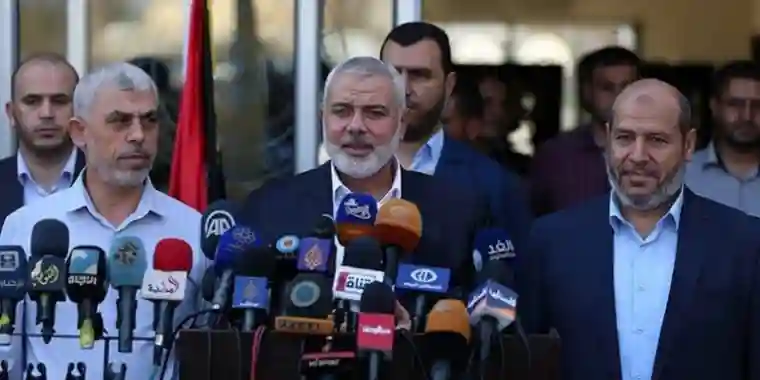
Gaza ceasefire agreement dated Monday, May 6, 2024
Basic principles for an agreement between the Israeli side and the Palestinian side in Gaza on the exchange of detainees and prisoners and the return of sustainable calm. Hamas has informed Qatar and Egypt of its acceptance of the agreement.
May 5, 2024
Full Text
The framework agreement aims to release all Israeli detainees in the Gaza Strip, whether civilians or soldiers and whether alive or otherwise, in exchange for the freeing of agreed upon numbers of prisoners in Israeli prisons, and a return to sustainable calm, in a way that achieves a permanent ceasefire, the withdrawal of Israeli forces from Gaza, and reconstruction.
The framework agreement consists of three related and interconnected stages, which are as follows:
The first stage (42 days)
- Temporary cessation of mutual military operations between the two sides and the withdrawal of Israeli forces eastward and away from densely populated areas to an area along the border in the entire Gaza Strip, including the Gaza Valley (Netzarim axis and Kuwait roundabout), as shown below.
- A halt to military and reconnaissance air operations in the Gaza Strip for ten hours a day, and for 12 hours on the days of the release of detainees and prisoners.
- The return of the displaced to their areas of residence and Israeli withdrawal from the Gaza Valley, Netzarim axis, and the Kuwait roundabout:
- On the third day (after the release of three detainees), Israeli forces withdraw completely from al-Rashid Street eastward to Salah Al-Din Street, completely dismantle the military sites and installations in this area, and allow the return of the displaced to their areas of residence (without carrying weapons), the freedom of movement of residents in all areas of the Strip, and the entry of humanitarian aid from al-Rashid Street from the first day without any obstacles;
- On the 22nd day (after the release of half of the civilian detainees still alive, including female soldiers), Israeli forces withdraw from the center of the Gaza Strip (especially the Netzarim-Martyrs axis and the Kuwait Roundabout axis) east of Salah al-Din Road to an area near the border and completely dismantle all military sites and installations. The displaced will be allowed to return to their places of residence in the north of the Gaza Strip and freedom of movement of residents in all areas of the Gaza Strip will be guaranteed.
- Starting from the first day, the entry of large and sufficient quantities of humanitarian aid and relief materials and fuel (600 trucks per day, of which 50 are fuel trucks, including 300 for the north), including the fuel needed to operate the electricity and commerce station and the equipment required for the removal of rubble, and rehabilitate and operate hospitals, health centers, and bakeries in all areas of the Gaza Strip, and this will continue throughout all stages of the agreement.
- Exchange of detainees and prisoners
During the first phase, Hamas releases 33 Israeli detainees (living or dead), including women (civilians and soldiers), children (under the age of 19, other than soldiers), the elderly (over the age of 50), and sick and wounded civilians, in exchange for numbers of prisoners in Israeli prisons and detention centers, according to the following schedule:
- Hamas releases all elderly living Israeli detainees (over the age of 50), the sick, and the wounded civilians. In return, Israel releases 30 elderly (over 50) and sick prisoners for every Israeli detainee, based on lists provided by Hamas, on the basis of the most distant arrest in time.
- Hamas releases all living Israeli female soldiers. In return, Israel releases 50 prisoners from its prisons for every Israeli female soldier released (30 life terms, 20 varying sentences), based on lists provided by Hamas.
* Scheduling of detainee and prisoner exchanges in the first stage:
- Hamas releases three Israeli detainees on the third day of the agreement, after which Hamas releases three more detainees every seven days, starting with women whenever possible (civilians and female soldiers). In the sixth week, Hamas releases all remaining civilian detainees included in this phase. In return, Israel releases the agreed-upon number of Palestinian prisoners in Israeli prisons, according to the lists that Hamas will submit.
- By the seventh day (if possible), Hamas will provide information on the numbers of Israeli detainees who will be released at this stage.
- On the 22nd day, the Israeli side releases all prisoners of the Shalit deal who were re-arrested.
- If the number of living Israeli detainees to be released is less than 33, the number of dead bodies of the same categories will be completed for this stage. In return, Israel will release all women and children who were arrested from the Gaza Strip after October 7, 2023 (under the age of 19 years). This should be done in the fifth week of this stage.
- The exchange process is linked to the extent of commitment to the terms of the agreement, including the cessation of mutual military operations, the withdrawal of Israeli forces, the return of displaced persons, and the entry of humanitarian aid.
- Completing necessary legal procedures to ensure that liberated Palestinian prisoners are not rearrested on the basis of the same charges on which they were previously detained.
- The first stage conditions shown above do not constitute a basis for negotiating those of the second stage.
- Lifting the measures and penalties taken against prisoners and detainees in Israeli prisons and detention camps after October 7, 2023, and improving their conditions, including those who were arrested after this date.
- No later than the 16th day of the first phase, indirect discussions will begin between the two sides regarding agreeing on the details of the second phase of this agreement with regard to the conditions for the exchange of prisoners and detainees from both sides (soldiers and remaining men), provided that they are completed and agreed upon before the end of the fifth week of this stage.
- The United Nations and its agencies, including UNRWA and other international organizations, carry out their work in providing humanitarian services in all areas of the Gaza Strip, and this continues throughout all stages of the agreement.
- Beginning the rehabilitation of the infrastructure (electricity, water, sewage, communications, and roads) in all areas of the Gaza Strip, introducing the necessary equipment for civil defense and removing rubble and debris, and continuing this throughout all stages of the agreement.
- Facilitating the entry of the necessary supplies and requirements to accommodate and shelter displaced persons who lost their homes during the war (at least 60,000 temporary homes – caravans – and 200,000 tents).
- Starting from the first day of this phase, an agreed-upon number (not less than 50) of wounded military personnel will be allowed to travel through the Rafah crossing to receive medical treatment, and the number of travelers, sick and wounded through the Rafah crossing will increase, restrictions on travelers will be lifted, and the movement of goods and commerce will return without restrictions.
- Initiating the necessary arrangements and plans for the process of the comprehensive reconstruction of homes, civilian facilities, and civilian infrastructure that were destroyed due to the war, and compensation for those affected, under the supervision of a number of countries and organizations, including Egypt, Qatar, and the United Nations.
- All measures in this phase, including the temporary cessation of mutual military operations, relief and shelter, withdrawal of forces, etc., will continue in the second phase until a sustainable calm is declared (cessation of military and hostile operations).
The second stage (42 days):
- Announcing the return of sustainable calm (cessation of military and hostile operations) and its taking effect before the exchange of detainees and prisoners between the two sides – all remaining Israeli men alive (civilians and soldiers) – in exchange for an agreed-upon number of prisoners in Israeli prisons and detainees in detention camps by Israeli forces, and the complete withdrawal of Israeli forces from the Gaza Strip.
The third stage (42 days):
- Exchanging the bodies and remains of the dead from both sides after reaching them and identifying them.
- Beginning the implementation of the Gaza Strip reconstruction plan for a period of 3 to 5 years, including homes, civilian facilities, and infrastructure, and compensating all those affected, under the supervision of a number of countries and organizations, including Egypt, Qatar, and the United Nations.
- Ending the complete siege on the Gaza Strip.
Guarantors of the agreement:
Qatar, Egypt, the United States, the United Nations
Read More:
Netanyahu: Strength and Strategy Against Hamas (Ceasefire Agreement)