Sarvarthapedia Meta-Concept

Sarvarthapedia is a comprehensive collection of universal knowledge
Sarvarthapedia, a comprehensive collection of universal knowledge
Sarvarthapedia is a collection of universal knowledge, created by Tanmoy Bhattacharyya from an Indian intellectual viewpoint. Sarvarthapedia aims to present knowledge in an original and scholarly manner. The word Sarvartha denotes everything or all things, while pedia denotes an encyclopedia. All articles are written from a scholastic and systemic perspective, combining research, reflection, and thoughtful interpretation. Click here to understand the twelve Core Areas.
Most Important Meta-Concept: Why intelligence systems emerge in civilizations at all.
Possible foundational thesis:
As civilizations grow in scale and complexity, they require increasingly sophisticated systems for uncertainty reduction, strategic prediction, internal cohesion, and external competition.
Under this model, intelligence becomes a civilizational survival mechanism. That single theoretical framework could unify the entire Sarvarthapedia System.
From an Indian intellectual perspective, Sarvarthapedia is founded on the proposition that intelligence systems and organized knowledge are not merely instruments of learning but civilizational survival mechanisms. As societies expand in scale and complexity, the capacity to reduce uncertainty, anticipate strategic challenges, preserve collective memory, and maintain social cohesion becomes essential for continuity and progress.
Sarvarthapedia therefore seeks to integrate abstract, empirical, cultural, and applied disciplines into a single interconnected 360-degree Knowledge Graph, reflecting a holistic view of knowledge that has long characterized Indian philosophical traditions. Its intellectual foundation rests on four pillars: 1. Civilizational Survival, which views knowledge as a strategic asset for societal resilience and adaptation; 2. Computational Planetary Awareness, which recognizes humanity’s evolution toward interconnected global consciousness through digital networks, artificial intelligence, and planetary-scale information systems; 3. Rigvedic Epistemic Circularity, inspired by the Vedic principle “Dhātā yathā pūrvam akalpayat” (“the Creator fashioned the world as before”), emphasizing cyclical processes of creation, preservation, decline, and renewal rather than purely linear models of history; and 4. Unified Knowledge Ecology, which treats all disciplines as interdependent components of a relational knowledge system, where every specialized field ultimately connects to deeper epistemological foundations. (See Epistemology)
To operationalize this vision, Sarvarthapedia organizes the entirety of human understanding into twelve equitable macro-areas, anchored by five foundational questions:
- What is knowledge?
- How is it acquired?
- How is it justified?
- What are its limits?
- And how is it applied?
The framework begins with Knowledge, Information & Inquiry (Area I) as the epistemic foundation, encompassing logic, information systems, methods of inquiry, and the validation of knowledge claims. It then expands into Natural Systems—The Universe & Physics (Area II), exploring cosmology, fundamental physics, and the mathematical structure of reality; The Earth & Dynamics (Area III), covering planetary systems, climate, and geophysical processes; and Life Sciences & Biosphere (Area IV), examining biological evolution, ecosystems, and genetic structures. Parallel to these are the Human Systems—Humanity & Evolution (Area V), focused on anthropological origins and human development; History & Civilisation (Area VI), studying the rise, transformation, and continuity of civilizations; and Society & Institutional Frameworks (Area VII), addressing law, education, governance structures, social organization, and economic distribution. These streams converge in the domain of Applied Expressions, which includes Politics, Law & Governance (Area VIII), Economics, Trade & Development (Area IX), Philosophy, Culture & Religion (Area X), Technology, Engineering & AI (Area XI), and Global Challenges & Futures (Area XII).
Together, these twelve dimensions form a comprehensive knowledge architecture designed to connect every domain of human understanding into a coherent, navigable, and continuously evolving civilizational knowledge system. (See The Taxonomy of Knowledge)

Recent Articles
-
Deep Grammar of Civilization (13-Volume): What Are the Irreducible Components of Civilization?
The exploration of civilization’s core components reveals a complex grammar underlying societies throughout history. This framework identifies essential functions that every civilization must perform, such as survival, reproduction, and governance, spanning multiple layers, including biological, ecological, and economic systems. Civilizations evolve, facing growth and stabilization alongside crises and potential collapse, yet they often regenerate and…
-
Dialectical Critique in India and the West: Purvapaksha, Nagarjuna and Hegel
Dialectical critique is a philosophical method involving systematic debate and counter-arguments to evaluate propositions. It has developed in both Indian and Western traditions, emphasizing the importance of engaging with opposing views. This approach fosters critical examination, intellectual humility, and conceptual innovation, reflecting a global commitment to rigorous reasoning and dialogue in philosophy.
-
Due Process and Equal Protection (Volume 3)
Volume 3 of Sarvarthapedia’s Encyclopedia of American Law explores the Fourteenth Amendment’s core promises, focusing on Due Process and Equal Protection. It explains the historical decline of the Privileges or Immunities Clause and highlights the significance of the Due Process Clause, which ensures fairness in legal processes and protects fundamental rights from government interference. The…
-
Education From Ancient Traditions to Modern Scientific Learning: Benefits of Non-Education
Sarvarthapedia highlights the multifaceted role of education in shaping individuals and societies. It traces the evolution of educational approaches from ancient to modern times, addressing the interplay of religious and secular systems. Furthermore, it emphasizes the significance of both formal and informal learning, showcasing their impact on personal growth, critical thinking, and societal advancement.
-
Encyclopedia of African Studies (10-Volume): History, Culture, and Development
African Studies is a multidisciplinary field examining the continent’s history, culture, and socio-political evolution. This ten-volume series explores Africa’s diverse societies from ancient civilizations to contemporary issues. It highlights the significance of African studies in understanding global dynamics, cultural exchanges, and future developments, fostering informed policy-making and research.
-
Encyclopedia of Contemporary Indian Politics: 111-Volume Statement on Indian Politics (1857–2026)
The Sarvarthapedia is an extensive 111-volume study on the evolution of Indian politics from 1857 to 2026. It outlines key historical milestones, significant movements, and legislative acts, framed within an objective narrative style. Each volume is meticulously structured with synopses, timelines, and thematic clusters, exploring topics such as nationalism, constitutional developments, and socio-political impacts. It…
-
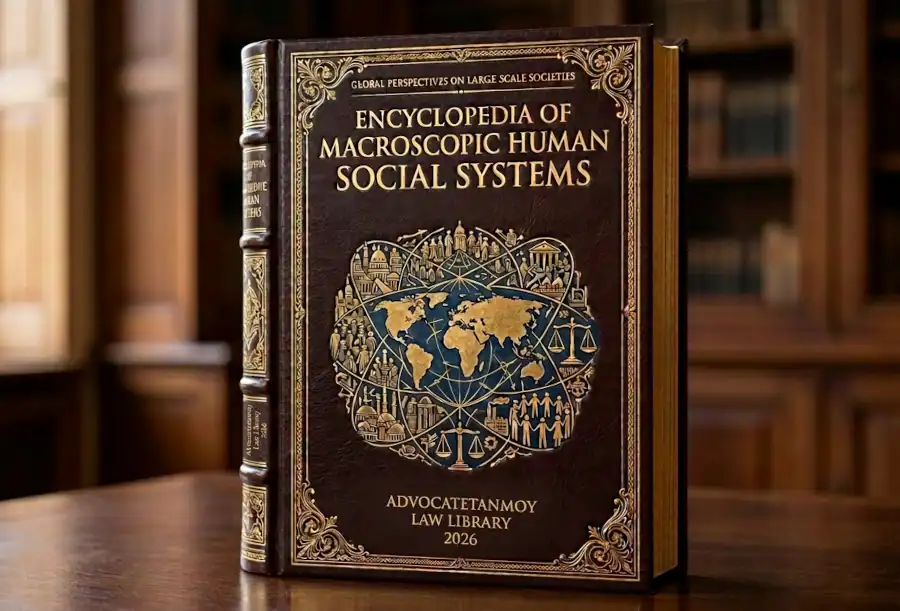
Encyclopedia of Macroscopic Human Social System Analysis (6-Volume): Civilization as a Complex Adaptive System
This encyclopedia under the Sarvarthapedia Project, analyzes the evolution of human civilization through a comprehensive examination of social systems, focusing on Vedic Civilization and major transformations from 1450 to 2026. The encyclopedia discusses civilization as a complex adaptive system, emphasizing the intertwined disciplines that shape societal dynamics. Key developments include the advent of agriculture, urbanization,…
-
Encyclopedia of Physical Measurement (3-Volume)
This encyclopedia explores the foundations of physics and measurement, detailing historical, mathematical, and experimental frameworks. It includes discussions on ancient civilizations, scientific revolution, measurement philosophy, and modern concepts like quantum mechanics and nanotechnology. Emphasizing precision and uncertainty, it bridges science with engineering and future research directions.
-
Encyclopedia of Religion, Faith, and Beliefs (12-Volume): History, Theology, Politics, and Conflict with Science
The evolution of religion spans thousands of years, shaping societies through diverse belief systems and practices, from animism to polytheism and monotheism. Key milestones include the rise of Judaism, Christianity, and Islam, the emergence of religious studies and theology, and the complex interplay between religion, politics, and science throughout history.
-
Evolution of Philosophical Examination: From Ancient Greece to Indian and Chinese Traditions
Philosophical examination has evolved from ancient traditions in Greece, India, and China to modern academic discourse. Starting with Socratic methods, it emphasized rigorous questioning and analysis of concepts. Throughout history, diverse methodologies emerged, fostering interdisciplinary collaboration and comparative studies. Today, it encompasses global philosophical traditions, enriching critical inquiry.
-
Existence of Future: Deep Understanding of Time and Space
The discourse on the future emphasizes its complex interplay with human consciousness, suggesting that our sense of the future arises from an intrinsic “sense of next,” facilitating intentional actions. Diverse civilizations perceive the future differently, as illustrated by the Hopi people’s language and philosophies from Buddhism to Abrahamic religions. Understanding futurity involves grappling with biological…
-
Fazlul Huq: From Hindu-Muslim Unity to Bengali Self-Determination
Abul Qasim Fazlul Haque (1873-1962) was a prominent Bengali Muslim political leader, advocating for Hindu-Muslim unity and peasant rights. His political career included significant contributions to Bengal’s governance and civil rights movements. However, his alignment with regionalism conflicted with broader Muslim nationalism, leading to his political decline post-partition.
-
Federalism and Separation of Powers (Volume 2): Encyclopedia of American Law
Volume 2 of Encyclopedia of American Law explores federalism and separation of powers in American law from the Founding to the contemporary administrative state. It discusses the distribution of powers between the national government and states, highlighting landmark cases that shaped federalism and the roles of Congress, the President, and the courts. It further examines…
-
First Amendment – Speech and Press (Volume 4): Encyclopedia of American Law
Volume 4 covers the full sweep of free speech and press doctrine: incitement, fighting words, true threats, obscenity, defamation, commercial speech, expressive conduct, compelled speech, time‑place‑manner restrictions, public forums, school speech, campaign finance, and press rights.
Sarvarthapedia
FAQs
1. What is Sarvarthapedia?
Sarvarthapedia is a comprehensive collection of universal knowledge. It is an encyclopedia that presents information from a distinct Indian intellectual viewpoint, aiming to offer original, scholarly insights rather than simply compiling existing sources.
2. What does the name mean?
The name is a combination of two parts: “Sarvartha,” a Sanskrit word meaning “the meaning of everything or all things,” and “pedia,” derived from “encyclopedia.” Therefore, Sarvarthapedia signifies an effort to explain knowledge in a comprehensive and meaningful way.
3. How is it different from other encyclopedias like Wikipedia?
Unlike platforms that may aggregate or copy from multiple sources, it focuses on creating original content. Each article is developed through careful research, library study, and the personal analysis of its creator, Tanmoy Bhattacharyya, offering a unique and thoughtful interpretation from an Indian scholarly perspective.
4. What kind of perspective does it offer?
Sarvarthapedia presents its content from an Indian intellectual viewpoint. This means the research, reflection, and interpretation of knowledge are approached through a scholastic and systemic lens rooted in Indian thought, providing a unique cultural and philosophical context.
5. Is the information on Sarvarthapedia well-researched and reliable?
Yes, the project emphasizes scholarly rigor. The creator states that every article is the result of careful research, library study, and personal analysis, combining these elements to present knowledge in an original and well-founded manner, rather than simply quoting other works.
6. Who is the target audience for it?
Sarvarthapedia is for anyone seeking a deeper, more thoughtful understanding of the world. It is particularly valuable for students, researchers, and individuals interested in encyclopedic knowledge that is interpreted through a considered, Indian scholarly framework.