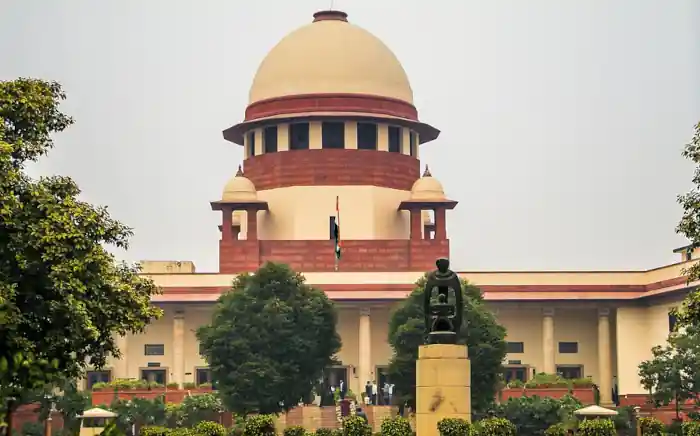
Supreme Court of India
ABHIJIT PANDEY VS. THE STATE OF MADHYA PRADESH – Crl.A. No. 446/2026 – Diary Number 59871 / 2025 – 23-Jan-2026 (2026 INSC 83)- Non-Reportable
High Court has rejected his regular bail application filed under Section 483 of the Bharatiya Nagarik Suraksha Sanhita, 2023.
Considering that the FIR relates to abetment of suicide, and the deceased sustained no injury attributable to her death, it prima facie appears that she died due to Atracurium Besylate, an anaesthetic drug. The deceased herself was an anaesthetist. Further, allegations of demand of money or dowry were not made initially but surfaced only in subsequent case diary statements. The appellant is not a hardened criminal; although another case of cheating and forgery involving multiple persons is registered against him, there is no likelihood of his absconding or being unavailable for trial. He has been in custody since 25.03.2025. In these circumstances, we are inclined to allow the appeal and direct that the appellant be released on bail.
HEMALATHA (D) BY LRS. VS. TUKARAM(D) BY LRS.. – C.A. No. 6640/2010 – Diary Number 20898 / 2010 – 22-Jan-2026 (2026 INSC 82)
The Court considers it necessary to suggest to the Union and State Governments the urgent digitization of registered documents and land records through secure, tamper-proof technologies such as Blockchain. Blockchain, a shared digital ledger, ensures that transactions relating to sale, mortgage, or similar nature, once recorded, become immutable and cryptographically secured. Registered documents must inspire absolute confidence to facilitate ease of doing business and preserve the sanctity of property titles in a modern economy, particularly since it is settled law that revenue or municipal entries do not confer or prove ownership. [See Suraj Bhan & Ors. v. Financial Commissioner & Ors. (2007) 6 SCC 186; Suman Verma v. Union of India & Ors. (2004) 12 SCC 58; Municipal Corporation, Aurangabad v. State of Maharashtra & Anr. (2015) 16 SCC 689; Ajit Kaur @ Surjit Kaur v. Darshan Singh (Dead) through LRs. & Ors. (2019) 13 SCC 70].
GLOSTER LTD. VS. GLOSTER CABLES LTD. – C.A. No. 2996/2024 – Diary Number 7939 / 2024 – 22-Jan-2026 (2026 INSC 81)
The Adjudicating Authority (National Company Law Tribunal) cannot declare title to an asset, such as a trademark, in insolvency resolution proceedings under Section 60(5)(c) of the Insolvency and Bankruptcy Code (IBC) when the approved resolution plan itself recognizes a dispute over ownership. The jurisdiction under Section 60(5)(c) is limited to questions “arising out of or in relation to” the insolvency process. Where a resolution plan explicitly notes rival claims to an asset (here, the “Gloster” trademark), granting a title declaration would impermissibly modify the binding approved plan and adjudicate a complex property dispute dehors the insolvency. Such a declaration exceeds the NCLT’s authority, as the issue of title is not incidental to the insolvency resolution on these facts. The proper course for a claimant is to pursue separate legal remedies to establish ownership.
RAJ SINGH GEHLOT VS. AMITABHA SEN – C.A. No. 385/2026 – Diary Number 20041 / 2020 – 20-Jan-2026 (2026 INSC 77)
The Supreme Court examined the scope of the National Green Tribunal’s jurisdiction under Section 14 of the NGT Act and held that it is confined to civil cases involving a “substantial question relating to the environment” arising from the implementation of enactments specified in Schedule I. The Court found that the issues entertained by the NGT substantially overlapped with pending writ proceedings before the High Court and involved seriously disputed questions of fact relating to land use and alleged deviations from sanctioned building plans. Such matters, already under scrutiny before the High Court, did not constitute a substantial environmental question warranting NGT intervention. Relying on precedents including Auroville Foundation and State of M.P. v. Centre for Environment Protection Research & Development, the Court reiterated that not every dispute touching upon the environment attracts NGT jurisdiction; there must be a clear allegation of violation of a specific statutory environmental obligation with substantial environmental impact. Consequently, the NGT’s assumption of jurisdiction was held to be doubtful and unwarranted.
PRAKASH ATLANTA JV VS. NATIONAL HIGHWAYS AUTHORITY OF INDIA – C.A. No. 4513/2025 – Diary Number 17730 / 2013 – 20-Jan-2026 (2026 INSC 76)
The dispute concerns the Building and Other Construction Workers (Regulation of Employment and Conditions of Service) Act, 1996 and the allied Building and Other Construction Workers’ Welfare Cess Act, 1996, both being welfare legislations intended to regulate construction activity and levy a cess of 1–2% of construction cost for funding workers’ welfare boards. The Supreme Court clarified that although the Acts were notified in 1995/1996, they could not be effectively implemented, nor could cess be levied, until State Welfare Boards were constituted under Section 18 of the BOCW Act, as the Cess Act is dependent on the existence of such Boards. It further upheld arbitral tribunals’ view that the Acts amounted to “subsequent legislation” under standard contract clauses, since the requisite machinery was put in place only after submission of bids and the cess liability could not have been factored into the contract price. Reiterating the limited scope of judicial review under the Arbitration Act, the Court held that the arbitral interpretation was a plausible and lawful view, warranting no interference merely because an alternative interpretation was possible.
Read More
Supreme Court Daily Digest (21st Jan 2026)
Supreme Court Daily Digest (19th Jan 2026)