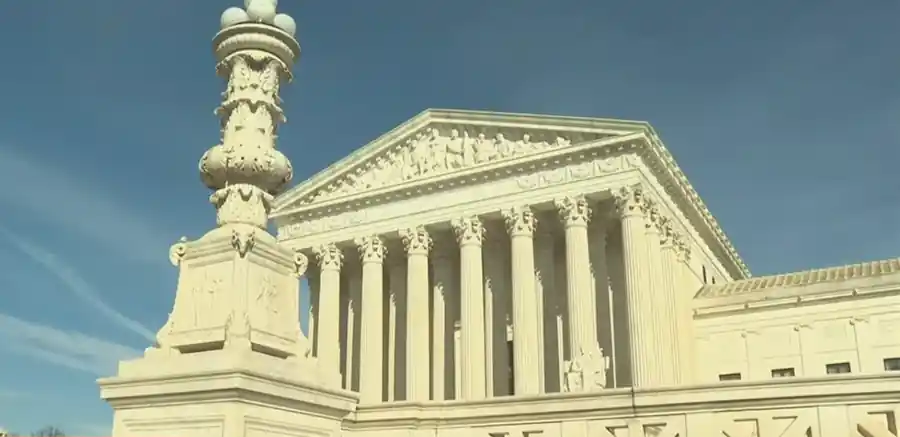
U.S. Supreme Court
U.S. Supreme Court Rules President Cannot Impose Tariffs Without Congress
Trump Tariffs on China, Canada, and Mexico Struck Down by the American Supreme Court
“IEEPA does not authorize the President to impose tariffs. The judgment in No. 24–1287 is vacated, and the case is remanded with instructions to dismiss for lack of jurisdiction; the judgment in No. 25– 250 is affirmed”.
In a landmark decision (6:3) with profound implications for the balance of power between the Legislative and Executive branches, the Supreme Court of the United States has held that the International Emergency Economic Powers Act (IEEPA) does not authorize the President to unilaterally impose tariffs. In the consolidated cases Learning Resources, Inc. v. Trump and Trump v. V.O.S. Selections, Inc., the Court affirmed that the power to levy tariffs—a core component of Congress’s constitutional authority over taxation and revenue—cannot be inferred from the statute’s general grant of authority to “regulate… importation.” This ruling, which strikes down the Trump administration’s imposition of broad-based tariffs on imports from Canada, Mexico, and China (including so-called “drug trafficking” tariffs and “reciprocal” tariffs on trading partners), reinforces the foundational principle that significant economic powers must be explicitly delegated by Congress. The decision is a resounding victory for importers and businesses challenging the tariffs and sets a critical precedent limiting presidential power under emergency statutes.
The dispute arose from two sets of executive actions taken by President Trump in early 2025. Citing an “unusual and extraordinary threat” to national security from the influx of illegal drugs, the President declared a national emergency and imposed a 25% duty on most Canadian and Mexican imports and a 10% duty on Chinese imports. Separately, to address “large and persistent” trade deficits, he declared another emergency and imposed a baseline 10% duty on imports from all trading partners, with higher rates for dozens of nations. The President asserted authority for these sweeping tariffs under Section 1702(a)(1)(B) of IEEPA, which permits the President, during a declared national emergency, to “regulate… importation… of… any property in which any foreign country or a national thereof has any interest.”
Two separate challenges to the tariffs were filed. In Learning Resources, two small businesses sued in the U.S. District Court for the District of Columbia, which granted a preliminary injunction after concluding IEEPA did not authorize the tariffs. In V.O.S. Selections, a group of businesses and 12 states sued in the U.S. Court of International Trade (CIT), which ruled in their favor, a decision affirmed by the Federal Circuit sitting en banc. The Supreme Court granted certiorari before judgment in the D.C. Circuit case and consolidated it with the Federal Circuit case to resolve the critical legal question.
Chief Justice Roberts, delivering the opinion of the Court with respect to Parts I, II-A-1, and II-B, grounded the decision in constitutional first principles. The Court emphasized that Article I, Section 8 of the Constitution vests in Congress the exclusive power “To lay and collect Taxes, Duties, Imposts and Excises.” Tariffs, the Court noted, are “very clear[ly]… a branch of the taxing power.” The Framers, having fought a revolution against “taxation without representation,” gave “Congress alone… access to the pockets of the people,” reserving no part of this power for the Executive Branch during peacetime. The Government conceded this point, relying entirely on IEEPA as its source of authority.
The Court’s textual analysis of IEEPA was dispositive. It observed that the statute grants the President specific powers to “investigate, block… regulate, direct and compel, nullify, void, prevent or prohibit” importation. Notably absent from this list is any mention of “tariffs” or “duties.” The Court found that the power to “regulate… importation” could not fill this void. Relying on dictionary definitions, it stated that “regulate” means to “fix, establish, or control; to adjust by rule… to subject to governing principles or laws.” While broad, this definition does not naturally encompass taxation. The Court highlighted a crucial point: the U.S. Code is replete with statutes granting the Executive the power to “regulate,” yet the Government could not identify a single other instance where that power was understood to include the power to tax. Congress’s own drafting practices confirm this distinction; when it intends to grant tariff authority, it does so with explicit terms like “duty” or “tariff” and, significantly, imposes strict limits on duration, amount, and procedural prerequisites—limits entirely absent in the President’s interpretation of IEEPA.
The Court also applied the “major questions doctrine,” a principle of statutory interpretation requiring “clear congressional authorization” for executive actions of vast “economic and political significance.” The Court found this case to be a quintessential example. The asserted power to impose “unbounded tariffs” of unlimited duration on any product from any country represents a “transformative expansion” of presidential authority. It noted that in IEEPA’s nearly 50-year history, no president had ever invoked it to impose tariffs, a “lack of historical precedent” that is a “telling indication” the power does not exist. The economic stakes, with the Government touting potential impacts in the trillions of dollars, further underscore the need for clear authorization. The Court rejected arguments for a foreign-affairs exception to the doctrine, noting that the Framers explicitly gave the tariff power to “Congress alone” despite its obvious foreign policy implications.
Justice Kagan, joined by Justices Sotomayor and Jackson, concurred in the judgment, agreeing IEEPA does not authorize tariffs, but argued the Court could reach this result using ordinary tools of statutory interpretation without invoking the major questions doctrine. Justice Jackson also filed a separate concurring opinion, emphasizing that the legislative history of IEEPA and its predecessor, the Trading with the Enemy Act (TWEA), confirms Congress intended the “regulate… importation” power to be a tool for freezing foreign assets, not imposing tariffs.
The dissent, authored by Justice Kavanaugh and joined by Justices Thomas and Alito, argued vigorously that the majority’s decision is contrary to text, history, and precedent. The dissent contended that the power to “regulate… importation” has always been understood to include tariffs, citing dictionary definitions, historical practice dating back to the Founding, and early Supreme Court cases like Gibbons v. Ogden. It placed heavy reliance on the 1971 Nixon tariffs, which were upheld under IEEPA’s predecessor statute (TWEA) based on identical language, and on the Court’s 1976 decision in Federal Energy Administration v. Algonquin SNG, Inc., which held that a statute authorizing the President to “adjust the imports” permitted monetary exactions. The dissent argued that because these events occurred just before IEEPA’s enactment in 1977, Congress and the public would have clearly understood the statute to authorize tariffs. It also argued the major questions doctrine should not apply in the foreign affairs context, where Congress historically grants the President broad discretion. Justice Thomas filed a separate dissenting opinion, arguing that the power to impose duties on imports is not part of Congress’s “core legislative power” and is therefore freely delegable to the President without raising nondelegation concerns.
The Supreme Court’s decision has several key practical outcomes. First, it affirms the judgment of the Federal Circuit in V.O.S. Selections, declaring the IEEPA-based tariffs unlawful. Second, it vacates the D.C. district court’s judgment in Learning Resources and remands with instructions to dismiss for lack of jurisdiction, clarifying that challenges to tariff modifications fall under the exclusive jurisdiction of the Court of International Trade. The practical effect is that the billions of dollars collected under these tariffs may be subject to refund, a process acknowledged as potentially complex. Furthermore, the decision casts doubt on the durability of any trade agreements negotiated under the threat of these now-invalidated tariffs. Ultimately, the ruling stands as a powerful defense of congressional prerogative, affirming that the power to tax—including through tariffs—remains firmly with the people’s elected representatives in Congress, and cannot be assumed by the President from vague or general statutory language, even in a declared emergency. The President must now, if he wishes to pursue similar tariffs, navigate the specific procedural and substantive requirements of other trade statutes like Section 232 of the Trade Expansion Act or Section 301 of the Trade Act of 1974.
21st February 2026
Case Meta
February 20, 2026
Learning Resources, Inc. v. Trump (24-1287)
The International Emergency Economic Powers Act, 91 Stat. 1626, does not authorize the President to impose tariffs.
SUPREME COURT OF THE UNITED STATES
LEARNING RESOURCES, INC., ET AL. v. TRUMP,
PRESIDENT OF THE UNITED STATES, ET AL.
CERTIORARI BEFORE JUDGMENT TO THE UNITED STATES
COURT OF APPEALS FOR THE DISTRICT OF COLUMBIA CIRCUIT
No. 24–1287. Argued November 5, 2025—Decided February 20, 2026
Read more
- Ellingburg v. United States: Supreme Court Defines Restitution as Criminal Penalty
- Berk v. Choy (2026): Supreme Court Declines to Enforce Affidavit Requirement in Diversity Cases
- Klein v. Martin (2026): Supreme Court Reaffirms Strict AEDPA Deference in Brady Habeas Cases