Those who knowKnowledge Knowledge is derived from the process of an informed person integrating data from sense organs or intuition into their psyche. This concept is explored in the Vedic Nasadiya Sukta, which questions the possibility of ultimate truth or knowledge. In different languages, such as Greek, Latin, Sanskrit, and Chinese, knowledge is expressed as "η γνώση," "Scientia," "ज्ञानम् ," and "知识 Zhīshì," respectively. what tactics were adopted by some peopleMen Ανθρωποι (People), a woman (γυναίκα), Man (Ανδρας) > Adama, Manu > No proof to establish that due to mutation a monkey turned into a human being. to defeat the course of justiceJustice δικαιοσύνη > judicature ( δικαιοσύνη) > judge (δικαστής / κριτής). The whole purpose of Plato`s Republic is to search for Justice. The purpose of Justice is to establish a perfect State. The State of happiness (ευτυχία) in this Court in this particular case will not be mistaken if they hold the view that, if this Court has erred at all in dealing with these methods, it has done so on the side of leniency.
AIRAIR All India Reporter 1977 SC 69 : (1976) 3 SCCSCC Supreme Court Cases 321
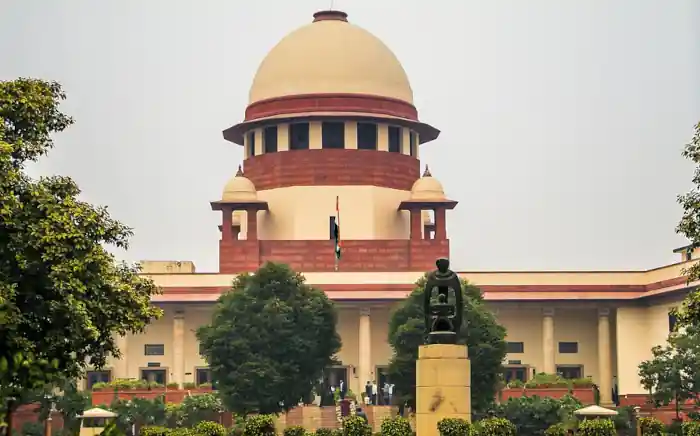
(SUPREME COURT OF INDIAArticle 124 of the Constitution of India Constitution of India > 124. Supreme Court (1) There shall be a Supreme Court of India consisting of a Chief Justice of India and, until Parliament by law prescribes a larger number, of not more than seven other Judges. (2) Every Judge of the Supreme Court shall be appointed by the President by warrant under his hand and seal and shall hold office until he attains the age of sixty-five years: Provided that-- (a) a Judge may, by writing under his hand addressed to the President, resign his office (b) a Judge may be removed from his office in the manner provided in clause (4). (2A) The age of a Judge of the Supreme Court shall be determined by such authority and in such manner as Parliament may by law provide. (3) A person shall not be qualified for appointment as a Judge of the Supreme Court unless he is a citizen of India and-- (a) has been for at least five years a Judge of a High Court or of two or more such Courts in succession; or (b) has been for at least ten years an advocate of a High Court or of two or more such courts in succession; or (c) is, in the opinion of the President, a distinguished jurist. (4) A Judge of the Supreme Court shall not be removed from his office except by an order of the President passed after an address by each House of Parliament supported by a majority of the total membership of that House and by a majority of not less than two-third of the members of the House present and voting has been presented to the President in the same session for such removal on the ground of proved misbehavior or incapacity. (5) Parliament may by law regulate the procedure for the presentation of an address and for the investigation and proof of the misbehavior or incapacity of a Judge under clause (4): (6) Every person appointed to be a Judge of the Supreme Court shall, before he enters upon his office, make and subscribe before the President, or some person appointed in that behalf by him, an oath or affirmation according to the form set out for the purpose in the Third Schedule. (7) No person who has held office as a Judge of the Supreme Court shall plead or act in any court or before any authority within the territory of India.)
Smt. indira Nehru Gandhi
Appellant
Versus
Raj Narain and another
Respondent
(Before : A. N. Ray, C.J.I., H. R. Khanna, K. K. Mathew, M. H. Beg And Y. V. Chandrachud, JJ.)
Civil Appeals Nos. 887 and 909 of 1975, Decided on : 19-12-1975.
Representation of the People Act, 1951—Section 116B(2)—PowerPower The amount of energy transferred or converted per unit of time. In the International System of Units, the unit of it is the watt, equal to one joule per second. The capacity of energy infrastructure is rated using watts, which indicate its potential to supply or consume energy in a given period of time. A Power-plant rated at 100 MW has the potential to produce 100 MWh if it operates for one hour. of judge to stay election judgmentJudgment The statement given by the Judge on the grounds of a decree or order - CPC 2(9). It contains a concise statement of the case, points for determination, the decision thereon, and the reasons for such decision - Order 20 Rule 4(2). Section 354 of CrPC requires that every judgment shall contain points for determination, the decision thereon and the reasons for the decision. Indian Supreme Court Decisions > Law declared by Supreme Court to be binding on all courts (Art 141 Indian Constitution) Civil and judicial authorities to act in aid of the Supreme Court (Art 144) Supreme Court Network On Judiciary – Portal > Denning: “Judges do not speak, as do actors, to please. They do not speak, as do advocates, to persuade. They do not speak, as do historians, to recount the past. They speak to give Judgment. And in their judgments, you will find passages, which are worthy to rank with the greatest literature….” Law Points on Judgment Writing > The judge must write to provide an easy-to-understand analysis of the issues of law and fact which arise for decision. Judgments are primarily meant for those whose cases are decided by judges (State Bank of India and Another Vs Ajay Kumar Sood SC 2022).
Counsel for the Parties:
Mr. Shanti Bhushan, Sr. Advocate, (Mr. J. P. Goyal Advocate with him), for the Petitioner in the Review PetitionReview petition Parsion Devi-vs.-Sumitri Devi, (1997) 8 SCC 715: Under Order 47 Rule 1 CPC a judgment may be open to review inter alia if there is a mistake or an error apparent on the face of the record. An error which is not self-evident and has to be detected by a process of reasoning can hardly be said to be an error apparent on the face of the record justifying the court to exercise its power review. In exercise of the jurisdiction, it is not permissible for an erroneous decision to be "reheard and corrected".
Mr. A. K. Sen, Sr. Advocate, (Mr. J. B. Dadachanji, Advocate with him), for Respondent in the Review Petition.
Judgement
Beg, J—This application purporting to be ‘for review of judgment and/or for clarification and/or expunging of the observations from the judgment’ has been filed under Order 47 of the Supreme CourtSupreme Court The Court of last resort. Supreme Court of India (26/01/1950), Supreme Court of the United States (1798), Supreme Court of UK (1/10/2009), Supreme Court of Canada (1949), International Court of Justice (22/05/1947), > Supreme Court Network Rules which indicates the inherent powers of this Court.
2. The body of the petitionPetition αναφορά > παρακαλώ (Prayer) as well as the prayers made show that the applicant has no grievance against the common conclusions of the five learned Judges of this Court, including myself, who delivered five separate judgments in the election Civil AppealCivil Appeal Vasant Ganesh Damle vs. Shrikant Trimbak Datar (AIR 2002 SC 1237) in the following words: "The appeal is considered to be an extension of the suit because U/S. 107 of the Code of Civil Procedure, the appellate Court has the same powers as are conferred by the Code on Courts of original jurisdiction in respect of suits instituted therein. Such a power can be exercised by the appellate Court "as nearly as may be" exercised by the trial Court under the Code. If the powers conferred upon the trial Court are under a specified statute and not under the Code, it has to be ascertained as to whether such a power was intended to be exercised by the appellate Court as well. Such a position can be ascertained by having a reference to the specified law by keeping in mind the legislative intention of conferment of power on the appellate Court either expressly or by necessary implication." No. 887 of 1975 and the cross appeal No. 909 of 1975, the first by Shrimati Indira Nehru Gandhi and the second by Shri Raj Narain, who were candidates at an election held in Rae Bareli constituency in Uttar PradeshUttar Pradesh Ancient Aryavarta Region (आर्यावर्त) > District Agra Aligarh Ambedkar Nagar Amethi Amroha Auraiya Ayodhya (Saket) Azamgarh Baghpat Bahraich Ballia Balrampur Banda Barabanki Bareilly Basti Bhadohi Bijnor Budaun Bulandshahar Chandauli Chitrakoot Deoria Etah Etawah Farrukhabad Fatehpur Firozabad Gautam Buddha Nagar Ghaziabad Ghazipur Gonda Gorakhpur Hamirpur Hapur Hardoi Hathras Jalaun Jaunpur Jhansi Kannauj Kanpur Dehat Kanpur Nagar Kasganj Kaushambi Kushi Nagar Lakhimpur Kheri Lalitpur Lucknow (Capital) Maharajganj Mahoba Mainpuri Mathura Mau Meerut Mirzapur Moradabad Muzaffar Nagar Pilibhit Pratapgarh Prayagraj Raebareli Rampur Saharanpur Sambhal Sant Kabir Nagar Shahjahanpur Shamli Shravasti Siddharth Nagar Sitapur Sonbhadra Sultanpur Unnao Varanasi in the first week of March, 1971. This petition of the election petitioner sets out the issues framed in the Trial CourtTrial court Court of original Jurisdiction > the court which examines the evidences for the first time.. It then states facts showing that the 39th Amendment of the ConstitutionConstitution The Constitution encompasses the global system of rules governing constitutional authority. Simply reading selected provisions of the written text may be misleading. Understanding the underlying principles, such as federalism, democracy, constitutionalism, the rule of law, and respect for minorities, is crucial. Democratic institutions must allow for ongoing discussion and evolution, reflected in the right of participants to initiate constitutional change. This right entails a reciprocal duty to engage in discussions. Democracy involves more than majority rule, existing within the context of other constitutional values. Therefore, a profound understanding of these principles informs our appreciation of constitutional rights and obligations. Read more as well as some amendments by the Election Laws (Amendment) Act 40 of 1975, were made before the above-mentioned appeals, filed under Section 116A of the Representation of the People Act, 1951 against the same judgment, were taken up for hearing by this Court. Thereafter, the petition gives an account of the hearing of the appeals by this Court in the course of which, after hearing argumentsArguments It is not quarreling. It can be divided into Deductive, inductive, and conductive > Functional includes include: “because”, “since”, “for”, and “as”; typical conclusion indicators include “therefore”, “thus”, “hence”, and “so”. पंच अवयव तर्कः प्रतिज्ञा हेतू उदाहरणम् निगमनम् अवयवाः > premises to conclusion or conclusion to premises to Proof something. Proof is a derivation of a conclusion from premises through a valid argument. on the constitutional amendment, his Lordship the Chief Justice, speakingSpeech 400 million years ago, the larynx was developed and allowed for communication with other animals. 60 million years ago, human beings talked about Dynosure or like animals in India. The vocal tract was in place to support modern human discourse as early as 300,000 years ago in the Indian subcontinent. for this Court, directed the parties to address their arguments on meritsMerits Strict legal rights of the parties; a decision “on the merits” is one that reaches the right(s) of a party as distinguished from a disposition of the case on a ground not reaching the rights raised in the action; for example, in a criminal case double jeopardy does not apply if charges are nolle prossed before trial commences, and in a civil action res judicata does not apply if a previous action was dismissed on a preliminary motion raising a technicality such as improper service of process. as well, as is admitted in paragraph 12 of the petition. The petitioner states that, as one of the learned Judges, Hon’ble Mr. Justice Mathew, indicated, while Mr. A. K. Sen was arguing the appeal No. 887 of 1975 on merits and dealing with facts, that arguments should first be heard on the amendment of the election laws, and, after that, as Hon’ble Mr. Justice Khanna also indicated that arguments on the amendment of election laws should be heard first, the Counsel for the election petitioner understood that he would have to confine his arguments to the validly of these amendments. The petition before us also contains statements showing that, so far as I was concerned, I had indicated to the parties that I regarded consideration of the merits of the case also to be essential for a just and proper decision and disposal of the appeals. Indeed, the direction given by His Lordship the Chief Justice to the parties to address their arguments on merits, after those on the constitutional amendment, necessarily meant, I think, that a consideration of merits could not be separated from questions of validity of the amendments of the election laws.
3. My own recollection of the hearing of the case is that merits, including broad questions of factFact Something तथ्य (In-formation) that truly exists or happens or some-thing that has actual existence. Circumstances: a fact or event that makes a situation the way it is. Indian Evidence Act: It means and includes— (i) anything, state of things, or relation of things, capable of being perceived by the senses; (ii) any mental condition of which any person is conscious. “facts in issue” means and includes any fact from which, either by itself or in connection with other facts, the existence, non-existence, nature or extent of any right, liability or disability, asserted or denied in any suit or proceeding, necessarily follows., were sufficiently gone into to enable us to deal with all questions of lawLaw νόμος: Positive command of sovereign or divine. One can be ruled either by a Statute, a Statue, or a Statement. Legislation is the rule-making process by a political or religious organisation. Physics governs natural law. Logical thinking is a sign of a healthy brain function. Dharma is eternal for Sanatanis. Judiciary > Show me the face, and I will show you the law. Some people know how to bend the law rather than break it. Law Practice. Read a scholarly article emerging out of findings of fact given by the learned Judge and that questions were also put by me to learned Counsel for the election petitioner asking him to justify findings of fact on the only two questions on merits arising for consideration in Civil Appeal No. 887 of 1975. Indeed, it appeared to me that questions of fact and law were very much intertwined. It was for this reason, amongst others, that I had repeatedly tried to draw the attention of Counsel, during the hearing, to these intertwined questions of law and fact with a view to getting their assistance and points of view on these questions.
4. The gravamen of the attack by the learned, Counsel for the election petitioner on the amendments was that “the rules of the game”, as the learned Counsel for the election petitioner called them, had been so altered that the party disqualified at the election, according to the law as it existed when the election petition was filed, became qualified and duly elected. This, it was vehemently urged, was completely destructive of the basis of a “free and fair” election. It was the contention of the learned Counsel for the election petitioner that the respondent in the High CourtHigh Court High Court Judges in England and Wales handle complex and tough cases, sitting in London and traveling to court centers around the country. They preside over serious criminal and important civil cases, and support the Lord and Lady Justices in hearing appeals. High Court Judges are commonly referred to as ‘Mr/Mrs/Ms Justice surname’ and are given the prefix ‘The Honourable’. They are assigned to the King’s Bench Division, the Family Division, or the Chancery Division. The King’s Bench Division focuses on civil wrongs and judicial review, the Family Division deals with family law, and the Chancery Division handles various cases including company law and probate. Judges are appointed through a rigorous process overseen by the Judicial Appointments Commission., being in the advantageous and powerful position of the Prime Minister of the country, supported by a large majority in Parliament, had obtained a change of laws in her favour so as to convert defeat into a victory. It was, therefore, essential for the decision of this issue raised by the learned Counsel for the election petitioner himself to convince us that the case of the election petitioner, according to the laws as they stood at the timeTime χρόνος. Judicial: Where any expression of it occurs in any Rules, or any judgment, order or direction, and whenever the doing or not doing of anything at a certain time of the day or night or during a certain part of the day or night has an effect in law, that time is, unless it is otherwise specifically stated, held to be standard time as used in a particular country or state. (In Physics, time and Space never exist actually-“quantum entanglement”) यमः , पुं, (यमयति नियमयति जीवानां फलाफलमिति । यम् + अच् । विश्वे च कलयत्येव यः सर्व्वायुश्च सन्ततम् । अतीव दुर्निवार्य्यञ्च तं कालं प्रणमाम्यहम् ॥यमैश्च नियमैश्चैव यः करोत्यात्मसंयमम् । स चादृष्ट्वा तु मां याति परं ब्रह्म सनातनम् ॥ when the election was held, was bound to succeed on merits. It was only if it could be shown that the amendments of election laws, by additions to them, had really altered the law, and also that this had the effect of so changing “the rules of the game” (the very words used by the Counsel for the election petitioner) as remove disqualifications actually incurred, that this line of argumentArguments It is not quarreling. It can be divided into Deductive, inductive, and conductive > Functional includes include: “because”, “since”, “for”, and “as”; typical conclusion indicators include “therefore”, “thus”, “hence”, and “so”. पंच अवयव तर्कः प्रतिज्ञा हेतू उदाहरणम् निगमनम् अवयवाः > premises to conclusion or conclusion to premises to Proof something. Proof is a derivation of a conclusion from premises through a valid argument. could possibly succeed. I, at any rate, am unable to understand how this issue, raised by the learned Counsel for the election petitioner himself, could possibly be decided satisfactorily without going into the facts of the case. And, if raised, as it was, it did call for a decision.
5. It is true that my learned brethren did not consider it necessary to go into either the above-mentioned issue or the merits of the case in such depth as I did possibly because of the concession of the learned counsel for the election petitioner that it was unnecessary to consider the merits at all if all the amendments of the election laws were valid and his interpretations of those amendments were not to be accepted. According to the learned Counsel for the election petitioner, his client could not succeed if our view on the validity and meaning of amendments was against his submissions. I, however, not only concluded, in agreementContract An agreement enforceable by law is a contract. All agreements are contracts if they are made by the free consent of parties competent to contract, for a lawful consideration and with a lawful object, and are not hereby expressly declared to be void. Indian Contract Act. with my learned brethren, that the amendments of election laws were valid but reached that conclusion by an alternative route. I found that there was no alteration of the election laws, except in one respect, and, therefore, there could be no question of an alteration of “the rules of the game” to the disadvantage of the election petitioner. Once I had reached this conclusion, it was not possible to avoid considering findings on merits. Learned Counsel for the election petitioner had conceded, no doubt in the interests of his client, that the findings of the learned trial Judge were unsustainable if the amendments were valid and his interpretations of these amendments were rejected. I do not think that I could possibly decide the case on this concession after reaching a conclusion, possibly not anticipated by the learned Counsel for the election petitioner, that the election laws were not really changed except in one respect. I came to the conclusions I reached after considering the findings on merits and the law applicable at the time when the election was held.
6. I do not think that we are required, by any rule of natural justiceNatural justice The rules of natural justice operate in areas not covered by any law. They do not supplant the law of the land but supplement it. They are not embodied rules and their aim is to secure justice or to prevent miscarriage of justice (A. K. Kraipak vs Union of India (1969) 2 SCC 262). Whenever a complaint is made before a Court that some principle of natural justice has been contravened, the Court has to decide whether the observance of that rule was necessary for a just decision on the facts of that case., to intimate to learned Counsel what particular route or reasoning will finally appeal to us or be adopted by us in reaching a particular conclusion in our judgment. All I can say is that if a counsel raises an issue which, in the opinionOpinion A judge's written explanation of a decision of the court. In an appeal, multiple opinions may be written. The court’s ruling comes from a majority of judges and forms the majority opinion. A dissenting opinion disagrees with the majority because of the reasoning and/or the principles of law on which the decision is based. A concurring opinion agrees with the end result of the court but offers further comment possibly because they disagree with how the court reached its conclusion. of any one of us, can only be answered by going into findings of fact, he should anticipate the possibility of such a view. I can also say that I gave enough indication, during the course of arguments, of the course I could and did finally adopt for reasons fully set out in my judgment.
7. The main grievance of the election petitioner before us seems to be that his counsel understood, from the course of the proceedings and observations made by some of us, after the Hon’ble Chief Justice had, on behalf of the whole Court, informed learned Counsel that this Court will hear arguments on merits as well, that such arguments should be confined to questions of law relating to the validity of amendments in election laws and will not touch questions of fact at all so that he did not argue on questions of fact. But, my view was that a decision on question of law relating to the validity of the amendments themselves necessitated consideration of all the findings given and the meanings of the laws applied by the trial Court.
8. It may be difficult for learned Counsel sometimes to anticipate and meet the requirements of every learned Judge of this Court when there are five of us hearing arguments. It is, however, the duty of Counsel who raise issues which may necessitate consideration of questions of fact and law, to satisfy the requirements of any one of us who may be of opinion, as I am, that these issues could not possibly be decided properly without considering findings of fact and the applications of law to them. It is too late now for the learned Counsel to complain that he misunderstood the position despite the efforts made by me to make clear my desire to hear arguments on facts and findings on them. Speaking for myself, I can only say that I could not possibly do full justice in this case and satisfy my conscienceConscience The mind (depending on bio-electricity) can not work without memory and information, but consciousness can. Dreams come from consciousness. Conscience, in its moral sense, is the innate human ability to discern right from wrong and, based on this awareness, to guide, monitor, evaluate, and regulate one’s actions accordingly. Read: Mind is man. without a consideration of all those findings and facts which I felt bound to consider and did consider and decide. That could not be avoided at all after the conclusion I reached – that the amendments did not amend the law except in one respect. The issues, whether the rules of the game were at all altered, and, if so, whether this had the effect of converting a defeat into a victory were raised by the counsel for the election petitioner himself. If, therefore, the findings and the facts of the case were examined by me to a greater extent than a party or his learned Counsel relish, so as to be able to decide these issues, I am unable to do anything about it on a petition such as the one now before us. Learned Counsel had ample opportunity to make all his submissions. If, due to some misapprehension, he failed to make any particular submissions, the case cannot be reopened particularly when nothing which could possibly affect the result is indicated even now.
9. It seems, from the petition now before us, that the greatest concern of the election petitioner and his learned Counsel is not the result of the election petition or the common conclusions reached by all the five learned Judges, with which no fault has been found in this petition, but that the merits of the case, on facts, were examined at all by me. If this is part of a political game, I think that it is high time that; it was realised by everyone that Courts are not meant for political tactics or propaganda. Those who know what tactics were adopted by some people to defeat the course of justice in this Court in this particular case will not be mistaken if they hold the view that, if this Court has erred at all in dealing with these methods, it has done so on the side of leniency. I will not say anything more about this unsavoury aspect of the case here.
10. After having heard arguments of learned Counsel for the election petitioner on the two appeals which definitely involved allegations of misuse of power by the Parliament and by the Prime Minister of this Country, I was rather amazed to hear from learned Counsel arguing the application before us that no question of bona fides or mala fides was raised by him. It may be that the learned Counsel, without using any particular label to describe the issue raised by him, made all the allegations and suggestions necessary to raise it. If he did not mean to argue such an issue seriously I do not think that learned Counsel for the petitioner was justified in taking up so much of this Court’s time in arguing what could be the purpose behind and the effects of the amendments assailed by learned Counsel. I do not think that I could, after the conclusion reached by me, as I have already mentioned above, properly deal with the issues raised by learned Counsel. Whatever be the term employed to describe them, without examining the validity of findings of fact and law on the only two questions involved in Appeal No. 887 of 1975. It became imperative and unavoidable on the view I took. Those who asked for justice got it even though it involved doing some justice to those who did not ask for it. The judicial process does not always produce the expected.
11. Learned Counsel for the election petitioner also seemed to complain that my judgment contained some remarks indicating that he did not discharge his professional duties towards his client satisfactorily. If that is so, I would like to remove this grievance by saying that he discharged his duty towards his client so well that he succeeded in averting a closer and more detailed scrutiny by all of us of the pleadings, the evidenceEvidence All the means by which a matter of fact, the truth of which is submitted for investigation, is established or disproved. Bharatiya Sakshya (Second) Adhiniyam 2023 , and the patently erroneous conclusions of the trial Judge in this case. I think that his client should be thankful for this success of his counsel added to the successful attack on the relevant part of 39th Constitutional Amendment. There is, however, also a duty towards this Court which has to be performed by trying to meet the possible point of view or requirements of every learned Judge hearing the appeals irrespective of whether this suits the party represented by counsel.
12. I was initially inclined even to let learned Counsel for the election petitioner file written arguments on such other questions of law and fact as he may have, due to some misapprehension, failed to place before this Court so that I may consider these also now. But, I have, after giving the matterMatter Normal matter is made of molecules, which are themselves made of atoms. Inside the atoms, electrons are spinning around the nucleus. The nucleus is made of protons and neutrons. Inside the protons and neutrons, exist indivisible quarks, like the electrons. All matter around us is made of elementary particles. ( building blocks of matter > quarks and leptons). All stable matter in the universe is made from particles that belong to the first-generation. Fundamental forces result from the exchange of force-carrier particles, which belong to a broader group called “bosons”. The strong force is carried by the “gluon”, electromagnetic force is carried by the “photon.” further thoughtThinking Human beings began conscious thought as far back as sixty million years ago. By around three hundred thousand years ago, humans inhabiting the Indian subcontinent had developed forms of cognition comparable to those of the modern age, including awareness of competition, defense, and collective security. These early communities were capable of abstract observation, such as counting stars in the night sky, and engaged in reflective discussion about everyday experiences, including the flavors and qualities of food, indicating a sophisticated mental and social life., reached the conclusion that the view of my learned brethren on this matter is correct and must be preferred to my initial desire to give learned Counsel a further opportunity. This view is that no useful purpose could be served by spending more time on this case which has already occupied enough of valuable time of this Court. The contents of the review petition also show that there is nothing overlooked which is worth considering upon any application for review. As already mentioned above, learned Counsel for the election petitioner does not question at all the correctness of the common conclusions of all the learned Judges of the Constitution bench.
13. The application before us seems to be only an explanation of the reasons for which learned Counsel for the election petitioner did not advance more detailed arguments on findings of fact. I am inclined to accept that explanation as bona fide and sufficient for whatever may be the reasons for the learned Counsel’s failure to submit more argument in support of the findings of the trial Court than he did offer in addition to those contained in the judgment under appeal. I am sure that the course adopted by the election petitioner’s learned Counsel has not injured his client’s case or interests at all even if it did not fully succeed in completely warding off a closer scrutiny of the pleadings, the evidence, and the findings of the trial Court than that which was good for the election petitioner’s case. It is undoubtedly a feather in the cap of the learned Counsel, who conducted the case before the High Court also, that a case so flimsy as that of his client succeeded in the High Court. And, I do not think that the election petitioner’s case could have been more skilfully conducted in this Court than it was done by his counsel Mr. Shanti Bhushan.
14. I have, however, closely gone through my judgment again as it had to, for reasons beyond our control, be dictated, typed and cyclostyled in great hury without sufficient opportunity for careful reading and necessary corrections of accidental slips and errors before and after it was cylostyled. I have done so particularly because I found that a numberNumber Αριθμός of typing errors had crept into the cyclostyled copies of my judgment which had to be ordered by me to be correct. I find that there are still two errors left in my judgment which call for correction. The first is at page 11 of my judgment where Section 116A (4) has been mentioned instead of Section 116 B (3) due to some accidental slip or clerical error. Again, at page 23 of my judgment, I find that, while considering the provisions of Section 100 (1) (d) (ii), it has gone down that the provision “postulates:firstly, a corrupt practice which can be committed only by an agentAgent An agent is a person employed to do any act for another or to represent another in dealings with third persons. The person for whom such act is done, or who is so represented, is called the principal. Indian Contract Act:and, secondly, the existence of such an agent.” I think that the first postulate is stated incorrectly by some error. It should be:”firstly, a corrupt practice which is committed only by an agent.” I, therefore, order that my judgment be corrected in these two respects. I am unable to find any other error in the judgment which calls for correction.
15. Subject to the correction in the two respects mentioned above, and the clarifications given above, this application is dismissed.
16. In view of the fact that one of us (Beg, J.) is of the opinion that there is no sufficient ground for reviewing the judgment, this review application is dismissed.