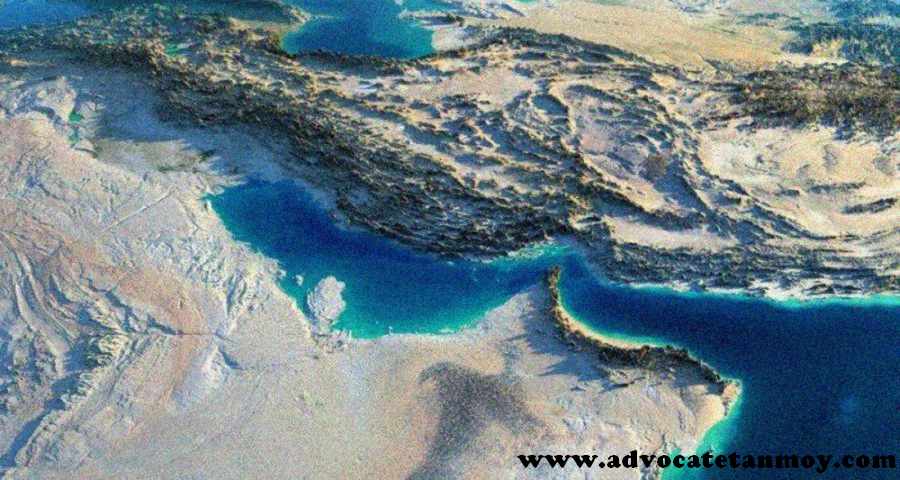
Bilādu ʾl-ʿArab (بلاد العرب), Jazīratu ʾl-ʿArab (جزيرة العرب), ʿArabistān (عربستان). The peninsula bearing, amongst the Arabs, these names is the country situated on the east of the Red Sea, and extending as far as the Persian Gulf.
The word probably signifies a “barren place,” “desert” (Heb. עֲרָבָה).
Ptolemy divides Arabia into three parts, Arabia Petræa, Arabia Felix, and Arabia Deserta; but Arabian geographers divide it into Tiḥāmah, al-Ḥijāz, an-Najd, al-ʿArūz̤, and al-Yaman.
The races which have peopled Arabia are divided into three sections, al-ʿArabu ʾl-Bāʾidah, al-ʿArabu ʾl-ʿĀribah, and al-ʿArabu ʾl-Mustaʿribah.
I. Al-ʿArabu ʾl-Bāʾidah, are the old “lost Arabs,” of whom tradition has preserved the names of several tribes, as well as some memorable particulars regarding their extinction. This may well be called the fabulous period of Arabian history; but, as it has the sanction of the Qurʾān, it would be sacrilege in a Muslim to doubt its authenticity. According to this account, the most famous of the extinct tribes were those of ʿĀd, S̤amūd, Jadīs, and T̤asm, all descended in the third or fourth generation from Shem. ʿĀd, the father of his tribe, settled, according to tradition, in the Great Desert of al-Aḥqāf soon after the confusion of tongues. Shaddād his son succeeded him in the government, and greatly extended his dominions. He performed many fabulous exploits; among others, he erected a magnificent city in the desert of ʿAdan, which had been begun by his father, and adorned it with a sumptuous palace and delightful gardens, in imitation of the celestial paradise, in order to inspire his subjects with a superstitious veneration for him as a god. This superb structure was built with bricks of gold and silver alternately disposed. The roof was of gold, inlaid with precious stones and pearls. The trees and shrubs were of the same precious materials. The fruits and flowers were rubies, and on the branches were perched birds of similar metals, the hollow parts of which were loaded with every species of the richest perfumes, so that every breeze that blew came charged with fragrance from the bills of these golden images. To this paradise he gave the name of Iram (see Qurʾān, Sūrah lxxxix. 6). On the completion of all this grandeur, Shaddād set out with a splendid retinue to admire its beauties. But heaven would not suffer his pride and impiety to go unpunished; for, when within a day’s journey of the place, they were all destroyed by a terrible noise from the clouds. As a monument of Divine justice, the city, we are assured, still stands in the desert, though invisible. Southey, in his Thalaba, has viewed this and many of the other fables and superstitions of the Arabs with the eye of a poet, a philosopher, and an antiquary. According to at̤-T̤abarī, this legendary palace was discovered in the time of Muʿāwiyah, the first K͟halīfah of Damascus, by a person in search of a stray camel. A fanciful tradition adds, that the Angel of death, on being asked whether, in the discharge of his duties, an instance had ever occurred in which he had felt some compassion towards his wretched victims, admitted that only twice had his sympathies been awakened—once towards a shipwrecked infant, which had been exposed on a solitary plank to struggle for existence with the winds and waves, and which he spared; and the second time in cutting off the unhappy Shaddād at the moment when almost within view of the glorious fabric which he had erected at so much expense. No sooner had the angel spoken, than a voice from heaven was heard to declare that the helpless innocent on the plank was no other than Shaddād himself; and that his punishment was a just retribution for his ingratitude to a merciful and kind Providence, which had not only saved his life, but raised him to unrivalled wealth and splendour. The whole fable seems to be a confused tradition of Belus and the ancient Babylon; or, rather, as the name would import, of Benhadad, mentioned in Scripture as one of the most famous of the Syrian kings, who, we are told, was worshipped by his subjects.
Of the ʿĀdites and their succeeding princes, nothing certain is known, except that they were dispersed or destroyed in the course of a few centuries by the sovereigns of al-Yaman.
The tribe of S̤amūd first settled in Arabia Felix, and on their expulsion they repaired to al-Ḥijr, on the confines of Syria. Like the ʿĀdites, they are reported to have been of a most gigantic stature, the tallest being a hundred cubits high and the least sixty; and such was their muscular power, that, with a stamp of the foot in the driest soil, they could plant themselves knee-deep in the earth. They dwelt, the Qurʾān informs us, “in the caves of the rocks, and cut the mountains into houses, which remain to this day.” In this tribe it is easy to discover the Thamudeni of Diodorus, Pliny, and Ptolemy.
The tribes of T̤asm and Jadīs settled between Makkah and al-Madīnah, and occupied the whole level country of al-Yaman, living promiscuously under the same government. Their history is buried in darkness; and when the Arabs wish to denote anything of dubious authority, they call it a fable of T̤asm.
The extinction of these tribes, according to the Qurʾān, was miraculous, and a signal example of Divine vengeance. The posterity of ʿĀd and S̤amūd had abandoned the worship of the true God, and lapsed into incorrigible idolatry. They had been chastised with a three years’ drought, but their hearts remained hardened. To the former was sent the Prophet Hūd, to reclaim them and preach the unity of the Godhead. “O my people!” exclaimed the prophet, “ask pardon of your Lord; then turn unto Him with penitence, (and) He will send down the heavens upon you with copious rains, and with strength in addition to your strength will He increase you.” Few believed, and the overthrow of the idolaters was effected by a hot and suffocating wind, that blew seven nights and eight days without intermission, accompanied with a terrible earthquake, by which their idols were broken to pieces, and their houses thrown to the ground. (See Qurʾān, Sūrah vii. 63, xi. 53.) Luqmān, who, according to some, was a famous king of the ʿĀdites, and who lived to the age of seven eagles, escaped, with about sixty others, the common calamity. These few survivors gave rise to a tribe called the Latter ʿĀd; but on account of their crimes they were transformed, as the Qurʾān states, into asses or monkeys. Hūd returned to Ḥaẓramaut, and was buried in the neighbourhood, where a small town, Qabr Hūd, still bears his name. Among the Arabs, ʿĀd expresses the same remote age that Saturn or Ogyges did among the Greeks; anything of extreme antiquity is said to be “as old as King ʿĀd.”
The idolatrous tribe of S̤amūd had the prophet Ṣāliḥ sent to them, whom D’Herbelot makes the son of Arphaxad, while Bochart and Sale suppose him to be Peleg, the brother of Joktan. His preaching had little effect. The fate of the ʿĀdites, instead of being a warning, only set them to dig caverns in the rocks, where they hoped to escape the vengeance of winds and tempests. Others demanded a sign from the prophet in token of his mission. As a condition of their belief, they challenged him to a trial of power, similar to what took place between Elijah and the priests of Baal, and promised to follow the deity that should gain the triumph. From a certain rock a camel big with young was to come forth in their presence. The idolaters were foiled; for on Ṣāliḥ’s pointing to the spot, a she-camel was produced, with a young one ready weaned. This miracle wrought conviction in a few; but the rest, far from believing, hamstrung the mother, killed her miraculous progeny, and divided the flesh among them. This act of impiety sealed their doom. “And a violent tempest overtook the wicked, and they were found prostrate on their breasts in their abodes.” (Qurʾān, Sūrah vii. 71, xi. 64.)
The tribes of Jadīs and T̤asm owe their extinction to a different cause. A certain despot, a T̤asmite, but sovereign of both tribes, had rendered himself detested by a voluptuous law claiming for himself a priority of right over all the brides of the Jadīsites. This insult was not to be tolerated. A conspiracy was formed. The king and his chiefs were invited to an entertainment. The avengers had privately hidden their swords in the sand, and in the moment of mirth and festivity they fell upon the tyrant and his retinue, and finally extirpated the greater part of his subjects.
II.—The pure Arabs are those who claim to be descended from Joktan or Qaḥt̤ān, whom the present Arabs regard as their principal founder. The members of this genuine stock are styled al-ʿArabu ʾl-ʿĀribah, the genuine Arabs. According to their genealogy of this patriarch, his descendants formed two distinct branches. Yaʿrub, one of his sons, founded the kingdom of al-Yaman, and Jurhum that of al-Ḥijāz. These two are the only sons spoken of by the Arabs. Their names do not occur in Scripture; but it has been conjectured that they were the Jerah and Hadoram mentioned by Moses as among the thirteen planters of Arabia (Gen. x. 26).
In the division of their nation into tribes the Arabs resemble the Jews. From an early era they have retained the distinction of separate and independent families. This partition was adverse to the consolidation of power or political influence, but it furnishes our chief guide into the dark abyss of their antiquities. The posterity of Yaʿrub spread and multiplied into innumerable clans. New accessions rendered new subdivisions necessary. In the genealogical tables of Sale, Gagnier, and Saiyid Aḥmad K͟hān, are enumerated nearly three-score tribes of genuine Arabs, many of whom became celebrated long before the time of Muḥammad, and some of them retain their names even at the present day.
III.—The ʿArabu ʾl-Mustaʿribah, the mixed Arabs, claim to be descended from Ishmael and the daughter of al-Muẓāẓ, King of al-Ḥijāz, whom he took to wife, and was of the ninth generation from Jurhum, the founder of that kingdom. Of the Jurhumites, till the time of Ishmael, little is recorded, except the names of their princes or chiefs, and that they had possession of the territory of al-Ḥijāz. But as Muḥammad traces his descent to this alliance, the Arabs have been more than usually careful to preserve and adorn his genealogy. The want of a pure ancestry is, in their estimation, more than compensated by the dignity of so sacred a connexion; for they boast as much as the Jews of being reckoned the children of Abraham. This circumstance will account for the preference with which they uniformly regard this branch of their pedigree, and for the many romantic legends they have grafted upon it. It is not improbable that the old giants and idolaters suffered an imaginary extinction to make way for a more favoured race, and that Divine chastisements always overtook those who dared to invade their consecrated territories.
The Scripture account of the expulsion and destiny of this venerated progenitor of the Arabs is brief, but simple and affecting. Ishmael was the son of Abraham by Hagar, an Egyptian slave. When fourteen years of age, he was supplanted in the hopes and affections of his father by the birth of Isaac, [19]through whom the promises were to descend. This event made it necessary to remove the unhappy female and her child, who were accordingly sent forth to seek their fortune in some of the surrounding unoccupied districts. A small supply of provisions, and a bottle of water on her shoulder, was all she carried from the tent of her master. Directing her steps towards her native country, she wandered with the lad in the wilderness of Beer-sheba, which was destitute of springs. Here her stock failed, and it seemed impossible to avoid perishing by hunger or thirst. She resigned herself to her melancholy prospects, but the feelings of the mother were more acute than the agonies of want and despair. Unable to witness her son’s death, she laid him under one of the shrubs, took an affecting leave of him, and retired to a distance. “And she went, and sat her down over against him, a good way off, as it were a bow-shot; for she said, Let me not see the death of the child. And she sat over against him, and lifted up her voice and wept.” (Gen. xxi. 16.) At this moment an angel directed her to a well of water close at hand,—a discovery to which they owed the preservation of their lives. A promise formerly given was renewed, that Ishmael was to become a great nation—that he was to be a wild man—his hand against every man, and every man’s hand against him. The travellers continued their journey to the wilderness of Paran, and there took up their residence. In due time the lad grew to manhood, and greatly distinguished himself as an archer, and his mother took him a wife out of her own land. Here the sacred narrative breaks off abruptly, the main object of Moses being to follow the history of Abraham’s descendants through the line of Isaac. The Arabs, in their version of Ishmael’s history, have mixed a great deal of romance with the narrative of Scripture. They assert that al-Ḥijāz was the district where he settled, and that Makkah, then an arid wilderness, was the identical spot where his life was providentially saved, and where Hagar died and was buried. The well pointed out by the angel, they believe to be the famous Zamzam, of which all pious Muslims drink to this day. They make no allusion to his alliance with the Egyptian woman, by whom he had twelve sons (Gen. xxv. 12–18), the chiefs of as many nations, and the possessors of separate towns; but as polygamy was common in his age and country, it is not improbable he may have had more wives than one.
It was, say they, to commemorate the miraculous preservation of Ishmael that God commanded Abraham to build the Kaʿbah, and his son to furnish the necessary materials.
Muḥammadan writers give the following account of Ishmael and his descendants:—Ishmael was constituted the prince and first high-priest of Makkah, and, during half a century he preached to the incredulous Arabs. At his death, which happened forty-eight years after that of Abraham, and in the 137th of his age, he was buried in the tomb of his mother Hagar. Between the erection of the Kaʿbah and the birth of their Prophet, the Arabs reckon about 2,740 years. Ishmael was succeeded in the regal and sacerdotal office by his eldest son Nebat, although the pedigree of Muḥammad is traced from Kedar, a younger brother. But his family did not long enjoy this double authority; for, in progress of time, the Jurhumites seized the government and the guardianship of the temple, which they maintained about 300 years. These last, again, having corrupted the true worship, were assailed, as a punishment of their crimes, first by the scimitars of the Ishmaelites, who drove them from Makkah, and then by divers maladies, by which the whole race finally perished. Before quitting Makkah, however, they committed every kind of sacrilege and indignity. They filled up the Zamzam well, after having thrown into it the treasures and sacred utensils of the temple, the black stone, the swords and cuirasses of Qalaʿah, the two golden gazelles presented by one of the kings of Arabia, the sacred image of the ram substituted for Isaac, and all the precious movables, forming at once the object and the workmanship of a superstitious devotion. For several centuries the posterity of Ishmael kept possession of the supreme dignity.
The following is the list of chiefs who are said to have ruled the Ḥijāz, and to have been the lineal ancestors of Muḥammad, as far as ʿAdnān:—
a.d. 538 ʿAbdu ʾllāh, the father of Muḥammad.
505 ʿAbdu ʾl-Mut̤t̤alib.
472 Hāshim.
439 ʿAbd Manāf.
406 Quṣaiy.
373 Kilāb.
340 Murrah.
307 Kaʿab.
274 Luwaiy.
241 Ghālib.
208 Fihr or Quraish.
175 Mālik.
142 an-Naẓr.
109 Kinānah.
76 Khuzaimah.
43 Mudrikah.
10 al-Yaʾs.
b.c. 23 Muẓar.
56 Nizār.
89 Maʿadd.
122 ʿAdnān.
The period between Ishmael and ʿAdnān is variously estimated, some reckoning forty, others only seven, generations. The authority of Abū ʾl-Fidāʾ, who makes it ten, is that generally followed by the Arabs, being founded on a tradition of one of Muḥammad’s wives. Making every allowance, however, for patriarchal longevity, even forty generations are insufficient to extend over a space of nearly 2,500 years. From ʿAdnān to Muḥammad the genealogy is considered certain, comprehending twenty-one generations, and nearly [20]160 different tribes, all branching off from the same parent stem.