Summary: Narendra Modi recently began his third term as Prime Minister of India, accompanied by a team of 70 ministers, including 35 cabinet ministers. The BJP secured a coalition government after the 2024 General Election. However, the cabinet has been noted for its absence of Muslim representation, prompting concerns about inclusivity. This issue underscores the complexity of addressing diverse demographic and religious groups in India. Achieving a balanced and inclusive government requires understanding and involving all voices in decision-making. The BJP’s approach to Muslim voters and policies under Modi’s leadership has sparked differing viewpoints within the party, emphasizing the need for open dialogue and inclusive decision-making processes.
Narendra Modi’s Third Term: Challenges of Inclusivity and Representation
Total 71 Ministers
Tally: 35 Cabinet Ministers, 36 Ministers of State, and 5 Ministers of State (independent charge)
Narendra Modi’s Third Term as Prime Minister with 70 Other Ministers
Narendra Modi took the oath of office from the President of India, Smt. Draupadi Murmu for the third time as the Prime Minister of India, along with a team of 70 ministers, including 35 cabinet ministers. In the 2024 General Election, the BJP secured 240 seats, falling short of a single-party majority. However, the NDA secured a clear majority, allowing them to form a coalition government for a third consecutive tenure.
Narendra Modi’s Third Term with 70 Ministers: 35 Cabinet Ministers, 36 State Ministers
The following Press Communique was issued by the office of the President, who notified the names of the ministers in the Modi-led NDA Government.
RASHTRAPATI BHAVAN
PRESS COMMUNIQUE
The President of India has appointed Shri Narendra Damodardas Modi as the Prime Minister of India. Further, as advised by the Prime Minister, the President has appointed the following as members of the Council of Ministers:-
Cabinet Ministers
- Shri Raj Nath Singh
- Shri Amit Shah
- Shri Nitin Jairam Gadkari
- Shri Jagat Prakash Nadda
- Shri Shivraj Singh Chouhan
- Smt. Nirmala Sitharaman
- Dr. Subrahmanyam Jaishankar
- Shri Manohar Lal
- Shri H. D. Kumaraswamy
- Shri Piyush Goyal
- Shri Dharmendra Pradhan
- Shri Jitan Ram Manjhi
- Shri Rajiv Ranjan Singh alias Lalan Singh
- Shri Sarbananda Sonowal
- Dr. Virendra Kumar
- Shri Kinjarapu Rammohan Naidu
- Shri Pralhad Joshi
- Shri Jual Oram
- Shri Giriraj Singh
- Shri Ashwini Vaishnaw
- Shri Jyotiraditya M. Scindia
- Shri Bhupender Yadav
- Shri Gajendra Singh Shekhawat
- Smt. Annpurna Devi
- Shri Kiren Rijiju
- Shri Hardeep Singh Puri
- Dr. Mansukh Mandaviya
- Shri G. Kishan Reddy
- Shri Chirag Paswan
- Shri C R Patil
Ministers of State (Independent Charge)
- Rao Inderjit Singh
- Dr. Jitendra Singh
- Shri Arjun Ram Meghwal
- Shri Jadhav Prataprao Ganpatrao
- Shri Jayant Chaudhary
Ministers of State
- Shri Jitin Prasada
- Shri Shripad Yesso Naik
- Shri Pankaj Chaudhary
- Shri Krishan Pal
- Shri Ramdas Athawale
- Shri Ram Nath Thakur
- Shri Nityanand Rai
- Smt. Anupriya Patel
- Shri V. Somanna
- Dr. Chandra Sekhar Pemmasani
- Prof. S. P. Singh Baghel
- Sushri Sobha Karandlaje
- Shri Kirtivardhan Singh
- Shri B. L. Verma
- Shri Shantanu Thakur
- Shri Suresh Gopi
- Dr. L. Murugan
- Shri Ajay Tamta
- Shri Bandi Sanjay Kumar
- Shri Kamlesh Paswan
- Shri Bhagirath Choudhary
- Shri Satish Chandra Dubey
- Shri Sanjay Seth
- Shri Ravneet Singh
- Shri Durgadas Uikey
- Smt. Raksha Nikhil Khadse
- Shri Sukanta Majumdar
- Smt. Savitri Thakur
- Shri Tokhan Sahu
- Shri Raj Bhushan Choudhary
- Shri Bhupathi Raju Srinivasa Varma
- Shri Harsh Malhotra
- Smt. Nimuben Jayantibhai Bambhaniya
- Shri Murlidhar Mohol
- Shri George Kurian
- Shri Pabitra Margherita
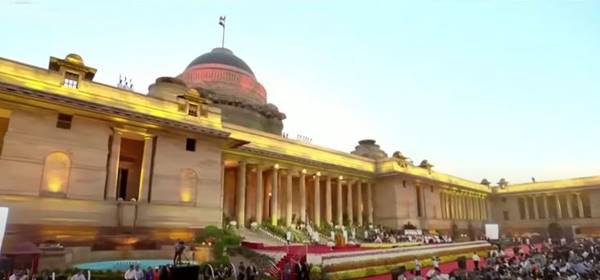
The President administered the Oaths of Office and Secrecy to the above Members of the Council of Ministers at a ceremony held in the Rashtrapati Bhavan, today (09.06.2024).
For immediate release.
(Ajay Kumar Singh)
Press Secretary to the President
09.06.2024
Modi’s Governance and Equitable Representation: Insights into New Cabinet Dynamics
It’s important to note that the political landscape in India is influenced by a complex array of factors, including religious, cultural, and regional dynamics. The role of different voter groups including Muslims and their representation in governance is a multifaceted issue that should be approached with sensitivity and a comprehensive understanding of the country’s political context.
The composition of the new cabinet indeed reflects an absence of Muslim representation, raising questions about inclusivity in the government. It’s essential for the leadership to address these concerns and strive for a balanced and inclusive approach, in line with Modi`s “Sabka Saath, Sabka Vikas” philosophy, to ensure the equitable representation and participation of all communities in the governance and decision-making processes. Achieving an inclusive and representative government requires a nuanced understanding of the diverse demographics and ensuring that all voices are heard and considered in the political landscape.
Modi may likely have now abandoned his old ‘Sabkasath’ slogun. Muslims got free Rations, Housing, Bank loans, and subsidised gas cylinders, till they never voted for the BJP. BJP lost the election in Uttar Pradesh, Rajasthan and West Bengal. Muslims failed to cast a single vote for BJP in those States. BJP`s Rastrabadi Mulim Cadres failed to garner Muslim votes in general.
Last five years Modi tried to uplift the Pasmanda Muslims in India and tried to address their issues equitably, it appeared for the time being that a section of Muslims are with the Bharatiya Janata Party, especially the Muslim women after getting security in the form of Triple Talaque Act. Support of the Muslim women was visible in TV debates and Social Media.
It seems that there are contrasting viewpoints within the BJP regarding the approach towards Muslim voters and the policies implemented under Narendra Modi’s leadership. The Citizenship Amendment Law has sparked significant debate and differing opinions, reflecting the complexity of addressing the needs and concerns of various demographic and religious groups within India. This diverse range of perspectives highlights the importance of fostering open dialogue and inclusive decision-making processes within the party, particularly on sensitive issues that impact the nation’s social fabric and inclusive politics.
It’s important to acknowledge that the composition of the new cabinet indeed reflects an absence of Muslim representation. This raises questions about inclusivity in the government and its approach towards diverse voter groups. Ensuring equitable representation and participation of all communities in the governance and decision-making processes is vital for maintaining an inclusive representative democracy. Open dialogue and inclusive decision-making processes are essential for fostering a balanced and representative government.
By Tanmoy Bhattacharyya
Monday, 10th June 2024
Read more:
18th Lok Sabha Elections 2024: Voter Turnout and Party Performance