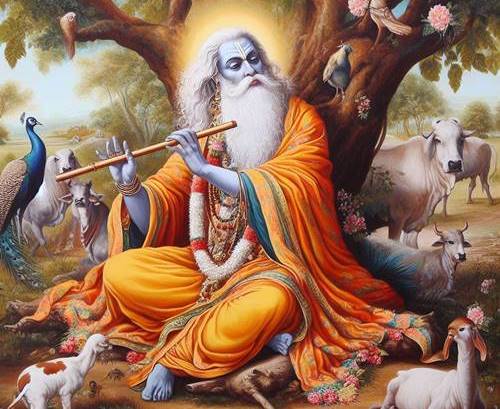
Sanskrit Heritage: Krishna Vasudeva of Vrishni clan at the age of 125 (3102 BCE)
भविष्य पर्व
Read also: Bharata Savitri: Supplement to Harivamsha
Bhavishya Parva (On future)
English translation of Harivamsha Purana
EDITED AND PUBLISHED BY
MANMATHA NATH DUTT, M.A., M.R.A.S.,
RECTOR, KESHUB ACADEMY;
Author of the English Translations of Ramayana, Mahabharata,
Srinadbhagavatam, Vishnupuran, Markandeyapuran,
Bhagavad Gita and many other works.
Writers like Charles-François Dupuis and Comte De Volney (1757–1820) have even gone the length of arguing in their respective works that the history of life and miracles of Christ have been borrowed from those of Indian Krishna.
Read: Harivamsa Purana of Acharya Jinasen (783 CE)
1897
Harivamsa Parva (Book-1)
Vishnu Parva (Book-2)
Bhavishya Parva (Book-3)
Harivamsha (हरिवंश) of Vayasa
Salutation unto Ganesha.
Salutation unto Veda Vyasa. Having saluted Nārāyana and the best of male beings Nara as well as the goddess of learning Saraswati let us utter Jaya (Victory)
Janamejaya’s Family
1-2. Shounaka said:—O son of Lomaharshana, who are the sons of Janamejaya? And by whom the family of Pandavas was founded? I have been stricken with curiosity to hear this history. I wish therefore to learn every detail about it as you have said.
3-4. Sauti said:—Parikshit’s son Janamejaya begat on his wife Kashya two sons, the king Candrapida and Suryapida who was conversant with the knowledge of emancipation. By performing works befitting the Kshatriyas, the hundred sons of Candrapida, who were all clever archers, acquired celebrity on earth under the appellation of Janamejayas.
5-6. Of them the eldest Satyakarana of long arms, the performer of many sacrifices accompanied with profuse gifts, was installed on the throne of Hastinapur. Satyakarna’s son the virtuous and powerful Svetakarna had no issue and he therefore entered into woods with his spouse.
7-8. The beautiful Yadu princess Malini, of fair eye-brows, conceived through the forest-ranging Svetakarna. Just in the beginning of this conception the patriarch Svetakarna entered like his forefathers into the woods for good.
9-11. Beholding her husband retire into forest, Malini, who was quick with a child, followed him, and on the way gave birth to a son having eyes like lotus petals. As Draupadi followed her husbands in the days of yore so the chaste and noble Malini followed her consort leaving the newborn baby behind. While that tender baby, divorced from his mother, was crying in the mountain cave, some cranes, stricken with compassion for the great prince, came there.
12-14. Seeing that crying prince Shravistha’s sons the Rishis Paippaladi and Kaushika felt compassion and took him up. They then washed with water his two sides which were bruised against the rock and covered with blood. The sides of the prince were dark blue like those of a goat and were high and well-formed. He therefore passed by the name of Ajaparsha. Thereupon those two foremost of the twice-born (Paippaladi and Kaushika) named him Ajaparsha and brought him up in the house of a Rishi named Vemaka.
15-16. Vemaka’s wife brought up Ajaparsha as her son, so he became Vemaka’s son and those two Brahmanas became his councillors. Ajaparsha and the sons and grandsons of Paippaladi and Kaushika lived the same life. This Ajaparsha, born in the race of Puru, founded the family of the Pandavas.
17-18. Formerly while transferring his decrepitude Nashusha’s son the intelligent Yayati sang this verse: “Earth will forsooth be divested of the sun, moon and planets but she will never be shorn of the Purus.”
Parikshit’s son Janamejaya’s Sarpamedha Yagna
1-3. Saunaka said:—I have thus recited to you the entire Harivamsha with all its Parvas as recounted by Vyasa’s disciple. May this endless history of Hari’s family, nectar-like and destructive of all sins, please us. O you endued with patience, because this history is pleasant to ears it has greatly gladdened our hearts. Afterwards, O Sauti, what did the king Janamejaya do on the termination of the Sarpayajna after listening to this most excellent history?
4-6. Sauti said:—Hear, I will describe to you all what the king Janamejaya did listening to this most excellent history after the termination of the Sarpayajna. When this sacrifice was finished Parikshit’s son Janamejaya collected materials for the celebration of a horse-sacrifice. Then inviting the Ritwikas, priests and preceptors he said:—”I am desirous of celebrating a horse-sacrifice. Do you dedicate these horses”.
7-10. Thereupon informed of the object of Parikshit’s son Janamejaya, of indefatigable energy, the virtuous-souled Krishna Dvaipayana, the foremost of the omniscient, all on sudden came there for witnessing (the sacrifice). Beholding the great Rishi Veda-Vyasa arrive there the king Janamejaya offered him Arghya, a seat and water for washing his feet according to the rules laid down in Sastras. O Shounaka, after they had both taken their seats the courtiers, from all sides, began to discourse on diverse Vedic themes. After they had finished their discourses, king Janamejaya said to the great Muni Veda-Vysa, the grand-father of the Pandavas and his own great grand-father:—”
11-23. The story of the Mahabharata, having many meanings and abounding in Srutis, is exceedingly pleasant to ears. It was finished as if in a moment. The history, which spreads glories and gives fame like unto milk in a conch shell, has been beautifully recorded by you. As a man is not satisfied with ambrosia and bliss of heaven, so I am not with listening to the stories of the Mahabharata. You are omniscient, O Brahman and therefore I accost you whether Rajasuya was not the cause of the destruction of the Kurus. It appears to me that as many unconquerable kings meet with death at the time of revolution so the Rajasuya Yajna was ordained for battle. I have heard that when this Rajasuya was undertaken by Soma it was followed by the war of which Taraka was the root. Afterwards, when Varuna undertook this great sacrifice it was followed by the war between gods and Asuras. When the royal saint Harishcandra undertook this sacrifice it was followed by the battle of Adivaka in which many Kshatriyas were killed. Last of all when the worshipful Pandavas undertook this most arduous sacrifice it was followed by the great Bharata war. O great sir, why did you not all put a stop to that Rajasuya Yajna the root of the world-destroying war? It is difficult to celebrate this sacrifice well with all its branches. When one of the branches of a sacrifice is neglected it leads to the destruction of people. You are the grandfather of our ancestors, their first lord and art cognizant of the past and future. Thyself living as their guide why did those intelligent kings, as if having none to govern them, and deviating from the paths of morality, commit sin?”.
24-32. Vyasa said:—O king, forsooth urged on by Destiny those kings acted against the established usages and customs. They did not ask me any thing about the future. And, I too did not tell them any thing unasked. Besides I was not capable of counteracting the future result, for none can with stand the work of Destiny. I will describe to you the future subject about which you have questioned me. But Destiny is now very powerful. And even listening to my words you will not be able to carry them out. Either through fear or zeal you will not be able to stand in the ways of a man for it is impossible to overcome predestination. The Sruti lays down that the Kshatriyas should celebrate Ashvamedha, the foremost of sacrifices. On account of the greatness of that sacrifice Vasava will violate your Ashvamedha. O king, even if you are capable of withstanding Vasava either by your manliness or through the will of the Providence you should not celebrate such a sacrifice. However you, Sakra, or the presiding priests will commit no sin thereby for Destiny is all-powerful. Ordained by Destiny Brahma will obstruct the termination of Indra’s sacrifice. In the course of time and according to the will of the Providence creation will come to an end with the termination of a cycle and the Brahmanas will sell the fruits of sacrifices. Therefore know this universe mobile and immobile, as being subject to Destiny.
33-Janamejaya said:—O reverend sir, tell me, what cause will arrive for putting a stop to the horse-sacrifice. Hearing it I will desist.
34-35. Vyasa said:—O king, the cause thereof will be the ireful curse of a Brahmana. You may fare well if you try to avoid it. O slayer of enemies, as long as the world will last, the Kshatriyas will not be able to collect materials for your horse-sacrifice.
36-38. Janamejaya said:—Asvamedha will be stopped by the power of the fiery curse of a Brahmana, but I will be the instrument thereof. Indeed I am filled with fear and shame. How will a man like myself, the performer of many good deeds, like unto a bird, tied with a noose, flying into the sky, engage in such a cursed work, and exert to live? If I engage in such a work, through me a rite, practised from generation to generation, will be spoiled. Console me, saying that the horse-sacrifice will again be undertaken (by kings).
39-45. Vyasa said:—As an energy, counteracted by another, lives in it, so the Asvamedha sacrifice, although stopped, will exist in the gods and Brahmanas. Leading the life of a soldier, some descendants of Kashyapa will again revive this horse-sacrifice in the Kali-Yuga. O king, as the hour of universal dissolution brings into being many evil portends such as white planets so a Brahmana, born in his race, will revive this sacrifice in the cycle of Kali. This sacrifice will bestow proper fruits on men celebrating it and they will range at the gate of the end of the cycle encircled by the Rishis. From that time the senses of men will not renounce the fruits of the pristine good works and will not be attached to them in this world. A highly subtle religion, deviating from the duties of the four orders, and having charity at its root only, the offspring of the time, will flourish. Practising austerities to a small extent men, O Janamejaya, at the end of this cycle will acquire spiritual powers. Thus blessed they will practise pious rites.
Kali-yuga Description
1-2. Janamejaya said:—I do not know whether the time for Moksha (emancipation) is distant or near. Therefore I wish to know about the cycle of Kali which has followed Dvapara struck with the arrows of virtue and sin. With deeds easily performed we will acquire virtue. Stricken with this desire we have been born in this Kali-yuga.
3-Shounaka said “O you conversant with religion the cycle of Kali, a source of trouble to the creatures and the destruction of virtue, is about to set in. Do you therefore describe it with its characteristics”.
4-Shouti said:—Thus accosted the Divine Vyasa accurately thought of the condition of men in the Kali-yuga and began to describe the future cycle.
5-15. Vyasa said:—When Kali will set in the kings, incapable of protecting their subjects, will only guard themselves busily exacting tributes from them. At the end of this cycle the kings will not act like the Kshatriyas, the Brahmanas will carry on their livelihood like the Sudras and the Sudras will behave like the Brahmanas. O Janamejaya, at the end of this cycle the Brahmanas, well read in Srutis and Vedas, will take up arrows and Havi will be divorced from sacrifices and all people will take their meals in the same row. When the last of the cycles Kali will appear men will be artizans, untruthful, fond of wine and meat and know the wives of their friends. In the Kali Yuga the thieves will fare like the kings and the kings will act like thieves and the servants will enjoy unfixed incomes. In the last cycle wealth will be spoken of highly, the character of the pious will be despised and the fallen will not be censured. The widows, divorced from the consciousness of virtue and sin, the ascetics and men of fifteen years of age will procreate offspring through promiscuous intercourse. In that last cycle the villagers will sell food, the Brahmanas will sell the Vedas, and the women will sell their persons. In this cycle all will read the Vedas and celebrate Vajasaneyi sacrifices and the Sudras will (boldly) address all as “O”. The Sudras following the tenets of Buddha will abstain from taking meat. And with white teeth, keen observation and shaving their heads and wearing silk raiments they will practise religion.
16-22. The Mlecchas will live in the province of Kurupancala and people of that country will live in that of the former. In the end of the cycle men will go downwards. The Brahmanas will sell the fruits of Tapas and sacrifices and the seasons will be perverted. The beasts, with tusks and teeth, will be set to ploughs and carts: men will till with the water of ponds and the clouds will irregularly discharge their contents. The thieves will steal the wealth of one another and wretched men will be rich acquiring very little money. In this last cycle men will be divorced from religious rites, the divisions of the land will abound in deserts, and the cities will be traversed by many roads. In the Kali-yuga everybody will become a merchant and the sons will divide the ancestral gifts. Impelled by covetousness and false-hood people will fight with one another and rob their wealth. In the absence of beauty, personal grace and ornaments the women will be only adorned with hairs.
22-23. In this last cycle, men, divorced from all objects of enjoyment, as garlands, sandal, etc., will find pleasure only in their wives.
24-29. When the wicked and non-aryans will multiply, when the number of males will decrease, and dis-proportionate to it that of women will increase know this as the real sign of the end of the cycle. Then everybody will be a beggar: and no one will give alms. Without distinction people will accept gifts from other Varnas (orders), And afflicted by the king, thieves and fire, people will meet with extinction. In this last cycle people will not get crops, youthful persons will be visited by decrepitude and people will be unhappy for their bad ambition. Blowing high and downwards the wind will shower dust in the rany season and people will feel doubts about the next world. Everyone will be wicked by nature, will villify the God and be egoistic: being covetous the Brahmanas will blame others. Adopting the ways of the Vaishyas the Kshatriyas will maintain themselves by cultivation and trade and the Brahmanas will destroy the dignity of religion.
30-34. At the end of the cycle men will not observe their vows and promise. And what to speak of their satisfying their own debts, they will, for it, even cast off courtesy. Fruitless will be a man’s joy and fruitful will be his anger. For milk the sheep will be regarded. In the end of the cycle, men, shorn of the knowledge of scriptures, will naturally behave thus. Disregarding moral laws, men, proud of their learning, will interpret the Sastras. When the last cycle will set in everyone, without the instruction of their elders, will acquire knowledge in all branches and there will be no one who will not be a poet. Deviating from their right duties the Brahmanas will turn out astrologers and the kings will become thieves.
35-43. In the end of the cycle those men, who will co-habit with bastard women, be deceiptful and drunkards, will be Brahmavadins and celebrate horse sacrifices. Eager for acquiring riches the Brahmanas will officiate as priests for unworthy persons and partake of the forbidden food. Every one will recite “Bho!” and no one will study the Vedas. The women will put on one conch bangle and use an ornament of the shape of a paddy. The stars will not be united with proper planets, the quarters will be contrary—the appearance of an evening and burning will always be seen. The son will engage his father in works and the daughter-in-law will order her mother-in-law. Men will co-habit with beasts and women of different castes. The disciples will wound their preceptors with wordy shafts and men, maddened, will speak many things. Without offering the first four oblations to the gods the Agnihotris will take their meals; and without offering food to their guests, men will eat themselves. Deceiving their sleeping husbands the women will visit other men, and men too, leaving their sleeping wives, will go to other women. When the cycle will run out people will be visited with diseases, mental agony and envy and they will not remedy their actions.
Further description of Kali-yuga
1-2. Janamejaya said:—When the whole world will thus be sullied, by whom men will be protected? How will they behave? What will they take and how will they enjoy? What will be their actions and endeavours? How long will they live? And meeting with what end will they attain to Satya-Yuga?.
3-7. Vyasa said:—When religion will be shaken and good conduct will be extinct, men, shorn of accomplishments, will be short-lived. With the decrease of the duration of life, there will be decay of strength. It will lead to the perversity of colour which will produce diseases. This will give birth to repentence which will beget the consciousness of the God. And this will produce again virtue. With this end they will attain to the Satya Yuga. Some, observing virtue in words only, will grow indifferent and some, being conscientious, will, with curiosity, enquire into causes. Having their minds freed from doubts, some men, proud of their learning, will find out unity between inference and evidence.
8-11. Others will disprove the Vedas. The wicked and ignorant men, proud of their learning, will be atheists. They will be proud and divorced from the knowledge of Sastras. They will have reverence for the apparent meaning and be fond of discussions. When at the revolution of the cycle religion will be shaken people will follow the last (Vishnu’s) dispensation; and with gifts and truthfulness they will perform many merciful acts.
12-20. During that period people will eat every sort of things, be of uncontrolled senses, devoid of accomplishments and shameless. Know this as the consummate sign of sinfulness. When the Kshatriyas and other orders, will resort to begging, the eternal means of subsistence unto the Brahmanas, for their livelihood know it as the sign that sin has set in. When this cycle, destructive of knowledge and learning, will be filled with sin, people, leading the life of celibacy, will attain to the consummation of spiritualism within a short time. In the last cycle will take place great wars, great tumults, great showers and fears: know these to be the signs of sinfulness. In the end of the Yuga the Rakshasas will assume the forms of the Brahmanas and the kings, bent upon speaking harsh words, will enjoy the earth. When men, divorced from the study of the Vedas, celebration of sacrifices and morals, proud, avaricious, eating all, performing useless rites, stupid, selfish, covetous, putting on worthless dresses, mean, deviating from the eternal religion, the stealers of other’s riches, the ravishers of others’ wives, lustful, wicked, deceiptful and brave, will be born with equal character the various ascetics will hide themselves.
21. With words men will worship those persons, devoted to the God, who were born in the Krita age.
22. Men will steal corns, raiments, edibles and even dry cow-dung.
23. The thieves will steal the property of other thieves and murderers will kill other murderers. When thieves will kill the other thieves people will fare well.
24. When the world will be impoverished, oppressed and divorced from evening prayers and when all the orders will live in the same style men, pressed down by the weight of taxes, will retire into woods.
25-29. The sons will engage the father in all works and the daughter-in-law will make the mother-in law work. And when sacrifices will be stopped the disciples will pain the preceptor with wordy shafts. The Rakshasas, the voracious animals, insects, mice and serpents will injure men. O king, in the close of the cycle, peace, prosperity, health, friends and literature of the people will suffer decrease. Being themselves their own masters and thieves, kings, loaded with the miseries of the cycle, will roam in circles in various countries. Travelling in their own countries and growing useless, men, with their friends, will await the appointed time.
30-34. Assailed with fear and hunger and carrying their sons on their shoulders men will cross the Kaushiki and seek shelter in the provinces of Anga, Banga, Kalinga, Kashmira, Mekala and Rishikantagiri. Men will live with the Mleccas on the sides of the Himalaya, the bank of the ocean of salt water or in the forests. The earth will be shorn and yet not shorn of its inhabitants. Although armed the guards will not do their duties. Men will live on deer, fish, birds, beasts of prey, serpents, insects, vegetables, fruits and roots.
35-36. Like Munis men will collect themselves and put on bark, leaves and deer-skin. Although living in mountain caves they will grow anxious for knowing and eating paddy growing in villages or in the forest. They will with care rear up sheep, goats, asses and camels.
37-43. Living on the bank of rivers for water they will obstruct the currents. And they will sell and buy cooked food amongst themselves. For taking their own shares the sons will fight over the capital. Under the influence of the age people will have children, have none and will be shorn of the good marks of their families. People, in that cycle, will follow a degraded faith preached by a degraded person. The duration of a man’s life will be thirty years. And attacked by fever they will grow weak and lose their wealth; their physical organs will be enfeebled by diseases and they will be visited by sorrow consequent upon the decrease of their longevity. They will be busily engaged with visiting and serving the pious and on account of the wane of their conduct they will attain to Satya-Yuga. They will practise pious rites because they will not get objects of desire; and they will shrink from committing oppressions on account of their weakness proceeding from the destruction of their own men.
44-53. Thus making gifts, observing truth and cherishing reverence for the safety of their own lives they will satisfy the four-fold duties and meet with well-being. Amongst those men rolling with the senses and their objects, some will acquire the true knowledge and say “Whether virtue or death has sweet fruits.” As decline gradually takes place so does advancement. Afterwards when religion will be completely followed by men Krita-yuga will set in. As the moon increases in the light half of the month and decreases in the dark half, so good conduct multiplies in the Krita-Yuga and suffers decrease in the Kali. However the time is one: according to increase and decrease, Satya, Treta, Dvapara and Kali are its four stages. As the moon is enshrouded by darkness in the dark fortnight and becomes full in the light fortnight so virtue increases in the Satya and decreases in the Kali Yuga. As a man does not regard an ancestral lump of gold covered with dust as gold and thinks himself poor, and again considers himself rich when he finds it gold after it is cleansed, so when the great soul is covered with Maya pervaded by the quality of darkness, men call it a creature and when it is divorced from Maya they call it pure intelligence. It is thus said in the Vedas and the learned men also have explained its meaning. By penances having heaven etc., for their object, eternal fruits are begotten: these fruits produce gunas or qualities and thus their actions are accomplished. By these truthful actions even body is not liberated. The fruits of actions follow the country, time and worthy person in various Yugas: and thus difference is seen in them. So the Rishis have said;in various cycles differences in worldly profit, objects of desire, adoration of the deities and duration of life, are created. As according to the nature of Providence the revolution of cycles takes place, so the rise and decay takes place in the world which cannot stand inactive even for a moment.
Vishvavasu Pacifies Janamejaya
1-Sauti said:—While the foremost of Rishis thus consoled the king Janamejaya, his words, relating to the past and future, were heard by all those who were present in that meeting.
2-Their ears were pleased with (drinking) the juice of that great Rishi’s words like unto the nectar-carrying rays of the moon.
3-4. Hearing the charming history of the Bharata war in which many heroes were killed and which yielded virtue, worldly profit and desire, some, in that assembly, shed tears and some engaged in meditation. That chronicle was described by the Rishi as if it was written on his palm.
5-Having circumambulated all the courtiers present there the divine Rishi Vyasa obtained their permission and departed saying “I will see you all again”.
6-7. Afterwards the leading ascetics followed that foremost of Rishis Vyasa, the best of speakers. After the departure of the divine Vyasa and of the Rishis, the priests and the kings repaired whence they had come.
8-11. Casting off anger like unto a serpent throwing off its venom and wrecking revenge on those dreadful Pannagas king Janamejaya went away. With the Homa fire the great Muni Astika saved Takshaka of burning hood and repaired to his own hermitage. King Janamejaya too, encircled by his own people, went to the city of Hastinapur and with joy began to govern his contented subjects. A few days after Janamejaya duly undertook the celebration of a horse sacrifice accompanied with profuse presents.
12-25. Having controlled herself according to the rites laid down in the scripture the worshipful lady Vapusthuma Kashya, went to the horse slain at Janamejaya’s sacrifice, and sat down near it. Desiring for that perfectly beautiful lady Vasava entered into the body of the slain horse and knew her. Beholding that change Janamejaya said to the sacrificing priest, “This horse has not been slain: kill him at once.” Coming to know of that endeavour of Indra’s the wise priest communicated it to the royal saint Janamejaya and imprecated a curse on Indra.
16-17. Janamejaya said:—”O Shounaka, if there is any fruit accruing to me for my penances, protection of the subjects and sacrifice, I swear by it and tell you some thing; hear;from to-day the Kshatriyas will no more worship the fickle-minded Indra, who has no control over his mind, with horse sacrifices”.
18-24. Then greatly worked up with anger king Janamejaya said to the presiding priests:—”While this sacrifice of mine has been spoiled by Indra, forsooth I know that you have not the least of a Brahmana’s energy in you. You should not therefore live in my territory. Do you go elsewhere with your friends.” Thus addressed the Brahmanas grew angry with Janamejaya and went away. Thereupon greatly worked up with anger the highly pious king Janamejaya went inside his palace and ordered his queens saying “Drive away the unchaste Vapushthama from my house who has placed on my head her feet covered with dust. She has destroyed my glory and fame and spoiled my honor. I do not wish to see that unchaste wife like a cast off garland. He, who in this world lives with a wife fond of other men, cannot enjoy sweet food and sleep happily in a solitary place. He should not enjoy her like unto spoiled Havi.” Saying this, Parikshita’s son, irate, was crying aloud. The Gandharva princess Vishvavasu then said to him:
25-28. Vishvavasu said:—O king, you have celebrated three hundred sacrifices; Vasava therefore cannot forgive you any longer. Vapusthama, this your properly wedded wife, has no fault. She was formerly the Apsara Rambha and is now born as the daughter of the king of Kashi. Enjoy with this best of beautiful damsels considering her as a great jewel. Do not ever leave her. O foremost of Kurus, you are like Saci’s lord in riches. Beholding you ready to celebrate sacrifices, the king of gods, seeking holes, has put in obstacles here. O king, thinking that you will surpass him in fruits of sacrifices, the king of gods has obstructed this Yajna.
29-35. Desirous of throwing an obstacle Vasava, seeing the horse slain and seeking loop holes, has employed this illusion here. Indra has known her thinking her as Rambha whom you dost regard as Vapusthama. Worked up with anger in consequence thereof you have cursed those priests who have officiated at your three hundred sacrifices and hast been deprived of the fruits which only Indra is entitled to. And those preceptors too have been driven away by you. Vasava always stood in fear of thyself and the Brahmanas. By accomplishing this feat through his illusory power he has been freed from both the fears. How can that highly powerful Purandara, who is desirous of achieving victories, ravish the wives of his sons and grand sons which even the ordinary men do not? As intelligence, virtue, control of senses, spiritual prowess and glory exist sufficiently in Indra the rider of lions so do they exist in you who hast celebrated three hundred sacrifices. Therefore do not blame Indra, the preceptors, Vapusthama and your own self. It is very difficult to overcome the Destiny.
35-By virtue of his spiritual powers the king of gods entered into the horse and excited your wrath: but be not worked up with anger. Those, who wish happiness, should always follow the ways of the Providence.
36-It is very difficult to overcome the adverse destiny as it is to cross the current from a contrary direction. Therefore desist from the attempt; and shorn of anxiety do you enjoy in the company of this jewel of a sinless wife,
38-49. O king, if ordinary innocent ladies are divorced by men, they curse the latter. One should never divorce a celestial wife if she is innocent. Rays of the sun, flames of fire, the sacrificial altar, oblations and a wife who is not attached by another are never sullied even when they are touched by others. Wives of good character like the goddess of prosperity should be always respected, maintained, protected and adored by the learned.
Janamejaya became happy
1-2. Shouti said:—Thus requested by Vishvavasu, Janamejaya, whose mind was filled with useless anxiety, was propitiated with Vapusthama and celebrated a religious rite for the removal of sin. Driving away his mental labour, desiring for fame and pleasing Vapusthama the pious Janamejaya governed his kingdom.
3-4. He did not abstain from worshipping the Brahmanas, celebrating sacrifices, making gifts and looking after his State and did not scold Vapusthama. Continually meditating with a confident heart on what the Rishis of great penances had said, viz., “It is impossible to overcome the work of Destiny” king Janamejaya cast off his anger.
- He, who reads these great words of the great Rishi, becomes most adorable unto men, lives sufficiently long and attains to fruits which it is difficult (for others) to acquire.
- The man, who reads these words destructive of the sin of the performer of hundred sacrifices, is freed from sins, obtains many desired-for objects and lives happily for a long time.
- As a tree yields fruits originating from flowers and it springs up again from those fruits, so those words, emanating from the great Rishi, make him prosperous again.
- By virtue of these words a son-less man obtains powerful sons, a man, losing his position in the world, regains it, one is freed from diseases and fetters, and being endued with accomplishments he performs auspicious works.
- By hearing these auspicious words of the Rishi the maidens obtain husbands after their hearts and give birth to powerful and accomplished sons capable of grinding their enemies.
- Hearing these words the Kshatriyas conquer the world, and their enemies and acquire immense wealth, the Vaishyas obtain sufficient properties and the Sudras attain to a better status.
11-13. Recollecting this episode which has been described to you in the circle of the Brahmanas, you, resorting to patience and calmness, range happily in the world. Thus I have recounted to you the lives and conduct of the great Rishis of wonderful deeds. Tell me what else you wish to hear. I will describe it to you.