The World Factbook (1982) by the Central Intelligence Agency
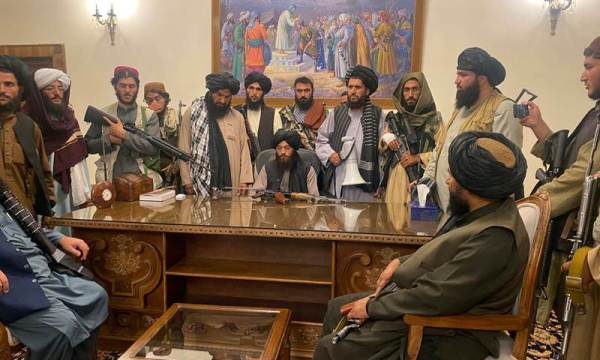
Afghanistan’s recent history is a story of war and civil unrest. The Soviet Union invaded in 1979, but was forced to withdraw 10 years later by anti-Communist mujahidin forces. The Communist regime in Kabul collapsed in 1992. Fighting that subsequently erupted among the various mujahidin factions eventually helped to spawn the Taliban, a hardline Pakistani-sponsored movement that fought to end the warlordism and civil war which gripped the country. The Taliban seized Kabul in 1996 and were able to capture most of the country outside of Northern Alliance srongholds primarily in the northeast. Following the 11 September 2001 terrorist attacks, a US, Allied, and Northern Alliance military action toppled the Taliban for sheltering Osama BIN LADIN. In late 2001, a conference in Bonn, Germany, established a process for political reconstruction that ultimately resulted in the adoption of a new constitution and presidential election in 2004. On 9 October 2004, Hamid KARZAI became the first democratically elected president of Afghanistan. The new Afghan government’s next task is to hold National Assembly elections, tentatively scheduled for April 2005.[Factbook 2004]
LAND
647,500 km²; 22% arable (12% cultivated, 10% pasture), 75% desert, waste, or urban, 3% forested
Land boundaries: 5,510 km
Geography : landlocked; the Hindu Kush mountains that run northeast to southwest divide the northern provinces from the rest of the country; the highest peaks are in the northern Vakhan (Wakhan Corridor)
PEOPLE
The term Afghan really applies to one section only of the mixed conglomeration of nationalities which forms the people of Afghanistan, but this is the dominant section known as the Durani. The Ghilzai (who is almost as powerful as the Durani) claims to be of Turkish origin; the Population, Hazaras, the Chahar-Aimak, Tajiks, Uzbegs, Kafirs and others are more or less subject races. Popularly any inhabitant of Afghanistan is known as Afghan on the Indian frontier without distinction of origin or language; but the language division between the Parsiwan (or Persian-speaking Afghan) and the Pathan is a very distinct one. The predominance of the Afghan in Afghanistan dates from the middle of the 18th century, when Ahmad Shah carved out Afghanistan from the previous conquests of Nadir Shah and called it the Durani empire.
The Durani Afghans claim to be Ben-i-Israel (Son of Israel), and insist on their descent from the tribes who were carried away captive from Palestine to Media by Nebuchadrezzar. Yet they also claim to be Pukhtun (or Pathan) in common with all other Pushtu-speaking tribes, whom they do not admit to be Afghan. The bond of affinity between the various peoples who compose the Pathan community is simply the bond of a common language. All of them recognize a common code or unwritten law called Pukhtunwali, which appears to be similar in general character to the old Hebraic law, though modified by Mahommedan ordinances, and strangely similar in certain particulars to Rajput custom. Besides their division into clans and tribes, the whole Afghan people may be divided into dwellers in tents and dwellers in houses; and this division is apparently not coincident with tribal divisions, for of several of the great clans at least a part is nomad and a part settled. [1911 Encyclopædia Britannica, Volume 1] Read more
Population 1982: 15,328,000 (July 1982), average annual growth rate 1.4%; this estimate includes an adjustment for net emigration to Pakistan during recent years, but it does not take into account other demographic consequences of the Soviet intervention in Afghanistan
Nationality: noun—Afghan(s); adjective—Afghan
Ethnic divisions: 50% Pashtuns, 25% Tajiks, 9% Uzbeks, 9% Hazaras; minor ethnic groups include Chahar Aimaks, Turkmen, Baluchi, and others
Religion 1982: 87% Sunni Muslim, 12% Shia Muslim, 1% other
The religion of the country throughout is Mahommedan. Next to Turkey, Afghanistan is the most powerful Mahommedan kingdom in existence. The vast majority of Afghans are of the Sunni sect;Religion. but there are, in their midst, such powerful communities of Shiahs as the Hazaras of the central districts, the Kizilbashes of Kabul and the Turis of the Kurram border, nor is there between them that bitterness of sectarian animosity which is so marked a feature in India. The Kafirs of the mountainous region of Kafiristan alone are non-Mahommedan. They are sunk in a paganism which seems to embrace some faint reflexion of Greek mythology, Zoroastrian principles and the tenets of Buddhism, originally gathered, no doubt, from the varied elements of their mixed extraction. Those contiguous Afghan tribes, who have not so long ago been converted to the faith of Islam, are naturally the most fanatical and the most virulent upholders of the faith around them. In and about the centre of civilization at Kabul, instances of Ghazism are comparatively rare. In the western provinces about Kandahar (amongst the Durani Afghans —the people who claim to be Beni-Israel), and especially in Zamindawar, the spirit of fanaticism runs high, and every other Afghan is a possible Ghazi —a man who has devoted his life to the extinction of other creeds.[1911 Encyclopædia Britannica, Volume 1]
Language: 50% Pashtu, 35% Afghan Persian (Dari), 11% Turkic languages (primarily Uzbek and Turkmen), 10% thirty minor languages (primarily Baluchi and Pashai); much bilingualism
Literacy: 10%
Labor force: 4.98 million (1980 est.); 67.8% agriculture and animal husbandry, 10.2% industry, 6.3% construction, 5.0% commerce, 7.7% services and other
Organized labor: government-controlled unions are being established
GOVERNMENT
Official name: Democratic Republic of Afghanistan
Type: Communist regime backed by multidivisional Soviet force
Capital: Kābul
Political subdivisions: 29 provinces with centrally appointed governors
Administrative divisions: 34 provinces (velayat, singular – velayat); Badakhshan, Badghis, Baghlan, Balkh, Bamian, Daykondi, Farah, Faryab, Ghazni, Ghowr, Helmand, Herat, Jowzjan, Kabol, Kandahar, Kapisa, Khowst, Konar, Kondoz, Laghman, Lowgar, Nangarhar, Nimruz, Nurestan, Oruzgan, Paktia, Paktika, Panjshir, Parvan, Samangan, Sar-e Pol, Takhar, Vardak, and Zabol
Legal system: not established; legal education at University of Kābul; has not accepted compulsory ICJ jurisdiction
Branches: Revolutionary Council acts as legislature and final court of appeal; President of Council acts as chief of state; Cabinet and judiciary responsible to Council; Presidium chosen by Council has full authority when Council not in session; Loya Jirga (Grand Assembly) supposed to convene eventually and approve permanent constitution
Government leaders: President of the Revolutionary Council and head of the People’s Democratic Party of Afghanistan Babrak KARMAL; Prime Minister Soltan Ali KESHTMAND
Suffrage: universal from age 18
Political parties and leaders: The People’s Democratic Party of Afghanistan (PDPA) is the sole legal political party
Communists: the PDPA reportedly claims 50,000 members; the Parcham faction of the PDPA was installed on 27 December 1979; members of the deposed Khalqi faction continue to hold some important posts; the Sholaye-Jaweid is a much smaller pro-Beijing group
Other political or pressure groups: the military and other branches of internal security are being rebuilt by the Soviets; insurgency continues throughout the country; widespread opposition on religious grounds and anti-Soviet sentiment
Member of: ADB, Colombo Plan, FAO, G-77, IAEA, IBRD, ICAO, IDA, IFAD, IFC, ILO, IMF, ITU, NAM, UN, UNESCO, UPU, WHO, WMO, WTO, WSG; suspended from ISCON in January 1980
ECONOMY
GNP: $2.8 billion (FY79), $225 per capita; real growth rate 2.5% (1975-79)
Agriculture: subsistence farming and animal husbandry; main crops—wheat, cotton, fruits
Major industries: carpets and textiles
Electric power: 360,000 kW capacity (1980); 756 million kWh produced (1980), 50 kWh per capita
Exports: $670.2 million (f.o.b., 1980); mostly fruits and nuts, natural gas, and carpets
Imports: $438.4 million (commercial, c.i.f., 1980); mostly food supplies and petroleum products
Major trade partners: exports—mostly USSR and other Eastern bloc countries; imports—mostly USSR and other Eastern bloc countries
Budget: current expenditure Afl6.7 billion, capital expenditure Afl1.7 billion for FY79 (est.)
Monetary conversion rate: 44.85 Afghanis=US$1 (official, end 1980)
Fiscal year: 21 March-20 March
COMMUNICATIONS
Railroads: 9.6 km (single track) 1.524-meter gauge, government-owned spur of Soviet line
Highways: 21,000 km total (1981); 3,000 km paved, 2,100 km gravel, 8,900 km improved earth, and 7,000 km unimproved earth
Inland waterways: total navigability 1,070 km; steamers up to about 500 metric tons use sections of Amu Darya
Ports: 3 minor river ports; largest Sher Khan
Civil air: 6 major transport aircraft
Airfields: 37 total, 36 usable; 10 with permanent-surface runways; 8 with runways 2,440-3,659 m, 12 with runways 1,220-2,439 m
Telecommunications: limited telephone, telegraph, and radiobroadcast services; television introduced in 1980; telephones (0.2 per 100 popl.); 5 AM and no FM stations, 1 TV station, 1 earth satellite station
DEFENSE FORCES
Military manpower: males 15-49, about 3,602,000; 1,998,000 fit for military service; about 146,000 reach military age (22) annually
Supply: dependent on foreign sources, almost exclusively the USSR
Military budget: estimated expenditures for fiscal year ending 31 March 1979, about $63.8 million; approximately 12% of central government budget
Military branches: Since 2004, Afghan National Army, currently being trained by the US with the assistance of the international community, is 7,000 strong; note – the December 2001 Bonn Agreement called for all militia forces to come under the authority of the central government, but regional leaders have continued to retain their militias and the formation of a national army remains a gradual process; Afghanistan’s militia forces continue to be factionalized, largely along ethnic lines