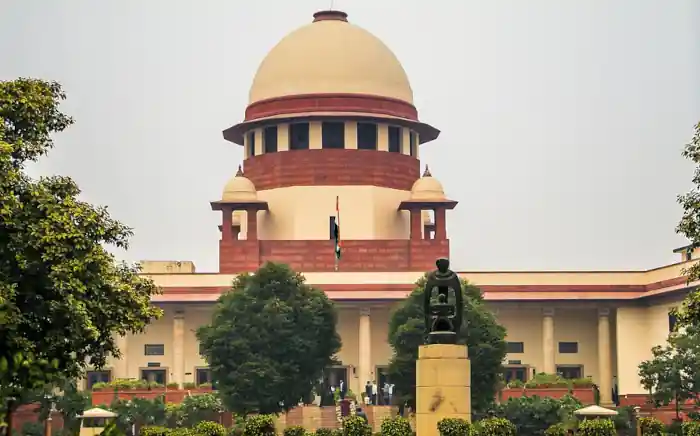
Supreme Court of India
Challenge: Whether the Uttar Pradesh Board of Madarsa Education Act, 2004 is unconstitutional because it violates the principle of secularism and Articles 14 and 21A of the Constitution.
SUPREME COURT OF INDIA
Anjum Kadari & Anr. v. Union of India & Ors.
(Special Leave Petition (C) No. 8541 of 2024)
05 November 2024
[Dr Dhananjaya Y Chandrachud, CJI, J.B. Pardiwala and Manoj Misra, JJ.]
The case revolves around the constitutional validity of the Uttar Pradesh Board of Madarsa Education Act, 2004, addressing whether the Act’s provisions align with the Constitution of India. Here’s a summary of the analysis and the judgment’s key points:
Constitutional Validity and Legislative Competence
- Scope and Purpose of the Madarsa Act:
- The Act was enacted to regulate the standard of education in Madarsas recognized by the Board in Uttar Pradesh.
- It aims to ensure students receive education that equips them for societal participation and livelihood, integrating secular and religious elements without violating the minority character of these institutions.
- Legislative Competence (Entry 25, List III):
- Education, including religious education, falls under Entry 25 of the Concurrent List, allowing both State and Union legislatures to legislate on this subject.
- Regulations imposed by the Act (e.g., on teaching standards and teacher qualifications) are permissible as they pertain to education, even if it includes religious components.
- Conflict with UGC Act (Entry 66, List I):
- Entry 66 provides the Union with exclusive authority to legislate on the coordination and determination of standards in higher education.
- The Act’s provisions concerning Fazil and Kamil degrees encroach upon this domain, rendering them unconstitutional due to conflict with the UGC Act.
Key Judgments
- Partial Invalidity:
- The provisions related to Fazil and Kamil degrees are unconstitutional due to conflict with the UGC Act. However, this does not render the entire Act invalid. The unconstitutional provisions are severable, leaving the remaining Act enforceable.
- Positive Secularism and Article 30(1):
- Article 30(1) guarantees minorities the right to establish and administer educational institutions, including Madarsas.
- The State’s regulatory measures (e.g., standards of education and recognition criteria) aim to ensure substantive equality and societal integration, consistent with the spirit of secularism and Article 30(1).
- Right to Education (Article 21-A) and RTE Act:
- The Act aligns with the obligation under Article 21-A to provide education while respecting the exemption of minority institutions under the Right to Education Act, 2009.
- Standards of Regulation:
- Regulations on standards of education, teacher qualifications, and infrastructure ensure quality education without infringing the management rights of Madarsas.
Principles Applied
- Interpretation of Legislative Entries:
- Legislative entries in the Seventh Schedule are interpreted broadly, with overlaps addressed by ensuring harmonious application.
- Education with a religious component does not preclude State legislation under Entry 25, List III.
- Basic Structure Doctrine:
- A statute cannot be invalidated solely on the grounds of violating the “basic structure” of the Constitution. Violations must be traced to specific constitutional provisions.
- Severability:
- Invalid provisions of a statute can be severed if the remaining parts retain their functionality and coherence.
Remarks
- The Uttar Pradesh Board of Madarsa Education Act, 2004, is constitutionally valid except for provisions concerning Fazil and Kamil degrees, which conflict with the UGC Act.
- The Act exemplifies positive secularism, balancing the right of minorities to manage educational institutions with the State’s role in ensuring educational standards and societal integration.
Case Laws
Anshuman Singh Rathore v. Union of India and Others, Writ (C) No. 6049 of 2023; S.R. Bommai v. Union of India [1994] 2 SCR 644; Dr. M. Ismail Faruqui v. Union of India [1994] Supp. 5 SCR 1 : (1994) 6 SCC 360; Seshammal v. State of Tamil Nadu [1972] 3 SCR 815 : (1972) 2 SCC 11; Ratilal Panachand Gandhi v. State of Bombay [1954] 1 SCR 1055 : (1954) 1 SCC 487; D.A.V. College v. State of Punjab [1971] Supp. 1 SCR 677 : (1971) 2 SCC 269; Aruna Roy v. Union of India [2002] Supp. 2 SCR 266 : (2002) 7 SCC 368; Ahmedabad St Xavier’s College Society v. State of Gujarat [1975] 1 SCR 173 : (1974) 1 SCC 717; T.M.A. Pai Foundation v. State of Karnataka [2002] Supp. 3 SCR 587 : (2002) 8 SCC 481; Indira Nehru Gandhi v. Raj Narain [1978] 2 SCR 405 : 1975 Supp SCC 1; State of Kerala v. Peoples Union for Civil Liberties [2009] 11 SCR 142 : (2009) 8 SCC 46; State of A.P. v. McDowell & Co. [1996] 3 SCR 721 : (1996) 3 SCC 709; State of Karnataka v. Union of India [1978] 2 SCR 1 : (1977) 4 SCC 608; Kuldip Nayar v. Union of India [2006] Supp. 5 SCR 1 : (2006) 7 SCC 1; Madras Bar Association v. Union of India [2014] 10 SCR 1 : (2014) 10 SCC 1; Ashok Kumar Thakur v. Union of India [2007] 7 SCR 63 : (2008) 6 SCC 1; Supreme Court Advocates-on-Record Association v. Union of India (2016) 5 SCC 1; State of Kerala v. Very Rev. Mother Provincial [1971] 1 SCR 734 : (1970) 2 SCC 417; In re Kerala Education Bill 1957 [1959] 1 SCR 995 : 1958 SCC OnLine SC 8; Saints High School v. Government of AP [1980] 2 SCR 924 : (1980) 2 SCC 478; Dayanand Anglo Vedic (DAV) College Trust and Management Society v. State of Maharashtra [2013] 4 SCR 821 : (2013) 4 SCC 14; Sidhajbhai Sabhai v. State of Bombay [1963] 3 SCR 837 : 1962 SCC OnLine SC 150; Milli Talimi Mission v. State of Bihar [1985] 1 SCR 410 : (1984) 4 SCC 500; Frank Anthony Public School Employees’ Association v. Union of India [1987] 1 SCR 238 : (1986) 4 SCC 707; Bihar State Madarasa Education Board v. Madarasa Hanfia Arabic College [1989] Supp. 2 SCR 399 : (1990) 1 SCC 428; Supriyo v. Union of India [2023] 16 SCR 1209 : 2023 SCC OnLine SC 1348; St Stephens College v. University of Delhi [1991] Supp. 3 SCR 121 : (1992) 1 SCC 558; Joseph Shine v. Union of India [2018] 11 SCR 765 : (2019) 3 SCC 39; Ravinder Kumar Dhariwal v. Union of India [2021] 13 SCR 823 : (2023) 2 SCC 209; Neil Aurelio Nunes v. Union of India [2022] 1 SCR 970 : (2022) 4 SCC 1; Bharatiya Seva Samaj Trust v. Yogeshbhai Ambalal Patel [2012] 7 SCR 1054 : (2012) 9 SCC 310; State of Tamil Nadu v. K Shyam Sunder [2011] 11 SCR 1094 : (2011) 8 SCC 737; Society for Unaided Private Schools of Rajasthan v. Union of India [2012] 2 SCR 715 : (2012) 6 SCC 1; Pramati Educational and Cultural Trust v. Union of India [2014] 11 SCR 712 : (2014) 8 SCC 1; Maharashtra State Board of Secondary and Higher Secondary Education v. K S Gandhi [1991] 1 SCR 772 : (1991) 2 SCC 716; Mineral Area Development Authority & Anr. v Steel Authority of India & Anr. [2024] 8 SCR 540 : 2024 INSC 607; Forum for People’s Collective Efforts v. State of W.B. [2021] 5 SCR 613 : (2021) 8 SCC 599; Prof. Yashpal & Anr. v. State of Chhattisgarh [2005] 2 SCR 23 : (2005) 5 SCC 420; R.M.D. Chamarbaugwalla v. Union of India [1957] 1 SCR 930 : 1957 SCC OnLine SC 11 – referred to.
Connected Laws: Uttar Pradesh Board of Madarsa Education Act, 2004; Right of Children to Free and Compulsory Education Act, 2009; University Grants Commission Act 1956; Constitution of India; Constitution (Forty-second Amendment) Act, 1976; Uttar Pradesh Non-governmental Arabic and Persian Madarsa Recognition, Administration and Services (Second Amendment) Regulations, 2018; Madrasa Education Rules 1969; Non-Government Arabic and Persian Madrasa Recognition Rules 1987; Uttar Pradesh Non-Governmental Arabic and Persian Madarsa Recognition, Administration and Services Regulations, 2016; Bihar State Madarasa Education Board Act 1982; Government of India Act 1935.