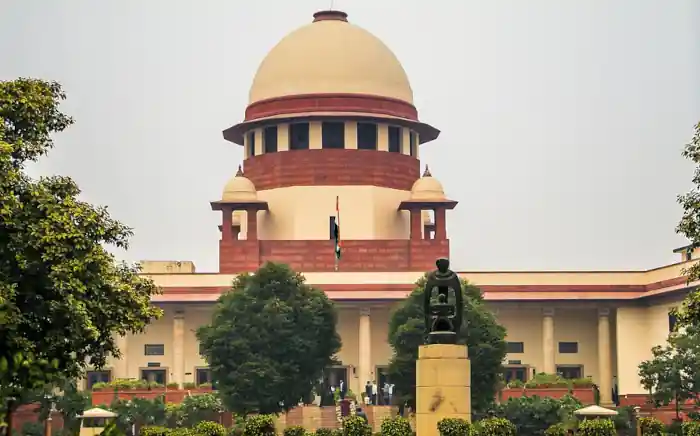
Supreme Court of India
SUPREME COURT OF INDIA
The Madhya Pradesh Madhya Kshetra Vidyut Vitran Company Limited & Ors. v. Bapuna Alcobrew Private Limited & Anr.
Why this appeal: Whether section 56(2) of the Electricity Act 2003 has any application to a demand raised by the appellants on the first respondent for recovery of sums payable under the 1910 Act and, hence, the impugned judgment is sustainable on this score; if not, whether the demand, if it be treated as one under the 1910 Act, is sustainable having regard to the long delay.
(Civil Appeal No. 1095 of 2013)
04 November 2024
[Dipankar Datta and Pankaj Mithal, JJ.]
Brief Summary of the Factual Matrix:
- Parties Involved:
- The appellants include the Madhya Pradesh Electricity Distribution Utility and its officers.
- The first respondent is a company engaged in manufacturing alcohol and bottling liquor.
- Initial Agreements:
- In 1991, the appellants and the first respondent entered into an agreement for electricity supply with a minimum guaranteed consumption.
- Supplementary agreements in 1992, 1995, and 1996 increased the contract demand and added conditions, including a minimum consumption requirement based on load factor.
- Dispute Arises:
- In 1996, the respondent installed a biogas generating set with conditions prohibiting its parallel use with the electricity supply. However, allegations arose of its parallel operation.
- In 2000, the appellants canceled permission for the generating set and issued a notice demanding minimum guarantee charges of ₹70.5 lakh for the period 1996–2000.
- First Legal Challenge:
- The first respondent filed a writ petition challenging the notice. The court allowed the operation of the generating set conditionally and upheld the respondent’s liability to pay minimum guarantee charges.
- In 2006, the respondent withdrew the writ petition, citing policy changes.
- Renewed Dispute:
- In 2009, the appellants issued a second show cause notice for the same liability and subsequently raised a demand for ₹70.5 lakh, threatening disconnection for non-payment.
- The respondent challenged this notice through a second writ petition.
- High Court Proceedings:
- A Single Judge partly upheld the demand but struck down retrospective application of enhanced contract demand, directing recalculation.
- The revised demand was reduced to ₹56.81 lakh, which was recovered through the respondent’s bank guarantee.
- Appeal to Division Bench:
- The respondent appealed the Single Judge’s decision to the Division Bench, resulting in a judgment that is the subject of the present civil appeal.
Key Issues and Rulings:
- Applicability of Section 56(2) of the Electricity Act, 2003:
- Issue: Whether the two-year limitation period under Section 56(2) of the Electricity Act, 2003 applies to liabilities incurred prior to its enforcement under the Electricity Act, 1910 or the Electricity (Supply) Act, 1948.
- Held: Section 56(2) of the 2003 Act applies only to liabilities arising under the provisions of that Act. Liabilities incurred prior to its enforcement cannot be barred by the limitation prescribed under Section 56(2). The High Court erred in applying this provision retroactively to liabilities accrued under earlier laws.
- Principle of Issue Estoppel:
- Issue: Whether the first respondent could challenge the second show cause notice on the same grounds as the first notice.
- Held: The issue of the respondent’s liability for minimum guarantee charges had been conclusively decided in the first proceeding and was not appealed. This finality precluded the respondent from re-agitating the issue under the principle of issue estoppel. The second writ petition was therefore not maintainable.
- Statutory Limitation and Delay:
- Issue: Whether the demand for charges raised by the appellant was barred due to delay in issuance or barred by the limitation period under other applicable statutes (e.g., the Limitation Act, 1963).
- Held: Section 24 of the Electricity Act, 1910 allows disconnection of supply for non-payment of charges, and no specific limitation period for raising such a demand is prescribed. However, suits for recovery of unpaid charges must be filed within three years under the Limitation Act, unless the delay is justifiable under Section 17 of the Limitation Act, which addresses bona fide mistakes.
- Effect of High Court Judgment:
- Issue: Whether the High Court was correct in quashing the second show cause notice and treating the claim as time-barred.
- Held: The High Court’s decision was unsustainable as it failed to consider the finality of earlier orders and misapplied Section 56(2) of the 2003 Act. However, since the appellants had accepted the Single Judge’s order and recovered a reduced amount, the court refrained from altering the status quo.
Summary of Findings:
- The liability for minimum guarantee charges, determined under the Electricity Act, 1910 and earlier proceedings, was enforceable despite the enactment of the 2003 Act.
- Delay in issuing the demand notice must be justified on a case-by-case basis, considering reasonable diligence and bona fide actions.
- Final decisions on liabilities that were not appealed or challenged are binding and operate as res judicata or issue estoppel.
- The appellants were within their rights to raise a demand for charges under the earlier laws, and their actions were consistent with statutory provisions.
The distinction between res judicata and issue estoppel
Apex Court in Hope Plantations Ltd. v. Taluk Land Board, where the principle of issue estoppel was expounded thus:
“26. It is settled law that the principles of estoppel and res judicata are based on public policy and justice. Doctrine of res judicata is often treated as a branch of the law of estoppel though these two doctrines differ in some essential particulars. Rule of res judicata prevents the parties to a judicial determination from litigating the same question over again even though the determination may even be demonstratedly wrong. When the proceedings have attained finality, parties are bound by the judgment and are estopped from questioning it. They cannot litigate again on the same cause of action nor can they litigate any issue which was necessary for decision in the earlier litigation. These two aspects are ‘cause of action estoppel’ and ‘issue estoppel’. These two terms are of common law origin. Again, once an issue has been finally determined, parties cannot subsequently in the same suit advance arguments or adduce further evidence directed to showing that the issue was wrongly determined. Their only remedy is to approach the higher forum if available. The determination of the issue between the parties gives rise to, as noted above, an issue estoppel. It operates in any subsequent proceedings in the same suit in which the issue had been determined. It also operates in subsequent suits between the same parties in which the same issue arises. Section 11 of the Code of Civil Procedure contains provisions of res judicata but these are not exhaustive of the general doctrine of res judicata. Legal principles of estoppel and res judicata are equally applicable in proceedings before administrative authorities as they are based on public policy and justice.”
Again Apex Court in Bhanu Kumar Jain v. Archana Kumar had the occasion to survey several decisions of English courts and explained that there was a distinction between res judicata and issue estoppel in the following words:
“30. Res judicata debars a court from exercising its jurisdiction to determine the lis if it has attained finality between the parties whereas the doctrine issue estoppel is invoked against the party. If such an issue is decided against him, he would be estopped from raising the same in the latter proceeding.
Case Law
Raymond Limited v. State of M.P. [2000] Supp. 4 SCR 668 : (2001) 1 SCC 534; K.C. Ninan v. Kerala SEB [2023] 9 SCR 637 : 2023 SCC OnLine SC 663; Kusumam Hotels (P) Ltd. v. Kerala SEB [2008] 9 SCR 752 : (2008) 13 SCC 213; Ajmer Vidyut Vitran Nigam Ltd. v. Rahamatullah Khan [2020] 2 SCR 929 : (2020) 4 SCC 650; Prem Cottex v. Uttar Haryana Bijli Vitran Nigam Ltd. [2021] 8 SCR 645 : (2021) 20 SCC 200; State of Orissa v. Madan Gopal Rungta [1952] 1 SCR 28 : 1951 SCC 1024; Hope Plantations Ltd. v. Taluk Land Board [1998] Supp. 2 SCR 514 : (1999) 5 SCC 590; Bhanu Kumar Jain v. Archana Kumar [2004] Supp. 6 SCR 1104 : (2005) 1 SCC 787 – referred to.