Photo by Amos Ben Gershom, GPO
Intelligence, Espionage, and Counterintelligence
PM Benjamin Netanyahu at the Mossad Director Change of Command Ceremony: “The Iranian regime is destined to vanish from the world – and we will help it reach this goal – it will no longer threaten our existence.”
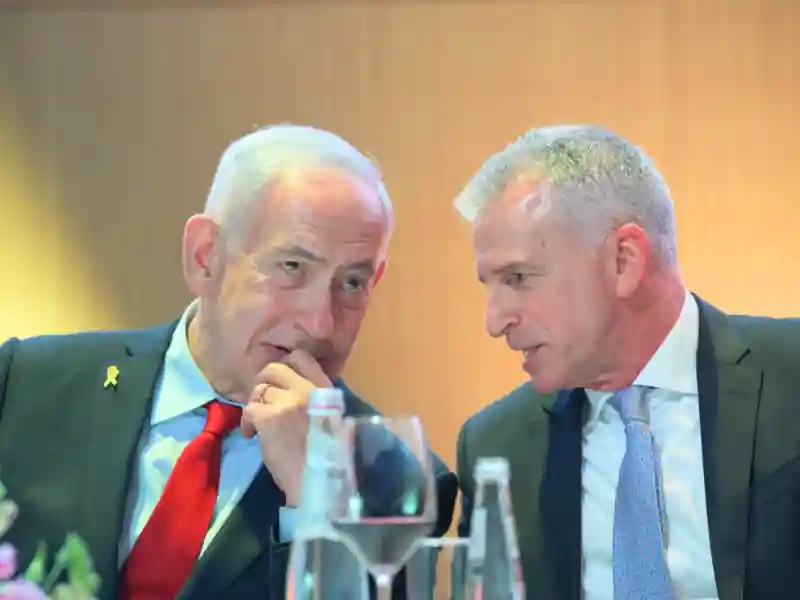
On 2 June 2026, at the official Change of Command Ceremony of Israel’s foreign intelligence service, the Mossad, Prime Minister Benjamin Netanyahu delivered a speech marking the appointment of Major General (res.) Roman Gofman as the organization’s 14th Director. The ceremony represented not only a transition in leadership within one of the world’s most prominent intelligence agencies but also a reaffirmation of Israel’s long-standing strategic doctrine regarding Iran, regional security, and the role of intelligence operations in safeguarding the state. Netanyahu’s remarks combined biographical reflections on Gofman’s life, praise for his military and governmental service, and a forceful declaration of Israel’s determination to prevent Iran from obtaining nuclear weapons or developing capabilities that could threaten Israeli security. (See Iran-US War on June 2, 2026)
The appointment of Roman Gofman occurred during a period of heightened geopolitical tensions in the Middle East. Since the establishment of the State of Israel on 14 May 1948 in Tel Aviv, Israeli governments have regarded intelligence gathering and covert operations as essential components of national defense. The Mossad, formally established in December 1949, evolved into one of Israel’s principal intelligence organizations, responsible for foreign intelligence collection, covert action, counterterrorism operations, and strategic missions beyond Israel’s borders. Over the decades, Mossad directors have played influential roles during critical periods including the Arab-Israeli conflicts, the Cold War, counterterrorism campaigns, and efforts to monitor nuclear developments across the Middle East.
In his address, Netanyahu placed particular emphasis on Gofman’s personal journey from Belarus to Israel. Referring to the historical connection between Eastern Europe and Israeli leadership, the prime minister observed that Belarusian soil had produced a succession of figures who later contributed significantly to the Israeli state. Belarus, formerly part of the Russian Empire and later the Soviet Union, was the birthplace or ancestral homeland of numerous Zionist activists, political leaders, military commanders, and intellectuals who shaped the development of modern Israel. Immigration from the territories of the former Soviet Union accelerated following the collapse of the USSR in 1991, bringing hundreds of thousands of newcomers to Israel and transforming the country’s demographic, political, and cultural landscape.
According to Netanyahu’s account, Roman Gofman immigrated to Israel from Belarus at the age of fourteen together with his parents, Ludmila Gofman and Vladislav Gofman. The family settled in Ashdod, a major Mediterranean port city located approximately thirty kilometers south of Tel Aviv. Ashdod, founded in 1956, became one of the principal destinations for immigrants arriving during successive waves of aliyah. By the early twenty-first century, it had developed into one of Israel’s largest cities and a significant center for immigrants from the former Soviet Union.
Netanyahu described the challenges faced by Gofman as a newly arrived immigrant teenager. The prime minister portrayed him as a young newcomer confronting social obstacles, language barriers, and the difficulties commonly experienced by immigrant youth. Such experiences reflected broader historical patterns observed among immigrant communities in Israel, where adaptation often involved balancing integration into Hebrew-speaking society while maintaining cultural ties to countries of origin. During the 1990s and early 2000s, Russian-speaking immigrants formed one of the largest immigrant populations in Israel, contributing substantially to science, technology, military service, and public administration.
A notable element of Netanyahu’s speech concerned Gofman’s achievements in boxing during his adolescence. The prime minister recalled that by the age of seventeen, Gofman had become Israel’s national youth runner-up in boxing. Boxing has held a modest yet enduring presence in Israeli sports history since the mid-twentieth century. For many immigrant communities, participation in combat sports provided opportunities for social mobility, discipline, and integration. Netanyahu employed this biographical detail symbolically, presenting boxing as evidence of perseverance, resilience, and determination—qualities he suggested later characterized Gofman’s military and intelligence career.
The speech traced Gofman’s progression through various professional and military challenges. Netanyahu emphasized that the new Mossad chief had overcome numerous obstacles before reaching the leadership of Israel’s premier intelligence organization. Such remarks reflected the significance traditionally attached to personal merit and military service within Israeli political culture. Since the state’s establishment, senior leadership positions in security institutions have frequently been occupied by individuals who rose through the ranks of the Israel Defense Forces (IDF), intelligence agencies, or related governmental structures.
Particular attention was given to a phrase associated with Gofman: “Let us win, deploy us!” Netanyahu stated that he had first observed Gofman’s actions before becoming familiar with the statement itself. The phrase originated from a widely discussed video in which Gofman addressed senior military officials. According to Netanyahu, some attendees reacted with smiles or skepticism, yet Gofman remained undeterred. The prime minister presented the episode as evidence of a leadership style centered on initiative, operational boldness, and a commitment to decisive outcomes. Within Israeli military history, concepts such as initiative, adaptability, and offensive action have often been emphasized, particularly following lessons drawn from conflicts including the Six-Day War of June 1967, the Yom Kippur War of October 1973, and subsequent regional confrontations.
Netanyahu also reflected on Gofman’s service as Military Secretary to the Prime Minister. The position occupies a crucial place within Israel’s governmental framework, serving as a bridge between political leadership and military institutions. Military secretaries advise prime ministers on security matters, coordinate strategic communications, and facilitate interactions with defense agencies. Netanyahu credited Gofman with demonstrating exceptional learning ability, analytical precision, strategic awareness, and attention to detail. He further highlighted what he termed resourcefulness, describing it as the capacity to identify vulnerabilities overlooked by adversaries and to develop innovative solutions beyond conventional frameworks.
The concept of resourcefulness occupies a prominent place in Israeli security doctrine. Since the state’s earliest years, military planners and intelligence officials have frequently emphasized creative problem-solving in response to strategic constraints. Israel’s relatively small geographic size, limited strategic depth, and challenging security environment contributed to the development of doctrines emphasizing intelligence superiority, technological innovation, and unconventional thinking. Netanyahu’s praise of Gofman’s resourcefulness therefore linked the incoming Mossad director to a broader institutional tradition.
The second major theme of the speech concerned the ongoing confrontation between Israel and Iran. Netanyahu declared that the Mossad would continue to stand at the forefront of efforts to counter Iranian aggression. Relations between Israel and Iran have undergone dramatic transformation since the mid-twentieth century. During the reign of Mohammad Reza Shah Pahlavi, who ruled Iran from 1941 to 1979, the two countries maintained cooperative relations despite the absence of formal diplomatic recognition. Economic exchanges, intelligence cooperation, and strategic coordination developed as part of broader regional alignments during the Cold War.
This relationship changed fundamentally following the Iranian Revolution of February 1979, which led to the overthrow of the Shah and the establishment of the Islamic Republic of Iran under Ayatollah Ruhollah Khomeini. The revolutionary government adopted a strongly anti-Israel position, severed official relations, and positioned support for Palestinian causes as a central component of its foreign policy. Since that time, Israel has regarded Iran as one of its principal strategic adversaries.
Throughout the 1980s, 1990s, and 2000s, concerns regarding Iran’s missile programs, regional influence, and nuclear activities became increasingly prominent within Israeli security planning. International attention intensified after revelations concerning previously undisclosed Iranian nuclear facilities in the early twenty-first century. Negotiations involving Iran and major world powers culminated in the Joint Comprehensive Plan of Action (JCPOA) signed in Vienna on 14 July 2015. The agreement sought to limit Iran’s nuclear activities in exchange for sanctions relief. Netanyahu emerged as one of the most vocal critics of the accord, arguing that it did not sufficiently prevent Iran from eventually acquiring nuclear weapons capabilities.
In his June 2026 speech, Netanyahu reiterated a position that has characterized much of his political career: the assertion that Israel will not permit Iran to obtain nuclear weapons. Since first becoming prime minister in 1996, and particularly during his later terms in office, Netanyahu repeatedly identified Iran’s nuclear ambitions as a central national security challenge. His speeches before the United Nations General Assembly, the United States Congress, and various international forums frequently focused on warning about what he viewed as the dangers posed by Iran’s nuclear program.
At the ceremony, Netanyahu declared that Israel would not allow the Iranian regime to “turn back the clock.” This phrase suggested opposition to developments that Israeli leaders perceive as reversing strategic gains achieved through diplomacy, sanctions, intelligence operations, or military actions. He further stated that Israel would not allow Iran to threaten its existence, linking contemporary security concerns to historical experiences that continue to influence Israeli political discourse. References to existential threats often carry particular resonance in Israel because of the legacy of the Holocaust, regional wars, and recurrent security crises.
Among the most striking elements of Netanyahu’s remarks was his statement that the Iranian regime was “destined to vanish from the world” and that Israel would help achieve that outcome. Such language reflected a longstanding pattern of rhetorical confrontation between Israeli and Iranian leaders. Since 1979, officials from both countries have frequently exchanged severe accusations regarding regional policies, military activities, and ideological objectives. Netanyahu’s statement underscored the intensity of the strategic rivalry that has developed over nearly five decades.
The prime minister also referred specifically to two perceived threats: nuclear weapons and ballistic missiles. Iran’s missile program has been a major source of international debate since the late twentieth century. Various missile systems developed by Iran possess ranges capable of reaching targets throughout the Middle East. Israeli officials have consistently argued that the combination of nuclear capabilities and long-range missile technology would represent an unacceptable security risk. Consequently, intelligence gathering related to Iranian missile and nuclear developments has remained a central mission for Israeli security agencies.
Historically, Mossad has played a prominent role in efforts connected to Iran. Public reports and international discussions have attributed numerous intelligence operations, cyber activities, and covert missions to Israeli agencies, although official acknowledgment has often been limited or absent. Netanyahu’s speech implied that such activities would continue under the leadership of Roman Gofman. By assigning the incoming director responsibility for confronting Iran’s strategic capabilities, Netanyahu reinforced the organization’s traditional role in implementing Israeli security policy beyond the country’s borders.
The ceremony itself represented continuity within a longstanding institutional framework. Leadership transitions within intelligence organizations are significant moments because they combine operational continuity with opportunities for strategic adaptation. The designation of Gofman as the fourteenth Mossad director placed him within a historical lineage extending back to the agency’s formative years under leaders who helped establish Israel’s intelligence infrastructure during the first decade of statehood. Successive directors have overseen operations during periods marked by regional wars, hostage crises, counterterrorism campaigns, diplomatic breakthroughs, and technological transformations.
Netanyahu concluded his remarks by framing the struggle against Iran as both a directive and a mission. Addressing Gofman directly, he stated that preventing Iranian nuclear armament and countering missile threats constituted the central task facing the new director and the thousands of personnel serving within the organization. This concluding message reflected a broader principle embedded within Israeli national security doctrine: the belief that intelligence capabilities, technological innovation, military preparedness, and strategic determination must operate together to address perceived existential challenges.
The Change of Command Ceremony of 2 June 2026 served multiple functions. It formally marked the elevation of Roman Gofman from military and governmental service to the leadership of Mossad. It highlighted themes of immigration, perseverance, and personal achievement through the narrative of Gofman’s journey from Belarus to Ashdod. It reaffirmed the importance of intelligence institutions within Israel’s national security architecture. Most significantly, it reiterated Prime Minister Netanyahu’s longstanding commitment to preventing Iran from acquiring capabilities that Israel views as threatening its survival.
Prime Minister Benjamin Netanyahu, on 2nd June 2026
“The soil of Belarus has yielded a line of leaders for Israel. Roman, when your foot first stepped onto the Land of Israel at the age of 14, you immigrated with your parents – Ludmila, of blessed memory, and Vladislav, who is here with us today. You immigrated from Belarus straight to the city of Ashdod. You paved your own path with your own two hands. Two hands mean two fists. When Roman arrived, they pounced on him. A foreign child, speaking with a Russian accent – you know what happens with kids. But Roman paved his way with his two hands – his two fists – and was already the national youth runner-up in boxing by the age of 17. Not bad, Roman. A sign of things to come.
Roman, you weathered all the obstacles. You overcame every hurdle on the way to this appointment. And now, you are officially being appointed as the 14th Director of Israel’s Mossad. I congratulate you on my behalf and on behalf of the entire nation. Go forth and succeed!
You said: ‘Let us win, deploy us!’ – I discovered this after I discovered you. I saw the actions before I heard the words. And afterwards, I saw the video. You turned to senior IDF officials in that famous video and said: ‘Let us win, deploy us!’ And quite a few sat there smiling. Some were even smirking. But you were not deterred. You instilled the spirit of victory into every role you reached.
Roman brought immense value to the role of Military Secretary to the Prime Minister. You demonstrated, and I saw this very quickly, that you possess an impressive capacity for learning, sharpness of thought, a comprehensive view of the campaign landscape combined with an eye for detail, and an extraordinary capacity for resourcefulness – meaning, thinking outside the box, searching for something the enemy hasn’t thought of but which constitutes a fundamental vulnerability – resourcefulness, and no less than that, a striving for victory.
The Mossad will continue to stand at the forefront of our struggle against Iran’s aggression. In continuation of the consistent policy we have been leading for years – we will not allow the Iranian regime to turn back the clock. We will not allow it to acquire nuclear weapons; we will not allow it to threaten our existence. This terrorist regime, which is destined to vanish from the world, and we will help it reach this goal, this regime will no longer threaten us with nuclear bombs and thousands of lethal ballistic missiles.
This is my directive – and this is your mission! This is your mission, Roman, and that of all the thousands who are here today.”
Sarvarthapedia Conceptual Network: PM Netanyahu at Mossad Director Change of Command Ceremony (2026)
Primary Entry
PM Netanyahu at the Mossad Director Change of Command Ceremony (2 June 2026)
This article intersects with themes of Israeli political leadership, intelligence institutions, immigration history, military culture, Middle Eastern geopolitics, nuclear deterrence, and Israeli-Iranian relations. The following conceptual network provides a structured “See also” system linking related subjects.
Israeli Leadership and Government
Benjamin Netanyahu
See also:
- Israeli Prime Ministers
- Israeli Security Doctrine
- Israeli Foreign Policy
- Israeli-Iranian Relations
- Israeli National Security Council
- Military Secretary to the Prime Minister
- Nuclear Deterrence
- Middle East Geopolitics
- Counterterrorism Policy
- Intelligence and Statecraft
- Jewish Encyclopedia Library
- Global Biographical Dictionary of Intelligence
Military Secretary to the Prime Minister
See also:
- Israel Defense Forces (IDF)
- Prime Minister’s Office
- National Security Decision-Making
- Strategic Planning
- Civil-Military Relations in Israel
- Roman Gofman
Israeli Prime Ministers
See also:
- David Ben-Gurion
- Levi Eshkol
- Golda Meir
- Menachem Begin
- Yitzhak Rabin
- Ariel Sharon
- Benjamin Netanyahu
- Israeli Political History
Intelligence and Security Institutions
Mossad
See also:
- Israeli Intelligence Community
- Shin Bet
- Aman (Military Intelligence Directorate)
- Covert Operations
- Foreign Intelligence Collection
- Counterterrorism
- Intelligence Leadership
- Mossad Directors
- Israeli National Security
Mossad Directors
See also:
- Roman Gofman
- Intelligence Leadership
- Strategic Intelligence
- National Security Institutions
- Covert Action
- Intelligence Reform
Israeli Intelligence Community
See also:
- Mossad
- Shin Bet
- Aman
- Cyber Intelligence
- Intelligence Gathering
- Counterintelligence
- National Security Policy
Covert Operations
See also:
- Intelligence Warfare
- Counterproliferation
- Sabotage Operations
- Strategic Deterrence
- Mossad
- Special Operations
Roman Gofman
Roman Gofman
See also:
- Mossad Director
- Belarusian Immigration to Israel
- Ashdod
- Israel Defense Forces
- Military Secretary to the Prime Minister
- Leadership Development
- Strategic Resourcefulness
- Israeli Security Establishment
Leadership Development in Israeli Security Institutions
See also:
- Roman Gofman
- Military Leadership
- Intelligence Leadership
- Meritocracy in Israeli Institutions
- Strategic Thinking
- Decision-Making Under Pressure
Resourcefulness in Security Strategy
See also:
- Asymmetric Warfare
- Innovation in Intelligence
- Strategic Adaptation
- Israeli Military Doctrine
- Operational Creativity
Immigration and Society
Belarusian Immigration to Israel
See also:
- Soviet Jewish Emigration
- Post-Soviet Immigration
- Aliyah
- Ashdod
- Russian-Speaking Israelis
- Integration of Immigrants
Aliyah
See also:
- Law of Return
- Jewish Diaspora
- Immigration Waves to Israel
- Soviet Immigration
- Ashdod
- Israeli Society
Russian-Speaking Israelis
See also:
- Post-Soviet Immigration
- Israeli Demographics
- Cultural Integration
- Political Participation
- Belarusian Immigration
Ashdod
See also:
- Israeli Port Cities
- Immigration Centers
- Mediterranean Coast of Israel
- Urban Development in Israel
- Soviet Immigrant Communities
Military and Strategic Culture
Israel Defense Forces (IDF)
See also:
- Military Doctrine
- National Service
- Israeli Security Establishment
- Strategic Deterrence
- Civil-Military Relations
- Military Innovation
Military Doctrine of Israel
See also:
- Offensive Defense
- Intelligence Superiority
- Strategic Deterrence
- Six-Day War
- Yom Kippur War
- Resourcefulness in Warfare
Strategic Deterrence
See also:
- Nuclear Deterrence
- Missile Defense
- Intelligence Operations
- National Security
- Iranian Nuclear Program
Civil-Military Relations in Israel
See also:
- Military Secretary to the Prime Minister
- Israel Defense Forces
- National Security Institutions
- Democratic Oversight
- Security Governance
Israeli-Iranian Relations
Israel-Iran Relations
See also:
- Iranian Revolution
- Nuclear Program of Iran
- Ballistic Missile Program
- Middle East Strategic Rivalries
- Proxy Conflicts
- Regional Security
Iranian Revolution (1979)
See also:
- Ayatollah Ruhollah Khomeini
- Islamic Republic of Iran
- End of Israel-Iran Cooperation
- Political Islam
- Middle Eastern Transformations
Islamic Republic of Iran
See also:
- Iranian Foreign Policy
- Revolutionary Ideology
- Nuclear Program of Iran
- Ballistic Missile Program
- Israel-Iran Relations
Iranian Foreign Policy
See also:
- Regional Influence
- Proxy Organizations
- Anti-Israel Policies
- Strategic Alliances
- Middle Eastern Geopolitics
Nuclear Issues
Iranian Nuclear Program
See also:
- Nuclear Proliferation
- Joint Comprehensive Plan of Action (JCPOA)
- Israeli Security Concerns
- Counterproliferation
- Strategic Deterrence
Joint Comprehensive Plan of Action (2015)
See also:
- Vienna Nuclear Agreement
- Iran Nuclear Negotiations
- International Sanctions
- United States Foreign Policy
- Israeli Criticism of JCPOA
Nuclear Proliferation
See also:
- Weapons of Mass Destruction
- Non-Proliferation Treaty
- Counterproliferation
- Strategic Stability
- Nuclear Deterrence
Counterproliferation
See also:
- Mossad Operations
- Intelligence Gathering
- Nuclear Security
- Strategic Deterrence
- Covert Action
Missile and Defense Issues
Ballistic Missile Program of Iran
See also:
- Missile Technology
- Strategic Deterrence
- Regional Security
- Missile Defense Systems
- Israeli Threat Assessments
Missile Defense Systems
See also:
- Iron Dome
- David’s Sling
- Arrow Missile Defense System
- Strategic Defense
- Ballistic Missile Threats
Arrow Missile Defense System
See also:
- Israeli Air Defense
- Ballistic Missile Defense
- Strategic Deterrence
- Iranian Missile Program
Historical Foundations
Establishment of Israel (1948)
See also:
- David Ben-Gurion
- Arab-Israeli Conflict
- Israeli State Formation
- National Security Institutions
- Early Intelligence Services
Founding of Mossad (1949)
See also:
- Israeli Intelligence Community
- David Ben-Gurion
- National Security Institutions
- Foreign Intelligence
Six-Day War (1967)
See also:
- Military Doctrine
- Intelligence Successes
- Strategic Depth
- Arab-Israeli Wars
- Israeli Security Thinking
Yom Kippur War (1973)
See also:
- Intelligence Failures
- Strategic Surprise
- Military Reform
- National Security Lessons
- Intelligence Assessment
Intelligence Concepts
Intelligence Gathering
See also:
- Human Intelligence (HUMINT)
- Signals Intelligence (SIGINT)
- Open-Source Intelligence
- Strategic Analysis
- Mossad
Human Intelligence (HUMINT)
See also:
- Espionage
- Intelligence Networks
- Covert Operations
- Mossad
- Counterintelligence
Counterintelligence
See also:
- Security Services
- Espionage Prevention
- Intelligence Community
- National Security
Strategic Intelligence
See also:
- Threat Assessment
- National Security Planning
- Decision Support
- Intelligence Analysis
- Mossad Leadership
Geopolitical Framework
Middle East Geopolitics
See also:
- Israel-Iran Relations
- Arab-Israeli Conflict
- Strategic Alliances
- Regional Security Architecture
- Energy Politics
Regional Security Architecture
See also:
- Strategic Deterrence
- Defense Cooperation
- Intelligence Sharing
- Middle Eastern Alliances
- Security Partnerships
Strategic Rivalries in the Middle East
See also:
- Israel and Iran
- Saudi-Iranian Competition
- Proxy Conflicts
- Regional Power Balance
- Nuclear Security
Conceptual Themes
National Security
See also:
- Mossad
- Israel Defense Forces
- Strategic Deterrence
- Intelligence Gathering
- Nuclear Security
- Counterterrorism
Intelligence Leadership
See also:
- Roman Gofman
- Mossad Directors
- Strategic Decision-Making
- Resourcefulness
- Organizational Leadership
Existential Threats in Israeli Political Thought
See also:
- Holocaust Memory
- National Security Doctrine
- Nuclear Proliferation
- Iranian Nuclear Program
- Strategic Deterrence
Victory Doctrine
See also:
- Military Strategy
- Operational Initiative
- Leadership Philosophy
- Roman Gofman
- Israeli Strategic Culture
Resourcefulness
See also:
- Innovation
- Strategic Thinking
- Asymmetric Warfare
- Intelligence Operations
- Leadership Development
Master Hub Connections
PM Netanyahu at the Mossad Director Change of Command Ceremony (2026)
Directly connected to:
- Benjamin Netanyahu
- Roman Gofman
- Mossad
- Mossad Directors
- Israeli Intelligence Community
- Military Secretary to the Prime Minister
- Israel Defense Forces
- Belarusian Immigration to Israel
- Ashdod
- Israeli Security Doctrine
- Israel-Iran Relations
- Iranian Nuclear Program
- Ballistic Missile Program of Iran
- Strategic Deterrence
- Counterproliferation
- Nuclear Proliferation
- Joint Comprehensive Plan of Action
- Intelligence Leadership
- National Security
- Middle East Geopolitics
- Victory Doctrine
- Resourcefulness
- Existential Threats in Israeli Political Thought
This network places the 2 June 2026 ceremony at the intersection of leadership transition, intelligence history, immigration narratives, Israeli strategic culture, and the long-term geopolitical confrontation between Israel and Iran.