|
1707: Last Royal veto on a Bill
Queen Anne refuses to give Royal Assent to the Scottish Militia Bill
1707: Union of England and Scotland
Scottish Parliament abolished; first meeting of Parliament of Great Britain.
1716: Septennial Act
Extended the length of Parliaments to seven years.
1800: Act of Union (with Ireland)
In 1801, 100 Irish MPs entered the House of Commons and Irish Peers elected representatives from among their number to sit in the Lords.
1803: Newspaper reporters allocated seats in the public gallery for the first time
1812: Assassination of Prime Minister Spencer Perceval
John Bellingham shoots and kills the Prime Minister in the Members’ Lobby of the House of Commons.
1832: Reform Act
Increased the electorate by almost 50 per cent and to 57 per cent overall. The proportion of adult English males entitled to vote was now 20 per cent.
1834: Fire!
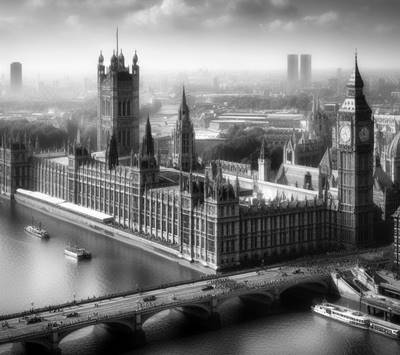
Fire destroys most of Parliament. Rebuilding the Houses of Parliament, in the design we know today, completed by 1870.
1876: Appellate Jurisdiction Act
Lords of Appeal in Ordinary (Law Lords) created as full-time, professional judges.
1911: Parliament Act
Removed the House of Lords’ right to refuse a Bill passed in the Commons – except those that proposed to extend the life of Parliament.
1918: Fourth Reform Act and Representation of the People Act
Gave the vote to men over 21 and women over 30 – increasing the electorate from 8 million to 21 million.
1919: First female MP
Viscountess Nancy Astor is the first woman to take her seat as an MP (Countess Constance Markiewicz was elected in 1918 but as a Sinn Fein member did not take her seat).
1920: Government of Ireland Act
Southern Irish MPs no longer attend UK Parliament.
1928: Representation of the People (Equal Franchise) Act
Reduced voting age for women to 21.
1941: World War II bombing
Commons chamber destroyed by enemy action on 10 May.
1949: Parliament Act
Reduced the Lords ability to delay a Bill passed in the Commons from two years to one year.
1950: New Commons chamber
Re-built after 1941 bombing; used for the first time on 26 October.
1958: Life Peerages Act
Permitted creation of peerages for life to persons of either sex, with no limit on numbers. First female life peer – Baroness Wootton of Abinger – is created.
1963: Peerage Act
Allowed hereditary peerages to be disowned for life, hereditary peeresses to be members of the House of Lords and all Scottish peers to sit. First female hereditary peer: Baroness Strange of Knokin.
1978: Radio broadcasts
Broadcasts of proceedings in Parliament begin on a permanent basis.
1985: Lords televised
Proceedings in the Lords televised for first time.
1989: Commons televised
Commons proceedings televised for first time.
1997: Parliament website launched
1999: UK devolution
Devolution of powers to Scottish Parliament, National Assembly for Wales and Northern Ireland Assembly.
1999: House of Lords Act
Removed the right of all but 92 hereditary peers to sit in the House of Lords.
1999: Westminster Hall sittings
MPs sit for the first time in a parallel chamber, held in Westminster Hall.
2002: Parliament webcasts
Webcasts of Parliament proceedings begins.
2005: Constitutional Reform Act
Separates judiciary from the legislature (a term for Parliament) with the creation of a Supreme Court (from 2009) when the judicial function of the House of Lords will cease.
2006: First Lord Speaker
Baroness Hayman elected as the first Lord Speaker.
|