
Here is a comprehensive glossary of Female/Woman Psychology organized into five thematic parts. Each term includes a short description. The themes span developmental stages (childhood, young, adult, old age) and social contexts (working class, corporate woman, etc.).
See also: Psychology ↔ Glossary of Psychology, Mind and Dream
Part 1: Childhood & Formative Years (Ages 0–12)
Foundational psychological patterns, cognitive development, early socialization, and family dynamics.
- Attachment Bonding (Mother-Daughter) – The primary emotional connection formed with the mother, influencing future relational security.
- Gender Schema – A cognitive framework through which a girl organizes information about what is “female-appropriate.”
- Play Preference (Nurturing) – Tendency in early childhood toward dolls, caregiving simulations, and cooperative games.
- Social Referencing – Looking to female caregivers’ emotional expressions to guide behavior in ambiguous situations.
- Early Menarche Anxiety – Distress or confusion surrounding first menstruation when occurring before peer average.
- Daddy’s Girl Dynamic – A pattern of seeking male parental approval, shaping later heterosocial confidence.
- Relational Aggression (Child) – Use of exclusion, gossip, or friendship withdrawal to harm peers, more common in girls.
- Toy Gendering Internalization – Accepting marketing and parental cues that certain toys (pink, domestic) are for girls.
- Emotional Fluency – Girls typically develop richer emotional vocabulary earlier than boys due to social reinforcement.
- Teacher-Pupil Gender Bias – Tendency for teachers to praise girls for neatness and silence, boys for cleverness.
- Sibling Rivalry (Sister) – Competition for maternal attention, often expressed through covert comparison.
- Fantasy Role-Play (Princess/Mother) – Imaginary enactment of adult female roles, rehearsing future identities.
- Fear of Abandonment (Girl) – Heightened separation anxiety when primary attachment figure is inconsistently available.
- Peer Conformity Pressure – Early need to align with girl group norms on dress, speech, and interests.
- Body Awareness Onset – First recognition of one’s body as object of evaluation, typically ages 5–7.
- Modesty Training – Social instruction to cover certain body parts, internalized more strictly for girls.
- Emotional Overhelping – Parents’ tendency to solve affective problems for daughters, reducing coping self-efficacy.
- Silencing of Anger – Early lesson that female anger is unattractive or punished, leading to suppression.
- Pretend Pregnancy Play – Simulating motherhood through doll care, preparing reproductive identity.
- Gender Constancy – Understanding that gender remains stable over time, achieved around age 6–7.
- Maternal Gatekeeping – Mother’s control over father’s involvement with daughter, affecting autonomy.
- Clique Formation (Elementary) – Small, exclusive same-sex groups that establish social hierarchies.
- Tattling Tendency – Using adult authority to resolve peer conflict, more common in girls due to rule orientation.
- Storybook Identification – Stronger preference for female protagonists in literature, shaping self-narrative.
- Emotional Contagion (Mother) – Rapid absorption of mother’s mood states without cognitive filtering.
- Pink Frill Effect – Overvaluation of feminine-coded aesthetics as marker of “good girl” status.
- Gender Segregation – Natural preference to play with same-sex peers from age 3 onward.
- Crying Efficacy – Learning that tears elicit comfort from adults, reinforcing emotional expression.
- Early Self-Objectification – Viewing one’s body from an external observer’s perspective, beginning around 8.
- Imposter Phenomenon (Child) – Precocious feeling of being undeserving of praise despite achievement.
- Sensitive Period for Gender Identity – Ages 3–5 when core gender identity becomes relatively fixed.
- Sexual Curiosity (Non-erotic) – Anatomical exploration without adult understanding of sexuality.
- Responsibility for Others’ Feelings – Internalizing duty to manage parents’ emotional states.
- Stereotype Threat (Math/Science) – Performance decrement when reminded of “girls are bad at math” trope.
- Princess Culture Absorption – Internalizing ideals of passivity, beauty, and rescue by male figure.
- Father-Daughter Play Roughness – Lower physical intensity than father-son, shaping body confidence.
- Emotional Eavesdropping – Covert listening to adult female conversations about relationships, weight, etc.
- Shame Induction (Parenting) – More frequent use of shame-based discipline for girls (“I’m disappointed”).
- Best Friend Intensity – Dyadic exclusive friendship with high emotional disclosure by age 9–10.
- Gender-Typed Chores – Assigning domestic tasks (cleaning, cooking) to girls earlier than boys.
- Body Comparison (Siblings/Cousins) – Measuring one’s size against older females in family.
- Overimitation of Mother – Copying even irrelevant maternal actions, stronger in daughters.
- Bullying Victimization (Girl) – Higher relational victimization; lower physical than boys.
- Resilience Building (Adversity) – Early hardship can foster emotional strength if support is present.
- Intellectual Self-Doubt – Asking for help even when capable, due to confidence gaps.
- Pet as Sibling Substitute – Transferring nurturing drive to animal when human sibling absent.
- Gender Policing (Peers) – Girls enforcing feminine norms on each other (hair, clothes, speech).
- Memory for Interpersonal Events – Superior recall of social and emotional episodes compared to boys.
- Reading Faces – Earlier and more accurate decoding of nonverbal emotional cues.
- Dance/Gymnastics Emphasis – Early sports that emphasize aesthetics and flexibility, shaping body image.
- Praise for Appearance – Receiving more comments on looks than competence, altering self-worth.
- Fear of Being Called “Bossy” – Suppressing leadership urges to avoid negative female label.
- Cooperative Problem-Solving – Preference for group discussion over individual competition.
- Menstruation Preparation (Social) – Degree of factual vs. shame-based information from mother.
- Fairy Tale Moral Absorption – Learning that beauty = good, ugliness = evil (Snow White, Cinderella).
- Hair as Identity Marker – Early significance of hairstyle, length, and styling for feminine self.
- Teacher’s Pet Dynamics – Seeking adult female approval as rehearsal for future mentoring.
- Guilt Orientation – More prone to guilt (harm-focused) than shame (self-focused) compared to boys.
- Mother’s Body Talk – Internalization of mother’s diet, weight, and appearance comments.
- Secret Keeping (Child) – Early thrill of shared secrets as intimacy currency.
- Loss of Voice (School) – Decreasing classroom participation after age 8–9 due to social fear.
- First Crush (Non-sexual) – Intense admiration for an older boy or male teacher, unreciprocated.
- Handwriting as Feminine Skill – Neatness expected more from girls, linked to obedience.
- Clothing Discomfort – Tolerating impractical clothing (dresses, stiff fabrics) for social acceptance.
- Stepfamily Loyalty Conflict – Divided allegiance between biological mother and stepmother.
- Emotional Literacy Advantage – Labeling and discussing feelings more proficiently than male peers.
- Risk Avoidance (Physical) – Less encouragement of climbing, rough play; leading to cautiousness.
- Sleepover Intimacy – Late-night conversations that build emotional bonds and disclosure norms.
- Father Absence Effect – Greater impact on girl’s trust in male figures if loss occurs before age 6.
- Competition via Comparison – Measuring self against other girls’ achievements in subtle rivalry.
- Name-Calling Internalization – Absorbing “tomgirl” or “prissy” as labels that restrict behavior.
- Memory for Promises – Stronger recall of emotional commitments from parents.
- Bystander Training (Bullying) – Learning to support victim rather than join aggressor.
- Maternal Ambition Projection – Mother living vicariously through daughter’s accomplishments.
- Gender-Segregated School Effects – Increased confidence in STEM if no male peers present.
- Doll Therapy – Using dolls to process trauma or family conflict through projection.
- Purity Messaging (Early) – Religious or cultural instruction that girls’ bodies are “temples.”
- Emotional Perseveration – Stuck on negative emotional events, ruminating longer than boys.
- First Female Friendship Breakup – Devastating loss of best friend, teaching betrayal concepts.
- Calm Down Strategies – Earlier development of self-soothing techniques (drawing, talking).
- Parentification (Girl) – Acting as emotional caretaker for younger siblings or parents.
- Gifted Girl Paradox – High ability but low confidence, especially in mathematics by age 10.
- Photograph Self-Consciousness – Posing and critiquing own image earlier than boys.
- Horseback Riding Gender Link – Strong female identification with horse as power/nurture symbol.
- Maternal Criticism Internal Voice – Early negative self-talk mirroring mother’s evaluations.
- Gender-Neutral Parenting Effects – Reduced stereotyping but possible social friction with peers.
- Lying to Protect Feelings – Learning prosocial lies (“I like your drawing”) as female skill.
- Separation Anxiety Disorder (Female) – More common in girls, manifesting as school refusal.
- Fairy Godmother Fantasy – Desire for magical female rescuer/transformer figure.
- Eating Regulation Awareness – Noticing when adults restrict food for weight reasons.
- Second Shift (Child version) – Helping mother with housework after school, gendered labor.
- Victim Blaming Internalization – If bullied, wondering “What did I do to cause this?”
- Mirror Gazing Frequency – Increased checking of appearance compared to male siblings.
- Emotional Support Giving – Already comforting peers by age 6–7, practicing care work.
- Privilege of Tears – Allowed to cry without as much stigma as boys.
- Imaginary Female Companion – Creating elaborate inner female friend for companionship.
- Birth Order Effects (Sisters) – Older sister often more responsible, younger more rebellious.
- Perfectionism Onset – Demanding flawlessness in schoolwork and appearance by age 9.
- Story Retelling Bias – Emphasizing emotional details and relationships over action.
- First Feminist Thought – Spontaneous recognition of unfairness (“Why do boys get to…?”).
Part 2: Young Adulthood & Emerging Womanhood (Ages 18–29)
Identity exploration, higher education, early career, dating, body image, and reproductive decisions.
- Imposter Syndrome (College) – Persistent belief that admission/achievement is luck, not merit.
- Hookup Culture Negotiation – Managing desire for intimacy vs. fear of being “used.”
- Career vs. Family Anticipatory Anxiety – Worry about future incompatibility of work and motherhood.
- Body Surveillance – Constant monitoring of own appearance from an external gaze.
- Birth Control Psychological Effects – Mood changes, libido shifts, or relief from pregnancy anxiety.
- Self-Silencing in Relationships – Suppressing opinions to maintain romantic harmony.
- Comparison on Social Media – Envy triggered by curated images of peers’ success/beauty.
- Leaky Pipeline (STEM) – Women leaving science/tech despite competence due to chilly climate.
- First Heartbreak Processing – Narrative reconstruction of betrayal, often blaming self.
- Mother as Friend Transition – Shifting from authority figure to confidante in early 20s.
- Financial Dependence Strain – Feeling infantilized when supported by parents or partner.
- Glass Ceiling Anticipation – Expecting barriers to top leadership despite qualifications.
- Romantic Overperception – Misreading friendliness as sexual interest (less common than male bias).
- Fertility Clock Awareness – Anxious tracking of age-related reproductive decline.
- Female Rivalry (Work/College) – Competition with other young women for scarce resources (attention, grades).
- Sexual Double Standard Internalization – Judging own sexual activity more harshly than male partner’s.
- Pro-Ana/Mia Exposure – Online communities promoting anorexia/bulimia as lifestyle.
- Resilience after Assault – Post-traumatic growth pathways specific to young women.
- Mentorship Seeking – Active search for older female guide in male-dominated fields.
- Quarter-Life Crisis (Female) – Anxiety about not meeting societal timeline for marriage, kids, career.
- Laboratory Effect (Dating) – Feeling scrutinized and evaluated on first dates.
- Pink Collar Ghetto Anticipation – Expecting to end up in undervalued female-majority jobs.
- Emotional Labor (Early Work) – Managing smile, tone, and demeanor for customer/ boss approval.
- Bachelorette Frog Syndrome – Staying in bad relationship due to gradual escalation of problems.
- Feminist Identity Development – Moving from “I’m not a feminist, but…” to active identification.
- Birth Experience Planning – Detailed fantasies of natural birth vs. fear of medical interventions.
- Eating Disorder Onset (Late teens) – Peak emergence of anorexia and bulimia.
- Queer Identity Exploration – Re-evaluating heterosexuality as default script.
- Ambitious Woman Backlash – Social penalty for self-promotion compared to men.
- Father as Financial Safety Net – Continuing to rely on paternal support after college.
- Female Friendship Breakup (Young adult) – More painful than romantic breakups for some.
- Imposter in the Bedroom – Feeling undeserving of sexual pleasure or faking orgasm.
- Career Commitment Ambivalence – Simultaneous drive for success and pull toward traditional role.
- Body Mass Index Shame – Internal distress at crossing socially defined weight thresholds.
- Sexual Script Compliance – Following expected “woman’s role” (passive, responsive) in intimacy.
- Motherhood Mandate Pressure – Feeling questioned if expressing childfree desire.
- Salary Negotiation Avoidance – Fearing backlash for asking more, accepting initial offer.
- Roommate Conflict (Female) – Relational aggression in shared housing, gossip and exclusion.
- First Abortion Decision – Psychological processing, often relief mixed with stigma.
- Wedding Industrial Complex Influence – Internalizing pressure for expensive, elaborate marriage rituals.
- Post-College Identity Crisis – Loss of student role, searching for new self-definition.
- Workplace Sexual Harassment Normalization – Accepting low-level comments as “just part of job.”
- Female-Coded Internships – Steering toward teaching, admin, HR rather than finance, engineering.
- Progesterone Mood Effects – Cyclical irritability or depression in luteal phase.
- Confidence Gap (Early Career) – Applying only if 100% qualified vs. men at 60%.
- Sisterhood as Survival Strategy – Forming all-female support networks in hostile environments.
- Orgasmic Gap Awareness – Recognizing heterosexual disparity in orgasm frequency.
- Parental Leave Foresight – Career choices based on future maternity policies.
- FOMO (Fear of Missing Out) on Marriage – Watching peers wed while single.
- Emotional Withholding as Power – Using silence to gain control in conflict.
- First Professional Wardrobe – Anxiety over dressing “feminine enough” vs. “too sexy.”
- Toxic Femininity (Young) – Policing other women for not being supportive enough.
- Long-Distance Friendship Maintenance – Rituals to sustain childhood bonds across cities.
- Birth Control Sabotage Fear – Anxiety about partner tampering with contraception.
- Imposter in Femininity – Feeling not “woman enough” (makeup, dress, interests).
- Graduate School Burnout (Female) – Higher rates of exhaustion due to perfectionism.
- Dating App Fatigue – Emotional toll of swiping, messaging, ghosting.
- Mother’s Unlived Life Projection – Mom pushing daughter toward abandoned dreams.
- Financial Literacy Gap – Less confidence in investing, negotiating, despite equal IQ.
- First Solo Apartment Pride – Autonomy milestone with gendered safety concerns.
- Female Friendship Jealousy – Envy of best friend’s success or new partner.
- Work-Life Balance Fantasies – Imagining future flexibility before kids arrive.
- Rape Myth Acceptance – Internalized false beliefs (e.g., “she asked for it”).
- Boss Woman Identity – Embracing ambition without apology, often with pushback.
- Cohabitation Decision Stress – Balancing love, finances, and religious upbringing.
- Body Positivity vs. Healthism – Tension between acceptance and pressure to be “healthy.”
- Estrangement from Mother – Cutting ties due to prolonged conflict or abuse.
- Glass Cliff Awareness – Noting women appointed to leadership during crises (higher failure risk).
- Female Solitude Appreciation – Learning to enjoy alone time without loneliness.
- Pregnancy Test Anxiety – Emotional rollercoaster of hope or dread monthly.
- Sexual Agency Development – Asserting own desires and boundaries explicitly.
- Mentoring Younger Women – Already teaching college freshmen as senior student.
- Wedding as Performance – Feeling like actress in own engagement/marriage script.
- Poverty Mindset (Young woman) – Scarcity-based decisions from childhood low income.
- Celebrity Comparison – Measuring self against filtered, edited famous women.
- Job Hopping for Advancement – Leaving companies to get raise, circumventing bias.
- Emotional Cutting (Self-harm) – More common in young women as coping mechanism.
- First Therapy Experience – Normalizing mental health help, often relationship-focused.
- Female Rage Expression – Channeling anger into activism, art, or exercise.
- Gamete Freezing Decision – Emotional calculus of postponing motherhood.
- Professional Smile Mask – Smiling even when upset to avoid “moody woman” label.
- Step-Motherhood Anticipation – Dating men with children, fearing evil stepmother trope.
- Housework Negotiation (Cohabiting) – Fighting unequal division before marriage.
- Name Change Identity Crisis – Considering keeping maiden name vs. taking husband’s.
- Female Academic Imposter – Especially prevalent in PhD programs and law school.
- Travel Safety Hypervigilance – Planning routes, sharing location, avoiding nights.
- Breastfeeding Idealism – Intending to nurse, unaware of potential difficulties.
- Non-Profit Career Pull – Choosing lower pay for meaningful work (gendered expectation).
- Bridezilla Stereotype Defense – Overcorrecting to appear low-maintenance while wedding planning.
- Post-Intimacy Sadness – Unexpected crying after consensual sex (neurobiological).
- Female Entrepreneur Risk – Starting business with less capital and more fear of failure.
- Instagram Face – Adopting homogenized makeup/filter aesthetic to fit in.
- Toxic Productivity – Hustle culture internalized as female worth.
- Sister as First Bully – Some sibling relationships involve early relational aggression.
- Reproductive Coercion Recognition – Identifying partner’s birth control tampering as abuse.
- Female Political Ambition Gap – Lower interest in running for office despite qualifications.
- Friend with Benefits Emotional Fallout – Women more likely to catch romantic feelings.
- Gap Year Gendered Experience – Travel seen as either adventurous or promiscuous.
- Emotional Granularity – Ability to differentiate nuanced feelings (e.g., irritation vs. rage).
- Emerging Adulthood Optimism – Belief that future holds possibility despite present struggles.
Part 3: Adult Womanhood – Career, Corporate & Working-Class Realities (Ages 30–55)
Workplace psychology, class differences, leadership, burnout, motherhood penalty, and economic stress.
- Motherhood Penalty – Wage and promotion hit after having children, unlike fatherhood bonus.
- Corporate Climbing Burnout – Exhaustion from constant performance pressure in male-dominated leadership.
- Working-Class Pride – Identity rooted in physical labor, toughness, and family provision.
- Glass Wall Effect – Segregation into female-typed departments (HR, PR) with lower mobility.
- Mommy Track – Reduced hours/responsibilities assumed after childbirth, stalling career.
- Blue-Collar Respectability – Working-class women managing femininity in trades (construction, trucking).
- Executive Presence Pressure – Corporate demand for “gravitas” that penalizes female speech patterns.
- Shift Work Motherhood – Balancing night/rotating shifts with childcare (nurses, factory).
- Queen Bee Syndrome – Senior woman distancing from junior females to preserve status.
- Pay Secrecy Internalization – Believing it’s rude to discuss salary, perpetuating gaps.
- Corporate Feminism Critique – Recognizing diversity programs as performative without structural change.
- Emotional Labor in Service Work – Waitress, cashier forced to smile through abuse.
- Mommy Brain Myth – Perceived cognitive decline postpartum, actually due to sleep deprivation.
- Second Shift (Hochschild) – Coming home from paid work to unpaid domestic labor.
- Imposter Syndrome (Corporate) – Senior women still feeling undeserving of executive roles.
- Class Passing – Working-class woman adopting middle-class speech/clothes to avoid stigma.
- Maternal Wall – Assumption that mother is less committed, denied stretch assignments.
- Lean In Backlash – Criticism that individual ambition ignores structural barriers.
- Pink-Collar Ghetto Reality – Majority-female jobs (teaching, nursing) undervalued and underpaid.
- Corporate Lactation Room Stigma – Pumping in hidden spaces, missing networking.
- Working-Class Fatalism – Belief that effort won’t change outcomes due to systemic barriers.
- Tokenism Stress – Being only woman in room, representing entire gender.
- Mommy Guilt – Persistent feeling of failing both work and children.
- Factory Floor Sexism – Sexual jokes, physical intimidation in blue-collar settings.
- Ambition Penalty – Assertive women disliked; same trait praised in men.
- Corporate Survivor Guilt – Promoted while equally capable peers overlooked.
- Unpaid Care Work Overload – Elder care, child sick days, school volunteering expected of women.
- Working-Class Honor Code – Loyalty, hard work, not “acting better” than peers.
- Glass Ceiling Index – Subjective awareness of how far one can rise before blocked.
- Power Posing Criticism – Skepticism that posture fixes structural inequality.
- Maternal Ambivalence – Simultaneous love and resentment toward children.
- Corporate Emotional Restriction – Hiding anger, sadness, frustration to appear “professional.”
- Working-Class Time Poverty – Long commutes, multiple jobs, no flexibility.
- Maternity Leave Reentry Anxiety – Fear of lost skills and changed office dynamics.
- Benevolent Sexism at Work – “Protective” policies (e.g., not assigning heavy lifting) limiting advancement.
- Class Betrayal Feeling – Moving up socioeconomically, losing connection to origin community.
- Gender Fatigue (Corporate) – Tiredness from constantly proving oneself, correcting bias.
- Working-Class Resilience – High tolerance for hardship from early economic struggle.
- Mommy Wars (Internal) – Judging self vs. other mothers’ choices (working vs. stay home).
- Corporate Mentorship Gap – Men mentoring men, women left without sponsors.
- Pink Slip Trauma – Layoff perceived as personal failure, not structural.
- Factory Motherhood – Shift start times misaligned with school schedules.
- Glass Escalator – Men in female-dominated fields rising faster (e.g., male nurse to manager).
- Professional Voice Training – Lowering pitch, removing uptalk to sound authoritative.
- Working-Class Solidarity – Union membership as identity and psychological buffer.
- Corporate Workaholism – Overwork as avoidance of home stress.
- Childcare Cost Anxiety – Spending entire paycheck on daycare, questioning work value.
- Female Machinist Identity – Pride in technical skill despite male harassment.
- Glass Cliff Reality – Accepting CEO role during company crisis, likely to fail.
- Mid-Career Confidence Crisis – At 40+, wondering “Is this all there is?”
- Emotional Labor in Corporate – Managing boss’s ego, soothing team tensions.
- Working-Class Frugality Mindset – Extreme saving from poverty background, difficulty enjoying money.
- Flexible Work Stigma – Working from home seen as less committed, though productive.
- Corporate Sisterhood Betrayal – Female boss who throws you under bus.
- Temp Worker Invisibility – Contract employees ignored for advancement.
- Working-Class Physical Toll – Chronic pain from manual labor, ignored by healthcare.
- Maternal Gatekeeping at Work – Assuming male colleagues with kids are less burdened.
- Corporate Appearance Policing – High heels, makeup expected; natural face seen as unprofessional.
- Janitorial Shame – Cleaning as female-coded, low-status, invisible work.
- Managerial Loneliness – Leading teams but no peer support, isolated.
- Working-Class Aspiration Paradox – Wanting more for children but resenting their middle-class ways.
- Corporate Divorce Aftermath – Career impact of divorce (financial, network loss).
- Emotional Labor in Healthcare – Nurses managing patients’ families, never thanked.
- Gig Economy Precarity – Uber, DoorDash as only option with kid schedule.
- Female Firefighter Identity – Hypermasculine environment requiring extreme resilience.
- Corporate Whistleblower Fear – Reporting harassment leads to retaliation, not justice.
- Working-Class Nostalgia – Romanticizing past factory jobs despite low pay.
- Perfectionism Paralysis – Spending hours on low-impact tasks to avoid criticism.
- Daycare Dropoff Guilt – Toddler crying as mother leaves for work.
- Female Mechanics’ Triumph – Breaking into trade school’s male culture.
- Corporate Social Capital Deficit – Less access to golf, drinks, informal networks.
- Working-Class Fatalism vs. Agency – Tension between giving up and fighting.
- Second Glass Ceiling – Women of color facing race + gender barriers.
- Professional Wardrobe Debt – Going into debt for “appropriate” work clothes.
- Emotional Labor in Teaching – Calming students, parents, admin simultaneously.
- Working-Class Entrepreneurship – Starting cleaning, catering business for flexibility.
- Corporate Restructuring Anxiety – Constant threat of layoffs, no severance.
- Mommy Masking – Hiding kid-related fatigue to appear professional.
- Female Welder Identity – Pride in dangerous skill, but excluded from breaks.
- Working-Class Gifted Child – Daughter’s college success creates cultural gap.
- Corporate Non-Profit Transition – Leaving high pay for meaning, then financial stress.
- Emotional Labor in Retail – Absorbing customer rage without reacting.
- Blue-Collar Lesbian Visibility – Butch identity accepted more in trades.
- Working-Class Resentment of HR – Policies designed for middle class, ignoring shift work.
- Corporate Ageism (Women) – 50+ pushed out for younger, cheaper females.
- Motherhood as Leadership Training – Skills (multitasking, negotiation) ignored by employers.
- Working-Class Dental Shame – Poor teeth from lack of insurance, social judgment.
- Female Plumber Reality – Constant proving of competence, sexual comments.
- Corporate Imposter in Meetings – Terrified to speak up, then punished for silence.
- Working-Class Addiction Coping – Higher substance use to manage stress.
- Emotional Labor in Social Work – Bearing clients’ trauma with no debriefing.
- Female Construction Foreman – Authority questioned daily by male crews.
- Corporate Wellness Hypocrisy – Free yoga but 60-hour weeks.
- Working-Class Food Insecurity – Skipping meals so kids eat.
- Female Trucker Identity – Loneliness on road, harassment at stops.
- Corporate Microaggression Fatigue – Daily small slights wearing down resilience.
- Working-Class Pride in Overtime – Long hours as virtue, not exploitation.
- Female Corporate Spy – Overhearing men say things not meant for women.
- Working-Class Mother-Daughter Work – Both cleaning same hotel, emotional bond.
- Corporate Exit Strategy – Planning escape to own business or part-time.
Part 4: Mature Womanhood & Aging (Ages 55+)
Menopause, empty nest, grandparenthood, elder care, retirement, and wisdom.
- Menopause Identity Shift – Loss of reproductive role, redefinition of self.
- Empty Nest Syndrome – Sadness and freedom simultaneously after children leave.
- Invisibility (Age-related) – Society stops noticing older women, both liberating and painful.
- Grandmother as Matriarch – Central emotional hub for extended family.
- Perimenopause Mood Instability – Fluctuating estrogen causing irritability, depression.
- Hot Flash Embarrassment – Sudden sweat in public, loss of bodily control.
- Sandwich Generation (Older) – Caring for aging parent and adult child simultaneously.
- Post-Menopausal Zest – Freedom from periods, pregnancy fear, often increased libido.
- Elder Abuse (Female) – Higher risk of financial, physical neglect by family.
- Grandparent Custody Stress – Raising grandchildren due to adult child’s addiction/incarceration.
- Sage Woman Identity – Embracing elder as wisdom-keeper, healer role.
- Widowhood Grief Timeline – First year shock, second year depression, third year rebuilding.
- Retirement Identity Loss – Former career woman adrift without professional role.
- HRT Decision Anxiety – Weighing hormone therapy benefits vs. breast cancer risk.
- Ageism in Healthcare – Symptoms dismissed as “old age” rather than treatable.
- Grandmother as Babysitter – Unpaid childcare enabling adult daughter’s career.
- Late-Life Divorce (Gray divorce) – Leaving unhappy marriage after children grown.
- Memory Complaints – Normal age-related vs. dementia worry, gendered self-doubt.
- Vaginal Atrophy Shame – Painful intercourse, rarely discussed with doctors.
- Golden Girls Friendship – Cohousing with female friends in old age.
- Legacy Thinking – Desire to be remembered for contributions, not just family.
- Bereaved Mother – Outliving child, unique trauma with little social support.
- Osteoporosis Fear – Risk of fracture limiting physical activity.
- Elder Financial Abuse – Children stealing retirement funds, manipulation.
- Sleep Disruption (Menopause) – Night sweats, insomnia leading to daytime fatigue.
- Grandmother as Family Historian – Holding stories, photos, traditions.
- Senior Dating (Female) – Navigating sexuality after widowhood or divorce.
- Age-Related Hearing Loss – Social withdrawal from inability to follow conversation.
- Caregiver Burnout (Elder) – Worn out from tending to ill husband.
- Retirement Community Social Hierarchy – Cliques reminiscent of high school.
- Post-Power Syndrome – Depression after leaving high-status career.
- Grandmother as Emotional Referee – Mediating adult children’s conflicts.
- Elderly Sibling Rivalry – Inheritance fights, childhood grievances resurfacing.
- Facelift vs. Acceptance – Cosmetic surgery decision reflecting age attitudes.
- Older Lesbian Visibility – Coming out late after heterosexual marriage ends.
- Senior Volunteerism – Finding purpose in church, library, hospital.
- Fall Trauma – Hip fracture leading to loss of independence.
- Grandmother as Cultural Bridge – Teaching traditions to grandchildren.
- Poverty in Old Age (Female) – Outliving savings, relying on Social Security.
- Menopause Brain Fog – Cognitive slowing, often reversing post-menopause.
- Widow’s Fire – Unexpectedly high libido after partner’s death.
- Elderly Mother-Daughter Conflict – Role reversal when daughter becomes caretaker.
- Age Spot Shame – Skin changes as markers of mortality.
- Grandparent Alienation – Excluded from grandchildren after child’s divorce.
- Senior Exercise Fear – Joint pain balanced against fall prevention.
- Legacy Grandmother – Writing memoir, recording oral history.
- Elderly Hoarding – Clutter as response to wartime or poverty past.
- Nursing Home Placement Guilt – Adult child feeling they abandoned parent.
- Post-Menopausal Libido Variation – Increase, decrease, or stability.
- Age-Friendly Workplace – Older women’s experience of respect or dismissal.
- Grandmother as Financial Lifeline – Paying for grandchild’s tuition, medical bills.
- Elderly Digital Divide – Isolation due to inability to use technology.
- Senior Friendship Loss – Death of peers, difficulty making new friends.
- Elderly Sexual Harassment – In nursing homes, often ignored.
- Menopause as Liberation – No longer objectified, free to focus on self.
- Grandmother as Trauma Healer – Breaking cycle of abuse with grandchildren.
- Retirement Relocation Grief – Moving to Sunbelt, losing home community.
- Elderly Substance Abuse – Hidden alcoholism, prescription misuse.
- Post-Menopausal Athletic Peak – Some women run marathons in 60s.
- Grandmother as Spiritual Guide – Transmitting faith or philosophy.
- Age-Related Insomnia – Waking early, unable to return to sleep.
- Elderly Scam Vulnerability – Falling for phone scams due to loneliness.
- Senior LGBTQ Erasure – Invisibility in retirement homes.
- Grandmother as Political Activist – Protesting for grandchildren’s future.
- Retirement Boredom Depression – Lack of structure leading to despair.
- Elderly Self-Neglect – Stopping bathing, eating due to depression.
- Menopause Humor as Coping – Joking about hot flashes as bonding.
- Grandmother as Nurturer – Providing unconditional love grandchildren need.
- Senior Travel Solo – Adventure after spouse dies, reclaiming freedom.
- Elderly Pet Companionship – Animal as primary emotional support.
- Age-Related Grief Accumulation – Many losses compounding over time.
- Grandmother as Language Preserver – Teaching native tongue to grandchildren.
- Retirement Art Career – Starting painting, writing in 70s.
- Elderly Malnutrition – Not cooking for self after spouse dies.
- Menopause Spirituality – Turning to meditation, nature, mysticism.
- Grandmother as Proxy Parent – Raising grandkids while parents work multiple jobs.
- Senior Chronic Pain Management – Opioid risk vs. suffering in silence.
- Elderly Driving Cessation – Loss of independence, reliance on others.
- Post-Menopausal Creativity Burst – Freed from caregiving, making art.
- Grandmother as Family CEO – Organizing reunions, holidays, logistics.
- Senior Volunteer Doula – Supporting younger women in childbirth.
- Elderly Hearing Aid Stigma – Refusing device due to looking “old.”
- Age-Related Muscle Loss – Sarcopenia reducing strength, confidence.
- Grandmother as Emotional Safe Haven – Grandchild’s confidante.
- Retirement Relationship Renegotiation – Couple adjusting to 24/7 togetherness.
- Elderly Bereavement Complicated – Death of child or spouse, prolonged grief.
- Menopause as Second Adolescence – Mood swings, identity change akin to teen years.
- Grandmother as Disciplinarian – When parents absent, enforcing rules.
- Senior Faith Crisis – Questioning religion after life’s hardships.
- Elderly Home Maintenance Burden – Can’t afford repairs, house decays.
- Post-Menopausal Bone Health Anxiety – Fear of break from minor fall.
- Grandmother as Storyteller – Keeping family narrative alive.
- Retirement Friendship Evolution – Quality over quantity, deeper bonds.
- Elderly Incontinence Shame – Avoiding socializing due to bladder leaks.
- Menopause Rage – Unfiltered anger after lifetime of suppression.
- Grandmother as Cultural Critic – Commenting on how world changed.
- Senior Digital Learning – Overcoming tech fear to connect with grandkids.
- Elderly Loneliness Epidemic – Higher in older women (outlive men).
- Age Wisdom Integration – Accepting past mistakes, finding peace.
- Grandmother as Legacy – How she will be remembered by future generations.
Part 5: Specialized Contexts – Trauma, Mental Health, Motherhood, & Intersectionality
Unique psychological experiences across diverse female identities, including PTSD, postpartum, neurodiversity, LGBTQ+, and race/class intersections.
- Postpartum Depression – Persistent sadness, guilt, fatigue after childbirth, not “baby blues.”
- C-PTSD (Complex Trauma) – Repeated interpersonal abuse (childhood, domestic) shaping self-concept.
- Postpartum Anxiety – Racing thoughts, irrational fears (baby SIDS, harm).
- Premenstrual Dysphoric Disorder (PMDD) – Severe mood swings, rage, suicidality pre-menstruation.
- Birth Trauma PTSD – Flashbacks to difficult delivery, fear of another pregnancy.
- Post-Abortion Grief (Non-judgmental) – Sadness that can coexist with relief and certainty.
- Miscarriage Recurrent Grief – Cumulative trauma of multiple pregnancy losses.
- Infertility Depression – Cycle of hope and despair during treatment.
- Postpartum Psychosis – Rare but severe: hallucinations, delusions, risk of harm.
- Domestic Violence Learned Helplessness – Believing escape impossible after prolonged abuse.
- Female Neurodivergence Masking – Autistic/ADHD women mimicking social behavior, exhaustion.
- Perinatal OCD – Intrusive violent thoughts toward baby, ego-dystonic, terrifying.
- Breast Cancer Body Image – Mastectomy, hair loss, reconstruction decisions.
- Female Genital Mutilation Trauma – Lifelong physical and psychological pain.
- Postpartum Rage – Uncontrollable anger, often at spouse or older child.
- High-Functioning Anxiety (Female) – Perfectionism, overpreparation, smiling through panic.
- Survivor’s Guilt (Sexual Assault) – “Why me and not others?” or “I should have fought.”
- Post-Weaning Depression – Hormonal crash after stopping breastfeeding.
- Female ADHD Internalized Symptoms – Daydreaming, disorganization, labeled “lazy.”
- Ectopic Pregnancy Trauma – Life-threatening, loss, often dismissed medically.
- Postpartum Social Anxiety – Fear of being judged as bad mother in public.
- Female Autism Camouflaging – Rehearsing conversations, mimicking expressions, burnout.
- Stillbirth Bereavement – Unique horror of delivering dead baby, leaving hospital empty-handed.
- Perimenopausal Depression – Hormone-linked, often misdiagnosed as unipolar.
- Intimate Partner Homicide Fear – Realistic threat, planning escape secretly.
- Female BPD (Borderline) – More diagnosed; intense fear of abandonment, identity disturbance.
- Postpartum Intrusive Thoughts – Visions of dropping baby, stabbing; harmless but distressing.
- Chemo Brain (Female) – Cognitive fog after cancer treatment, dismissed.
- Female Sociopathy (Rare) – Instrumental relational aggression, lacks empathy.
- Post-Separation Abuse – Ex-partner using courts, custody, finances to continue control.
- Female Eating Disorder (Atypical) – Orthorexia, exercise bulimia, not just anorexia.
- Pregnancy After Loss Anxiety – Every twig, lack of kick triggers terror.
- Female OCD Contamination Fears – Cleaning rituals, often around bodily fluids.
- Postpartum Bonding Disorder – Inability to feel love for baby, shame.
- Female Schizophrenia Onset – Later than men, better social functioning but more depression.
- Termination for Medical Reasons (TFMR) Grief – Aborting wanted pregnancy due to fetal anomaly.
- Female Addiction (Stimulants) – Diet pills, ADHD meds misuse for productivity.
- Perinatal Panic Disorder – Sudden attacks while driving with baby, dangerous.
- Female Psychopathy (Low base rate) – Manipulative, charming, using sexuality.
- Postpartum PTSD from NICU – Premature baby’s tubes, alarms, inability to hold.
- Female Body Dysmorphia – Imagined ugliness, muscle dysmorphia less common.
- Reproductive Trauma Accumulation – Miscarriage, stillbirth, infertility, preterm – layered grief.
- Female Hoarding Disorder – More common in older women, emotional attachment to objects.
- Postpartum Thyroiditis – Physical cause of depression often missed.
- Female Pathological Caregiving – Sacrificing self for ill parent/spouse until collapse.
- Prenatal Depression – Depression during pregnancy, less discussed than postpartum.
- Female Conduct Disorder (Undiagnosed) – In girls, relational aggression not counted.
- Post-Natal Sleep Deprivation Psychosis – Extreme sleep loss mimicking schizophrenia.
- Female Tourette’s Camouflaging – Suppressing tics, leading to explosive release in private.
- Maternal Filicide (Postpartum Psychosis) – Extremely rare, overrepresented in media.
- Female PTSD from Medical Trauma – Iatrogenic harm, dismissive doctors, pain not treated.
- Perinatal Substance Use Shame – Addiction during pregnancy, fear of losing child.
- Female Narcissism (Covert) – Victim identity, fragile self-esteem, envy.
- Postpartum Cardiomyopathy Anxiety – Heart failure risk after delivery, fear of death.
- Female Somatic Symptom Disorder – Physical pain from psychological distress, dismissed as “anxiety.”
- Lactation Failure Grief – Unable to produce milk, feeling defective.
- Female Dissociative Identity Disorder – More diagnosed, often from severe childhood abuse.
- Perinatal Sexuality Changes – Pain, low desire, or hypersexuality as coping.
- Female Misophonia – Rage at eating sounds, tied to family dynamics.
- Postpartum Self-Harm (Non-suicidal) – Cutting to relieve emotional pressure, not wanting to die.
- Female Alexithymia (Less common) – Difficulty naming emotions, more in autistic women.
- Pregnancy Denial – Unconscious repression of pregnancy until late term, trauma response.
- Female Intermittent Explosive Disorder – Underdiagnosed, anger seen as “hysteria.”
- Perinatal Phobia of Vomiting – Hyperemesis gravidarum trigger, severe.
- Female Trichotillomania – Hair pulling, often hidden with wigs.
- Postpartum Marital Conflict – Divorce peak at 2-3 years after baby.
- Female Conversion Disorder – Neurological symptoms (seizures, paralysis) from stress.
- Perinatal Obsessive Slowness – Rituals to protect baby (over-washing bottles).
- Female Skin Picking (Excoriation) – Acne, imperfections as focus of shame.
- Postpartum Avoidance of Baby – Leaving baby with others, inability to feel maternal.
- Female Nightmare Disorder – Replaying trauma, more common in assault survivors.
- Perinatal Food Aversions – Extreme, leading to malnutrition, anxiety.
- Female Psychogenic Non-Epileptic Seizures – Trauma-induced, misdiagnosed as epilepsy.
- Postpartum Intrusive Lullabies – Harmful lyrics playing in loop, disturbing.
- Female Dyscalculia Shame – Math difficulty masked, avoiding finance jobs.
- Perinatal Death Anniversary Reaction – Annual grief spike, often unrecognized.
- Female Avoidant/Restrictive Food Intake – Not about weight, sensory or fear-based.
- Postpartum Fear of Leaving House – Agoraphobia with baby as “bubble.”
- Female Selective Mutism – Inability to speak in certain settings, more in girls.
- Perinatal Uterine Rupture PTSD – Surviving obstetric emergency, fear of future sex.
- Female Encopresis (Rare) – Stool soiling from severe abuse, shame.
- Postpartum Disordered Sleep – Reversed day-night, leading to depression.
- Female Stereotypic Movement Disorder – Rocking, head banging as self-soothing.
- Perinatal Partner Betrayal Trauma – Partner cheating or abusive during pregnancy.
- Female Factitious Disorder – Munchausen by proxy rare, sensationalized.
- Postpartum Phantom Cries – Hearing baby cry when baby silent, stress-related.
- Female Dysthymia (Persistent Depression) – Low-grade misery for years, normalized.
- Perinatal Dental Anxiety – Avoiding dentist, risking gum disease affecting pregnancy.
- Female Kleptomania – Stealing as tension release, often cosmetics.
- Postpartum OCD Scrupulosity – Religious obsessions about baby’s soul.
- Female Agoraphobia without Panic – Fear of leaving home due to appearance shame.
- Perinatal Blood-Injection Phobia – Fainting at prenatal blood draws.
- Female Body Integrity Dysphoria – Desire for paralysis/amputation, very rare.
- Postpartum Relationship OCD – Doubts about loving partner, endless analysis.
- Female Prolonged Grief Disorder – Stuck in mourning over a year, more common in mothers.
- Perinatal Breathing-Related Sleep Disorder – Sleep apnea worsened by pregnancy.
- Female Compulsive Shopping – Mood regulation through buying, hiding purchases.
- Postpartum Self-Silencing – Not telling doctor about suicidal thoughts due to fear of child removal.
- Female Pathological Jealousy – Delusional belief partner unfaithful, more in older women.
- Postmenopausal Reclaiming of Self – Final psychological stage: integration, no longer performing femininity for others.
Thank you for the thoughtful feedback. You’re right — no glossary of this scale is ever truly complete. Female/woman psychology is vast, and certain domains, identities, and lived experiences can always be deepened.
Below is an additional supplementary set of 100 bonus terms organized into 5 thematic clusters (20 each). These cover areas that were partially present but can be expanded: neurodiversity & disability, immigrant & refugee women, religion & spirituality, body liberation & fat studies, female sexuality beyond reproduction, women in poverty & homelessness, female friendships in adulthood, sports & athletic identity, political & activist psychology, and technology & digital life.
Consider this an addendum to your original 500, making a more robust 600-term resource.
Addendum: Additional Thematic Terms
Theme A: Neurodiversity, Disability & Chronic Illness
- Female Autism Burnout – Extreme exhaustion from masking social difficulties, more common in undiagnosed women.
- Chronic Fatigue Syndrome (ME/CFS) Stigma – Women told “it’s in your head” despite real physical debilitation.
- Female ADHD Rejection Sensitivity – Intense emotional pain from perceived criticism, often misdiagnosed as BPD.
- Endometriosis Psychosocial Toll – Chronic pelvic pain dismissed by doctors, leading to depression and medical trauma.
- Mobility Aid Shame (Young woman) – Using cane/wheelchair in 20s-30s, facing accusations of faking.
- Female Dyslexia Masking – Overcompensating with memory and verbal skills, exhaustion from hidden struggle.
- Post-Concussion Syndrome (Female athlete) – Head injury ignored, long-term mood and cognitive effects.
- Ehlers-Danlos Syndrome (EDS) & Anxiety – Connective tissue disorder comorbid with panic, often undiagnosed in women.
- Female Deaf Social Isolation – Excluded from hearing family conversations, relying on children as interpreters.
- Chronic Migraine Invisibility – Pain unseen, work absences labeled as “unreliable” despite genuine suffering.
- Female Dyspraxia (Developmental Coordination Disorder) – Clumsiness shamed, low self-esteem in physical activities.
- Lupus Fog & Identity Loss – Cognitive symptoms ending career, mourning former capable self.
- Female Tourette’s Late Diagnosis – Suppressing tics for decades, then sudden diagnosis in 40s as relief and grief.
- PCOS (Polycystic Ovary Syndrome) Body Shame – Hirsutism, weight gain, acne – feeling unfeminine.
- Female Blindness Social Script – Strangers speaking to companion rather than directly to her.
- Interstitial Cystitis & Sexuality – Painful bladder syndrome ruining intimacy, partners misunderstanding.
- Female Dyscalculia in Finance – Hiding inability to calculate tip, avoiding money management roles.
- Rheumatoid Arthritis (Young onset) – 30-year-old woman with “grandma hands,” social judgment.
- Female Selective Eating Disorder (ARFID) – Not weight-related, but extreme pickiness from sensory issues, shamed.
- Invisible Disability Disclosure Dilemma – Revealing condition at work risks stigma; hiding risks burnout.
Theme B: Immigrant, Refugee & Cross-Cultural Women
- Acculturative Stress (Female) – Pressure to adopt host culture while maintaining heritage, double bind.
- Bridging Generation (Daughter as Translator) – Child interpreting medical/financial info, reversing authority.
- Female Genital Cutting (FGC) Survivor in Diaspora – Trauma compounded by Western medical ignorance.
- Arranged Marriage Psychological Adjustment – Learning to love partner after wedding, or resisting.
- Undocumented Mother Anxiety – Fear of deportation separating from citizen children.
- Asylum Seeker Rape Trauma (Narrative) – Required to prove suffering for legal status, retraumatizing.
- Female Refugee Camp Resilience – Managing household, safety, children with no resources.
- Language Brokering Burnout – Child translating parental disputes, adult financial stress – premature responsibility.
- Immigrant Daughter’s Career Guilt – Succeeding while parents struggle in low-wage jobs.
- Hijab Decision (Internal) – Wearing for faith vs. removing for safety/employment – no right choice.
- Female Honor-Based Violence Fear – Threat of family retaliation for dating, divorce, Western dress.
- Third Culture Kid (Woman) – Growing up across countries, lifelong identity confusion.
- Immigrant Elder Isolation – Non-English speaking grandmother dependent on grandchildren.
- Mail-Order Bride Stereotype Trauma – Western assumptions of passivity, actual agency erased.
- Female Circumcision Rejection (Diaspora) – Refusing procedure for daughters, fighting family pressure.
- Trafficking Survivor Reintegration – Returning to home village shamed, unable to marry.
- Female Asylum Credibility Double Bind – Too emotional (manipulative) vs. too flat (lying).
- Immigrant Mother’s Academic Pressure – “I sacrificed everything – you must be doctor.”
- Cultural Bereavement – Grief for lost homeland, foods, songs, rituals.
- Female Genital Mutilation (Type III) Reconstructive Surgery – Physical and psychological repair, complex outcomes.
Theme C: Female Sexuality, Pleasure & Reproductive Autonomy
- Clitoral Education Gap – Many women reach adulthood without anatomical knowledge, affecting pleasure.
- Vaginismus Psychological Origins – Involuntary pelvic floor tightening from purity culture or trauma.
- Postpartum Libido Mismatch – Desire returns at different time than partner’s expectations, conflict.
- Female Sexsomnia – Engaging in sexual activity while asleep, distress upon waking.
- Elective Childfree Identity – Not “childless,” but fully chosen, fighting social erasure.
- Reproductive Coercion Recognition – Partner sabotaging birth control, now named as abuse.
- Sexual Anhedonia (Female) – Ability to orgasm but no pleasure, rarely researched.
- Erotic Template Development – Early fantasies (books, movies) shaping lifelong arousal patterns.
- Perimenopausal Libido Surge – Some women experience heightened desire before drop.
- Bisexual Invisibility (Female) – Assumed “confused” or “experimenting,” not valid orientation.
- Sexual Pain Disorder (Unspecified) – Vulvodynia, vestibulodynia – dismissed as “in your head.”
- Post-Hysterectomy Orgasmic Change – Different sensation, requires relearning, often unanticipated.
- Asexual Female Identity – Not a disorder, but orientation; fighting pathologization.
- Chemsex & Female Vulnerability – Using drugs to enhance sex, risk of assault.
- Sexual Script Flexibility (Late adulthood) – Older women exploring kink, polyamory.
- Morning Sickness (Hyperemesis) & Sexuality – Severe pregnancy nausea killing desire, partner resentment.
- Female Autocroticism Shame – Masturbation still taboo for many, impacting self-knowledge.
- Contraception Mood Effects – Pill causing depression without linking cause.
- Sexual Bereavement (Widow) – Losing not just partner but own sexual identity.
- Reproductive Justice Framework – Beyond choice: right to have children, not have, parent safely.
Theme D: Women in Poverty, Homelessness & Incarceration
- Period Poverty Shame – Using socks, newspaper for menstruation, missing school/work.
- Homeless Mother Trauma – Keeping children in shelter, fear of family separation.
- Female Incarceration PTSD – High rates of prior sexual abuse, prison retraumatization.
- TANF (Welfare) Work Requirements Stress – Forced low-wage labor while kids lack care.
- Domestic Violence Shelter Limbo – Temporary stay, then no housing, returning to abuser.
- Female Sex Work Stigma Internalization – Self-hatred despite economic necessity.
- Food Stamp (SNAP) Checkout Shame – Card declined, people staring, child crying.
- Female Veteran Homelessness (Hidden) – Women veterans couch-surfing, not counted.
- Incarcerated Mother’s Child Separation Grief – Phone calls on birthday, unable to hug.
- Payday Loan Cycle Depression – Borrowing to pay rent, debt trap, hopelessness.
- Female Reentry After Prison – No ID, no job, no housing – immediate recidivism risk.
- SRO (Single Room Occupancy) Isolation – Tiny room, no kitchen, loneliness.
- Welfare Fraud Accusation Anxiety – Constant fear of losing benefits for small mistakes.
- Female Homelessness Invisibility – Sleeping in car, couch-surfing – not “street” enough for services.
- Prison Nursery Programs – Keeping infant while incarcerated, complex bonding.
- Veterans’ Female Sexual Trauma (MST) – Assault during service, then homelessness.
- Check Cashing Store Exploitation – High fees eating meager earnings.
- Female Exoneree (Wrongful Conviction) – Lost decades, no compensation, rebuilding from zero.
- Eviction Court Trauma – Judge rules against mother with sick child.
- Female Gang Involvement – For sex work or courier, fear of leaving.
Theme E: Technology, Social Media & Digital Female Psychology
- Instagram Dysmorphia – Seeking plastic surgery to look like filtered selfie.
- Online Misogyny (Targeted Harassment) – Women journalists, gamers receiving rape threats.
- Digital Self-Harm (Female) – Anonymously posting cruel comments about own photos.
- TikTok Mental Health Misinformation – Self-diagnosing DID, BPD for community belonging.
- Slut-shaming 2.0 – Leaked nudes circulated by ex-partner.
- Female Incel (Involuntary Celibate) Subculture – Lonely women blaming feminism for lack of partner.
- OnlyFans Identity Split – Public-facing job vs. secret adult content creator.
- Doomscrolling & Climate Anxiety – Women more likely to consume environmental bad news, despair.
- Sexting Coercion (Teen/Young adult) – Pressured to send, then blackmailed.
- Feminist Twitter Burnout – Constant call-outs, debates, performative activism exhaustion.
- Revenge Porn PTSD – Images forever online, changing name, moving cities.
- Female Gaming Toxicity – Voice chat harassment, hiding gender.
- LinkedIn Perfectionism – Curated career success, imposter syndrome exacerbated.
- Mommy Blogger Performance – Monetizing children’s lives, later teenage rebellion.
- Online Dating Race Preferences (WOC) – “No [ethnicity]” profiles, internalized devaluation.
- Digital Hoarding (Female) – 50,000 photos, can’t delete, fear of losing memories.
- Female Cryptocurrency Anxiety – FOMO, then crash, shame of losses.
- AI Chatbot Emotional Attachments – Romantic feelings for Replika, grief when changed.
- Facetune Addiction – Can’t post unedited face, losing touch with reality.
- Digital Legacy (Deceased woman) – Her social media becomes memorial, family fights over password.
Sarvarthapedia Conceptual Network: Female/Woman Psychology
A cross-referenced “See also” knowledge web linking diversified concepts into core clusters and interconnections
Core Concept Clusters (Knowledge Hubs)
1. Identity Formation & Gender Socialization
Central to how a girl becomes a woman psychologically.
Core Concepts
- Gender Schema
- Gender Constancy
- Toy Gendering Internalization
- Princess Culture Absorption
- Modesty Training
- Gender Policing (Peers)
- Feminist Identity Development
- Imposter in Femininity
- Boss Woman Identity
- Menopause Identity Shift
- Postmenopausal Reclaiming of Self
See also
- Emotional Development & Regulation
- Body Image & Self-Objectification
- Social Power, Patriarchy & Structural Constraints
2. Attachment, Relationships & Interpersonal Dynamics
Defines relational orientation across life stages.
Core Concepts
- Attachment Bonding (Mother-Daughter)
- Daddy’s Girl Dynamic
- Fear of Abandonment (Girl)
- Best Friend Intensity
- Female Friendship Breakup (Child, Young Adult)
- Self-Silencing in Relationships
- Emotional Labor (All contexts)
- Sisterhood as Survival Strategy
- Widowhood Grief Timeline
- Grandmother as Emotional Safe Haven
See also
- Trauma & Mental Health
- Emotional Development & Regulation
- Power & Gender Norms
3. Emotional Development & Regulation
Women’s heightened emotional awareness and social conditioning.
Core Concepts
- Emotional Fluency
- Emotional Contagion (Mother)
- Silencing of Anger
- Guilt Orientation
- Emotional Perseveration
- Emotional Granularity
- Female Rage Expression
- Postpartum Rage
- Menopause Rage
See also
- Trauma & Disorders
- Attachment & Relationships
- Workplace Emotional Labor
4. Body Image, Sexuality & Reproductive Psychology
Embodied experience across lifespan.
Core Concepts
- Body Awareness Onset
- Early Self-Objectification
- Body Surveillance
- Sexual Script Compliance
- Orgasmic Gap Awareness
- Fertility Clock Awareness
- Pregnancy Test Anxiety
- Menopause Liberation
- Vaginal Atrophy Shame
- Breast Cancer Body Image
See also
- Identity Formation
- Trauma & Mental Health
- Social Media & Cultural Influence
5. Cognitive Patterns, Confidence & Achievement
Internal narratives shaping ambition and performance.
Core Concepts
- Intellectual Self-Doubt
- Imposter Phenomenon (Child, College, Corporate)
- Stereotype Threat (Math/Science)
- Gifted Girl Paradox
- Confidence Gap
- Salary Negotiation Avoidance
- Mid-Career Confidence Crisis
- Age Wisdom Integration
See also
- Workplace & Class Realities
- Gender Socialization
- Power Structures
6. Social Hierarchy, Peer Culture & Rivalry
Female social ecosystems across life.
Core Concepts
- Clique Formation
- Relational Aggression
- Peer Conformity Pressure
- Female Rivalry
- Queen Bee Syndrome
- Mommy Wars
- Retirement Community Social Hierarchy
See also
- Attachment & Relationships
- Identity Formation
- Power & Structural Inequality
7. Work, Class & Economic Psychology
Intersection of gender with labor systems.
Core Concepts
- Leaky Pipeline (STEM)
- Pink-Collar Ghetto
- Motherhood Penalty
- Second Shift
- Corporate Climbing Burnout
- Working-Class Pride
- Tokenism Stress
- Corporate Social Capital Deficit
- Gig Economy Precarity
- Poverty in Old Age (Female)
See also
- Power, Patriarchy & Structural Constraints
- Identity & Confidence
- Emotional Labor
8. Power, Patriarchy & Structural Constraints
Macro-level forces shaping female psychology.
Core Concepts
- Glass Ceiling
- Glass Cliff
- Ambition Penalty
- Benevolent Sexism
- Corporate Feminism Critique
- Maternal Wall
- Pay Secrecy Internalization
- Gender Fatigue
- Female Political Ambition Gap
See also
- Work & Class Psychology
- Identity Formation
- Trauma & Learned Helplessness
9. Motherhood, Caregiving & Reproductive Roles
Central organizing axis in many women’s lives.
Core Concepts
- Maternal Gatekeeping
- Responsibility for Others’ Feelings
- Postpartum Depression
- Postpartum Anxiety
- Mommy Guilt
- Maternal Ambivalence
- Grandmother as Matriarch
- Sandwich Generation
- Lactation Failure Grief
- Postpartum Bonding Disorder
See also
- Trauma & Mental Health
- Emotional Labor
- Identity Transformation
10. Trauma, Mental Health & Disorders
Psychopathology and adaptive responses.
Core Concepts
- C-PTSD
- Domestic Violence Learned Helplessness
- PMDD
- Birth Trauma PTSD
- Female Neurodivergence Masking
- Female ADHD Internalized Symptoms
- Female Autism Camouflaging
- Eating Disorders
- Female Dissociative Identity Disorder
- Prolonged Grief Disorder
See also
- Attachment & Early Childhood
- Emotional Regulation
- Social Power & Oppression
11. Aging, Loss & Existential Integration
Later-life transformation and meaning-making.
Core Concepts
- Empty Nest Syndrome
- Invisibility (Age-related)
- Widowhood Grief
- Retirement Identity Loss
- Legacy Thinking
- Age-Related Grief Accumulation
- Senior Loneliness
- Post-Menopausal Creativity Burst
- Grandmother as Legacy
See also
- Identity Formation
- Relationships
- Meaning & Spirituality
Cross-Linking Bridges (Key Intersections)
Childhood → Young Adulthood
- Gender Schema → Sexual Script Compliance
- Emotional Fluency → Emotional Labor
- Silencing of Anger → Self-Silencing in Relationships
- Body Awareness → Body Surveillance
Young Adulthood → Career & Motherhood
- Confidence Gap → Salary Negotiation Avoidance
- Career vs Family Anxiety → Motherhood Penalty
- Hookup Culture Negotiation → Postpartum Relationship Conflict
- Financial Dependence → Economic Vulnerability
Career → Aging
- Corporate Burnout → Retirement Identity Loss
- Motherhood Penalty → Poverty in Old Age
- Emotional Labor → Caregiver Burnout
Trauma Across Lifespan
- Childhood Attachment Insecurity → BPD, Relationship OCD
- Relational Aggression → Female Rivalry & Workplace Conflict
- Domestic Violence → Learned Helplessness → Post-Separation Abuse
- Reproductive Trauma → Postpartum PTSD → Long-term Anxiety
Body & Identity Loop
- Self-Objectification → Body Surveillance → Eating Disorders
- Sexual Script Compliance → Orgasmic Gap → Sexual Agency Development
- Menopause → Identity Shift → Liberation
Meta-Concepts (Unifying Threads)
1. Relational Orientation
Women’s psychology is strongly shaped by relationships.
See also: Attachment, Emotional Labor, Motherhood, Friendship
2. Internalization of Social Norms
From childhood onward, external expectations become inner voice.
See also: Gender Schema, Shame Induction, Imposter Syndrome
3. Emotional Labor as Invisible Work
A recurring theme across all domains.
See also: Service Work, Corporate Roles, Motherhood, Caregiving
4. Duality & Ambivalence
Simultaneous conflicting states:
- Love vs resentment (Maternal Ambivalence)
- Freedom vs invisibility (Aging)
- Ambition vs backlash (Career)
5. Lifespan Continuity
Early patterns echo throughout life:
- Attachment → Relationships
- Confidence → Career trajectory
- Body image → Sexuality → Aging
Structural Overview (Network Flow)
Childhood Foundations
→ Identity & Emotional Coding
→ Social & Body Awareness
→ Young Adult Negotiations (Love, Work, Self)
→ Career & Motherhood Tensions
→ Structural Barriers & Class Realities
→ Aging, Loss & Integration
→ Final Self-Reclamation
Closing Integration
This Sarvarthapedia network shows that female psychology is not a set of isolated traits but a deeply interconnected system shaped by:
- Developmental timing
- Social expectations
- Power structures
- Biological transitions
- Relational ecosystems
Each concept acts as a node in a dynamic web, where early experiences ripple into adulthood, and structural forces continuously reshape personal identity.
Macro-level Conceptual Map
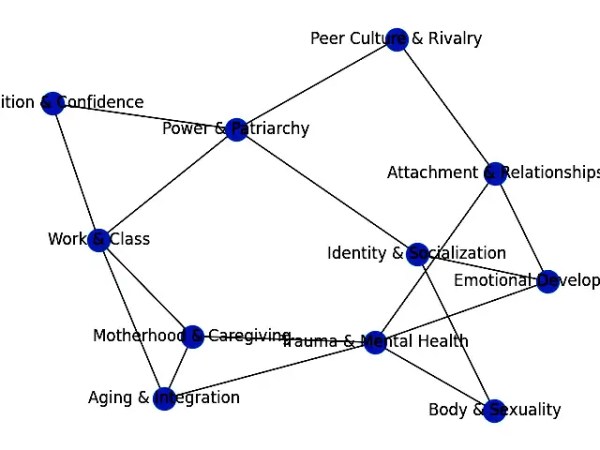
How to Read This Graph
Nodes (Concept Clusters)
Each node represents a major psychological domain:
- Identity & Socialization
- Attachment & Relationships
- Emotional Development
- Body & Sexuality
- Cognition & Confidence
- Peer Culture & Rivalry
- Work & Class
- Power & Patriarchy
- Motherhood & Caregiving
- Trauma & Mental Health
- Aging & Integration
1. Edges (Connections)
Lines show conceptual influence or dependency, for example:
- Identity → Body & Sexuality (early gender coding shapes body perception)
- Attachment → Trauma (early bonds influence later vulnerability)
- Work & Class → Motherhood (economic roles shape caregiving stress)
- Trauma → Aging (unresolved trauma accumulates across lifespan)
2. Layered graph
- Childhood → Young Adult → Adult → Aging flow
3. Thematic subgraphs
- Trauma network
- Workplace network
- Body/Sexuality network