New Labour Codes India 2025: 4 Codes, Minimum Wages & Social Security Benefits
श्रम संहिता
After seven decades of independence, India has finally undertaken the most comprehensive overhaul of its labour laws. In 2020, Parliament consolidated 29 archaic and overlapping central labour laws into four modern, forward-looking Labour Codes:
- The Code on Wages, 2019
- The Industrial Relations Code, 2020
- The Occupational Safety, Health and Working Conditions Code, 2020
- The Code on Social Security, 2020
For the first time, the benefits of labour laws extend universally to all workers — whether in the organised or the unorganised sector, whether permanent or on fixed-term contracts, whether employed in factories or working as gig and platform workers.
Key Highlights of the Reforms
Universal Minimum Wages and Timely Payment
- Every worker in India, including the nearly 40 crore in the unorganised sector, is now legally guaranteed minimum wages.
- Floor wage introduced to reduce regional disparities.
- Minimum wages to be revised at least every five years.
- Timely payment of wages made mandatory; wages must be credited by the 7th of every month.
- Equal remuneration for men and women for same or similar work.
Social Security for All
- Nine old laws merged into one Social Security Code.
- Provident Fund, pension (EPS), gratuity, and ESI medical benefits extended to all categories of workers.
- Gig, platform, and unorganised workers can now voluntarily join ESIC and EPFO schemes.
- Aadhaar-based Universal Account Number ensures seamless portability across jobs and states.
- National database of unorganised workers being created through portal registration.
- Social Security Fund to be set up specifically for 40 crore unorganised workers.
- Fixed-term employees get the same social security benefits as permanent workers; no minimum service required for gratuity.
Occupational Safety, Health and Dignified Working Conditions
- Thirteen laws consolidated into the OSH Code.
- Employers must provide free annual health check-ups.
- Appointment letters made compulsory for all workers.
- Women permitted to work in all establishments and during night shifts, subject to consent and adequate safety measures.
- Special provisions for inter-state migrant workers: annual travel allowance, portability of benefits under the Building Workers’ Cess, access to public distribution system through One Nation One Ration Card, and a national migrant worker database.
Special Focus on Inter-State Migrant Workers
- Workers can now self-register on the national portal and gain legal identity without depending on contractors.
- Helplines in every state for grievance redressal.
- Entitlement to ration both at the place of work and for family back home.
Industrial Harmony and Faster Justice
- Three laws merged into the Industrial Relations Code.
- Trade unions securing 51% support recognised as sole negotiating union; otherwise a negotiating council is formed.
- Workers facing retrenchment entitled to 15 days’ wages for re-skilling, deposited directly into their account.
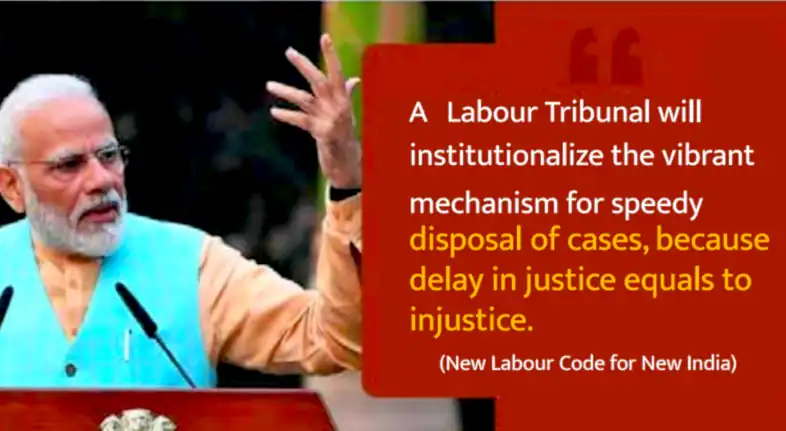
- Disputes to be resolved within one year through two-member tribunals.
- Right to strike remains intact; notice period introduced to encourage dialogue before industrial action.
Ease of Doing Business and End of Inspector Raj
- Single registration, single licence, and single return for all four Codes.
- Web-based random and risk-based inspections; inspectors re-designated as inspector-cum-facilitators.
- Heavy use of technology for transparency and reduction of compliance burden.
These four Labour Codes mark the transition from the old mindset of “Satyamev Jayate” to a new era of “Shramev Jayate” — where the dignity and contribution of every worker is recognised as the foundation of national progress. The reforms protect workers with minimum wages, social security, and safe working conditions while freeing industry from outdated regulations, excessive paperwork, and arbitrary inspections.
The message is clear: when workers prosper, industry grows, and India moves towards a truly Aatmanirbhar Bharat.
November 28, 2025